October 28, 2026. XREAL Aura is officially on sale. Announced on stage at Google’s Android Developer Summit, the first wired glasses built on Android XR opened to general orders today in the United States, Canada and South Korea, with a surprise launch discount that takes the entry model to $1,099, $180 below the price XREAL set three weeks ago. Shipping is expected to begin in mid-November, and in the US the glasses can also be ordered from Best Buy.
XREAL Aura Price: The Launch Discount, Explained
When XREAL first priced Aura on October 7, the list prices were $1,279 and $1,499, and orders were limited to people who had already paid a reservation deposit. Those list prices still stand, but according to the launch release, XREAL is now offering a limited-time price through December 2026:
- 12GB RAM, 256GB storage: $1,279 list, $1,099 launch price (a $180 saving).
- 16GB RAM, 512GB storage: $1,499 list, $1,299 launch price (a $200 saving).
XREAL’s fine print says the offer applies to standalone purchases in all launch markets and does NOT apply to bundles, with local pricing and terms listed on each regional store. The release does not say whether buyers who paid the full price earlier, including holders of the $299 Founder Priority Pass, will receive the difference. Those holders still face an October 31 payment cutoff to keep priority shipping, so anyone in that queue should check XREAL’s terms before paying.
Release Date and Where You Can Buy It
Orders are open now at XREAL.com/aura and, in the US, at BestBuy.com. Google’s launch post, written by XR chief Shahram Izadi, says orders open in Japan on November 2, while XREAL’s release lists Japan among the markets taking orders today; Japanese buyers should check the local store. Buyers must be 18 or older. Android Authority reports that wider retail availability, including select Google Store locations, is planned for 2027. The UK and EU remain outside the first wave, as we reported earlier this month.
XREAL Aura Specs at Launch
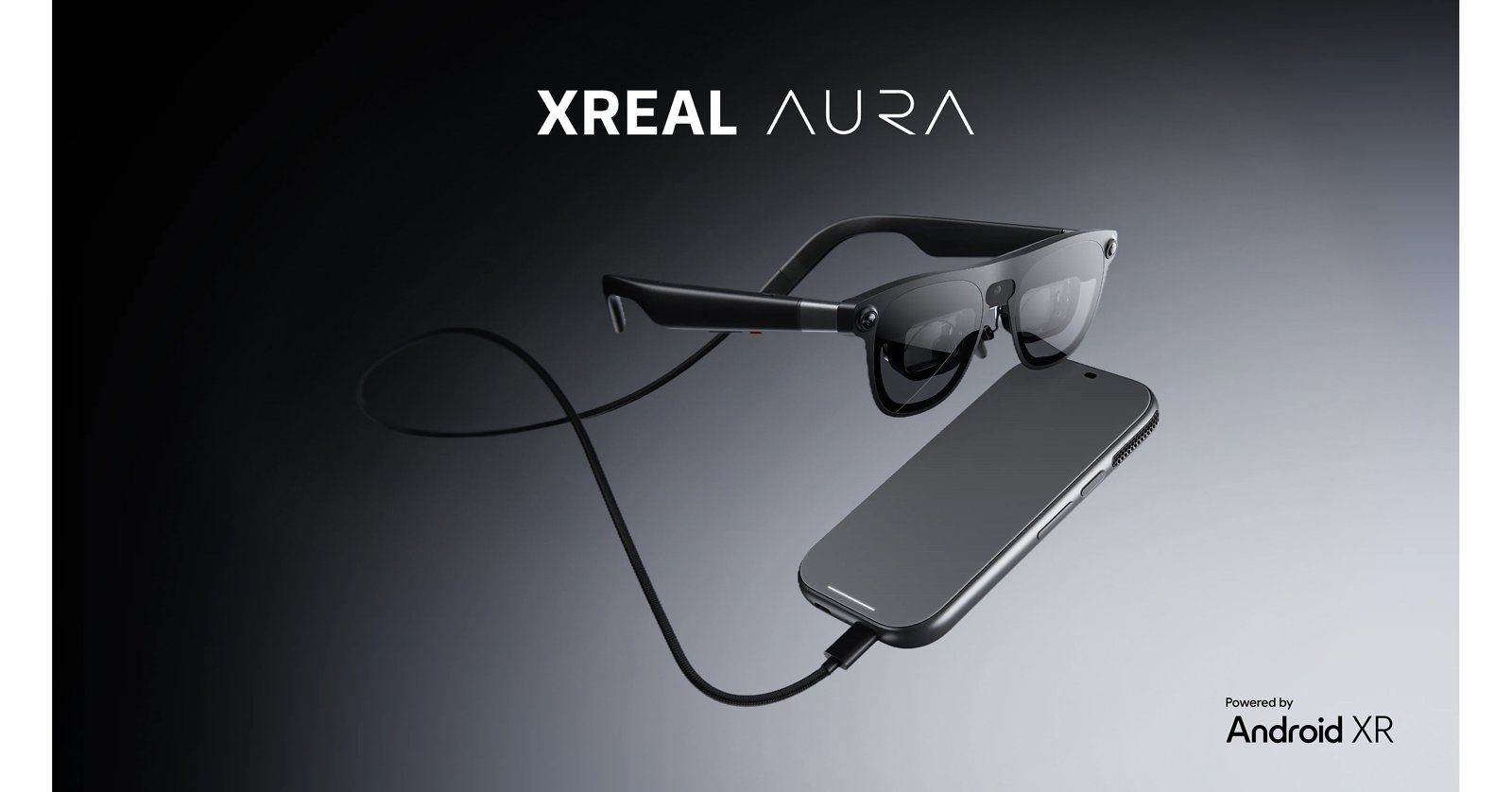
The hardware matches the spec sheet XREAL published on October 15. Aura is a split-compute device: the glasses handle display and sensing, while a cabled puck holds the processor and battery and doubles as a trackpad.
- Display: Sony micro-OLED, 1200p per eye at up to 120Hz, with electrochromic dimming.
- Field of view: 70 degrees, optical see-through (some launch coverage cited a higher figure; XREAL’s own release says 70).
- Weight: under 95 grams for the glasses.
- Chips: Qualcomm Snapdragon Reality Elite in the puck, XREAL X1S in the frame.
- Audio: Sound by Bose.
- Input: hand, voice, keyboard, puck trackpad and game controller.
- Wired Mirroring: plug a laptop or handheld console in over USB-C and it appears as a window beside Android XR apps.
XREAL also says Aura earned five TÜV Rheinland certifications, including a five-star Eye Comfort rating. Accessories announced today include a GameSir-built controller with a dedicated Gemini key and a wireless portable keyboard; the box itself includes a carry case for the glasses, puck and cable. XREAL has still not published a battery-life rating for the puck, and neither the release nor Google’s post fills that gap.
Apps and Gemini on Day One
Because Aura runs Android XR, it opens with access to Google Play apps and games plus what XREAL calls more than 150 made-for-XR experiences. Named titles include the NBA App for Android XR with three-game multiview for League Pass subscribers, Andy Serkis’s Nevatars (free for its first six months), Fallout: Factions, Project Hail Mary: Journey Among the Stars, a NASCAR XR app, San Francisco Ballet’s The Nutcracker filmed in stereoscopic 8K, Doug Liman’s interactive film Asteroid, and ports of Cubism, Chess Club and nDreams’ Oh My Galaxy!. Owlchemy’s Hyper Visor, which we covered last week, is part of the same launch push.
Gemini is built in and, per Google, can help with what is on screen and in the wearer’s surroundings. For a primer on how the platform works across headsets and glasses, see our guide What Is Android XR?
How Aura Compares With Meta VR Glasses
The launch discount changes the price comparison that framed Aura’s October announcement. At list price, Aura’s base model was $20 under Meta VR Glasses, which Meta has set at $1,299 for Spring 2027. At $1,099 through December, Aura is $200 cheaper and ships several months earlier. The two devices take different approaches: Aura is optical see-through, so the real world is seen directly through the lenses, while Meta’s device uses passthrough cameras. TechCrunch also notes that Aura’s glasses are heavier than Meta’s Ray-Ban Display (69 grams) and require carrying the puck.
What It Means
Aura is the first Android XR device in glasses form that anyone can order, which makes it the real test of Google’s partner strategy outside Samsung’s Galaxy XR headset. The discount suggests XREAL wants volume before the holidays and before Meta’s glasses arrive. The open questions are the ones only reviews can settle: puck battery life, how well 70 degrees of see-through display holds up in bright rooms, and how many of the 150-plus XR titles hold attention beyond launch week. Buyers comparing it with display glasses at a fraction of the price should start with our guide to the best smart glasses of 2026.
Sources: XREAL via PR Newswire, Google, TechCrunch, Android Authority, XREAL on X.