
UN Secretary-General António Guterres has asked governments to treat NEURAL DATA as “highly sensitive personal data” and to BAN the coercive use of neurotechnology in police work, courts and prisons. The ask sits in a report to the General Assembly, Human rights in the administration of justice (A/81/351), dated August 27 and FIRST reported by The New York Times on October 8. It is about JUSTICE systems, not headsets. But the data rules it proposes REACH the CONSUMER wearables market, and that market now includes the input devices XR companies are building around.
The recommendations are NOT binding and carry NO timetable. They still MATTER, because this is the FIRST UN report in this series devoted ENTIRELY to neurotechnology. The 2024 edition gave it ONE short section, according to a detailed October 11 breakdown by Inside BCI.
What the report actually asks for
Guterres makes TEN recommendations to member states. The CORE ones, as summarized by Inside BCI:
- Prohibit compulsory or coercive neurotechnology in justice settings, including brain-based DECEPTION detection, predictive tools, “thought-decoding” applications, neuromodulation and arbitrary cognitive surveillance.
- Require consent that is free, prior, informed, explicit and REVOCABLE, with an INDEPENDENT lawyer and a route to redress. The report says such consent should face the HIGHEST evidentiary standard, because justice settings are coercive by nature.
- Validate evidence independently for safety, reliability and reproducibility before any court ADMITS it.
- Classify neural data as highly sensitive personal data, with clear LIMITS on collection, sale, retention, reuse and sharing.
- Press companies to run human rights DUE DILIGENCE under the UN Guiding Principles, including plain-language disclosures and safety by design.
The report is also CAREFUL about capability. Inside BCI notes it says neurotechnology CANNOT yet read minds, though it can reportedly INFER emotions and internal reactions from neural signals. NO brain-based lie detection method has gained GENERAL acceptance in court. In India, police have used an EEG test called BEOS since the 2000s; the country’s Supreme Court ruled in 2010 that FORCED testing breaches the protection against self-incrimination.
Why a justice report lands on the wearables industry
The SHARPEST line for device makers concerns CONSUMER products. Wearable EEG devices sold for wellness, gaming and productivity face LITTLE or no regulation outside medicine, and the report warns that the data they collect could be ACCESSED by state authorities or introduced as EVIDENCE without regard to its sensitivity. It cites an April 2024 Neurorights Foundation review of 30 consumer neurotech companies: 29 appeared to have access to users’ neural data with NO meaningful limits, 17 said they could share data to comply with legal requests, and NONE said it would resist requests from law enforcement.
XR is moving TOWARD this territory. Meta’s Neural Band reads electrical signals at the wrist (EMG) to CONTROL its display glasses, and headsets already track EYES, FACES and hands. The UN report does NOT name XR companies, and it does not say whether wrist EMG counts as neural data. That question is UNSETTLED. It is worth noting, HOWEVER, that California’s 2024 law, SB 1223, defines neural data as information generated by measuring activity of a consumer’s central OR PERIPHERAL nervous system, while excluding data inferred from nonneural information. Where a muscle-signal band falls under that wording is EXACTLY the kind of definitional fight the NEXT round of privacy rules will have to resolve.
The U.S. patchwork, in one table
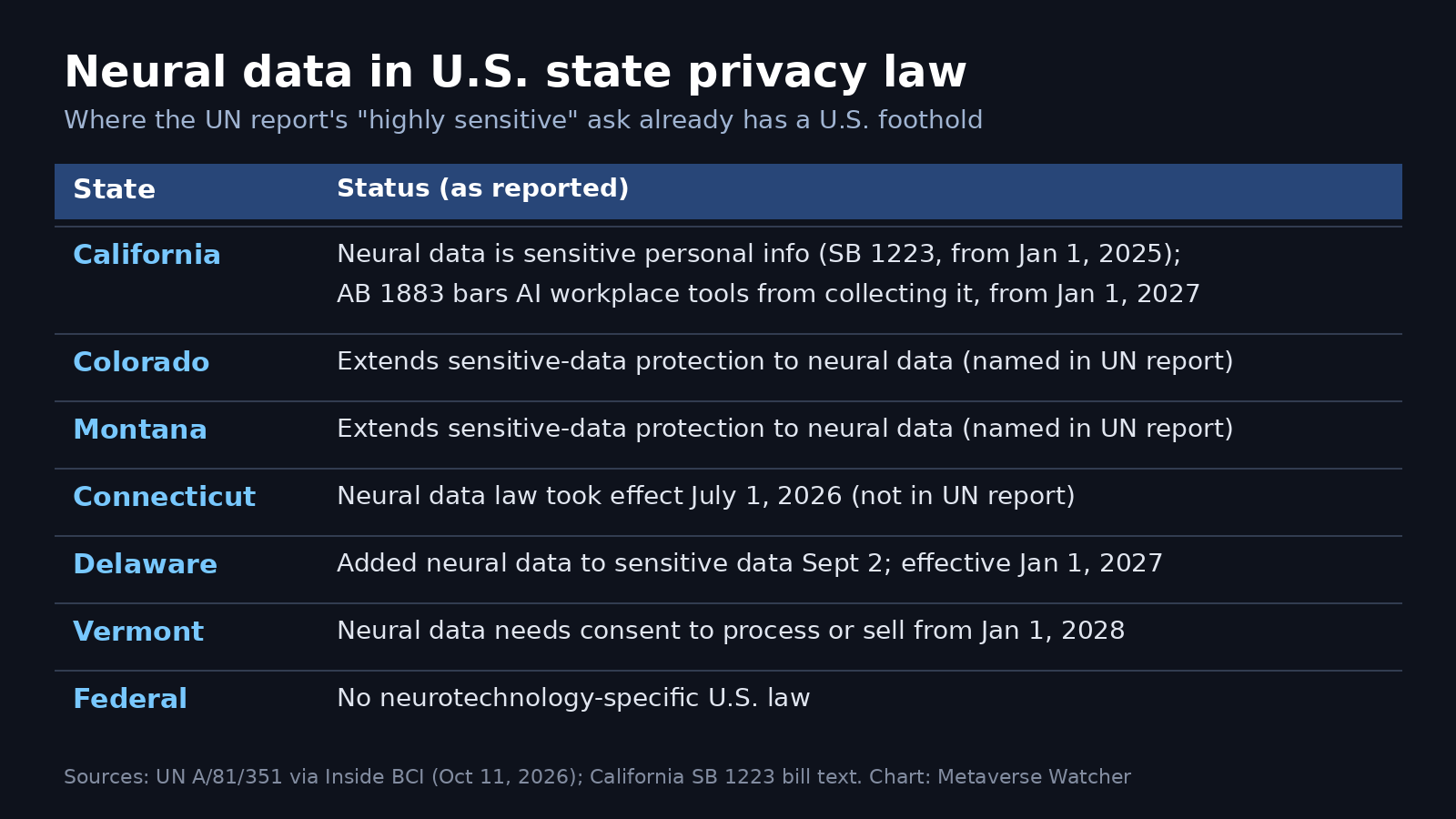
The United States has NO federal neurotechnology law. The report names California, Colorado and Montana as states that extend sensitive-data protection to neural data. Inside BCI adds what the report MISSED: Connecticut’s law took effect July 1; Vermont will require consent to process or sell neural data from January 1, 2028; and Delaware added neural data to its sensitive category on September 2, effective January 1, 2027. In California, the governor VETOED AB 1542 on September 27, which would have BANNED the sale of sensitive personal information, then SIGNED AB 1883, which from January 1, 2027 bars employers from using AI workplace tools to collect workers’ neural data.
Abroad, Chile amended its constitution in 2021 to PROTECT brain activity, and its Supreme Court applied that protection in 2023 in a case against headset maker Emotiv. In the EU, the AI Act can classify AI-driven emotion recognition and neurotech as HIGH-RISK, with police polygraph-type obligations applying from December 2, 2027.
What to watch
THREE tracks follow. The General Assembly returns to the topic in its current session, and its next resolution will show whether the coercion ban and neural data language survive. The Human Rights Council’s Advisory Committee is DRAFTING guidelines for early 2027. And the UN Office on Drugs and Crime and Interpol are working on law enforcement uses. For XR platforms, the PRACTICAL test is SIMPLER: will companies that COLLECT nerve, eye or face signals publish how they answer LAW ENFORCEMENT requests for that data? Today, MOST do not say.
Sources: Inside BCI, October 11, 2026; The New York Times via Headlines Briefing, October 8, 2026; California SB 1223 bill text; ExplorXR XR Daily, October 13, 2026. Featured photo: António Guterres, March 23, 2023, by Christophe Licoppe, European Commission, via Wikimedia Commons, CC BY 4.0.
