MIT engineers have built a SOFT silicone sheet that RECONSTRUCTS its own 3D shape as it bends and twists, and they are pitching it as the basis for a WEARABLE motion-capture “skin” for VR, gaming and PHYSICAL THERAPY. The work, described by MIT News on October 8, is a LAB PROTOTYPE. There is NO product, partner or ship date, and the fibers inside are still about 1 mm THICK.
Soft Fibers Instead of Rigid Pucks
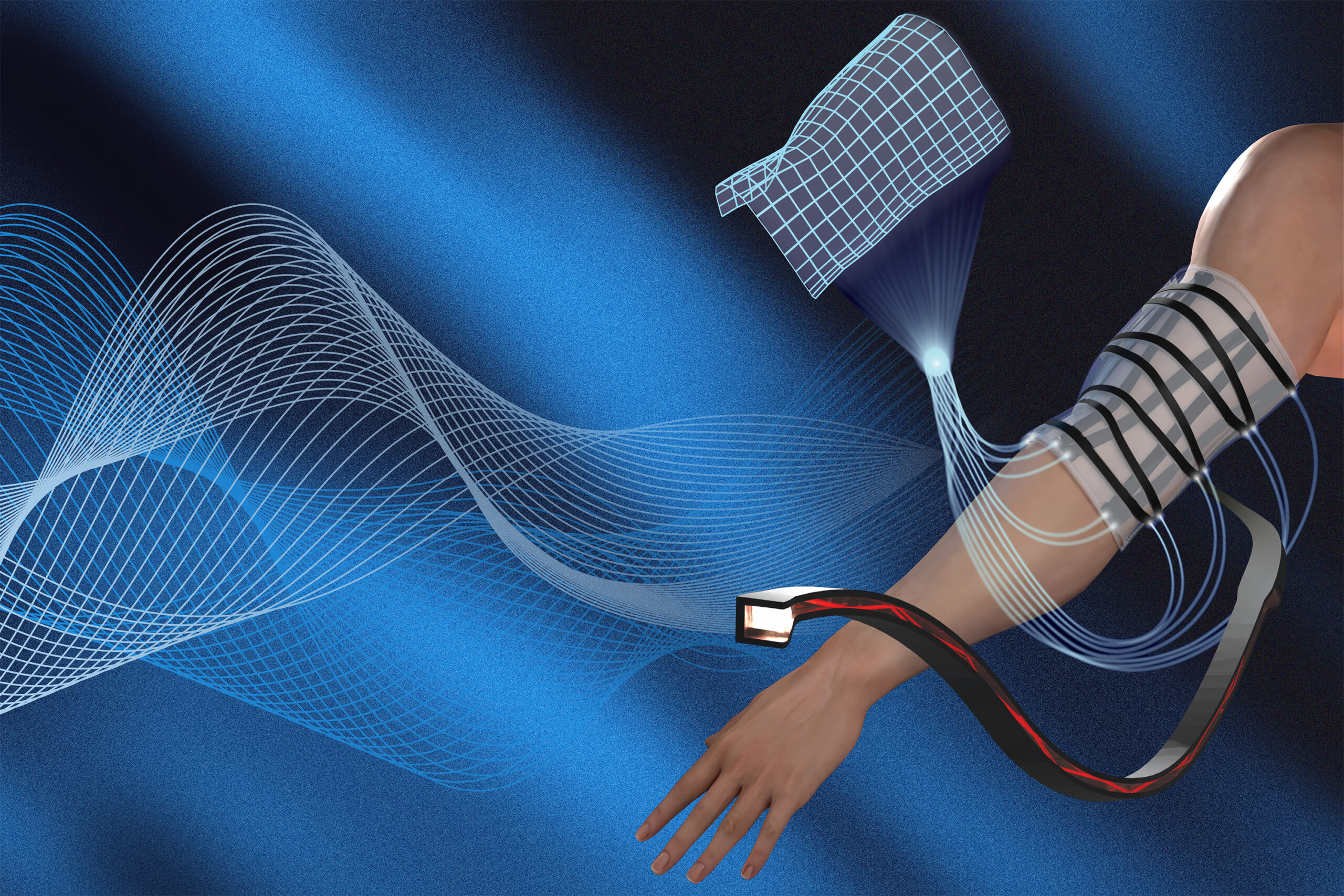
Today’s motion-capture garments usually stitch RIGID sensors into a suit at chosen points. The MIT design does something different. Several SOFT optical fibers, or waveguides, run in a ZIG-ZAG pattern through a stretchable sheet. When the sheet bends, the fibers BEND with it, and the amount of light reaching the far end CHANGES. An algorithm turns those readings into a moving DIGITAL TWIN of the sheet, almost in REAL TIME.
The team made its OWN fibers: a clear, flexible rubber core with cladding of the same rubber dyed black. The key change is that one side of the core is deliberately ROUGHENED. Bending toward the rough side scatters light differently than bending toward the smooth side, so each fiber can tell WHICH WAY it is bending, not just HOW FAR. Simulations of several layouts, from a checkerboard to criss-cross patterns, showed that one SPECIFIC zig-zag spacing came CLOSEST to recreating the true shape.
“Our setup is targeting fully soft and stretchable sensing surfaces so it’s potentially SAFER for interacting with a human or a soft environment,” mechanical engineering graduate student Qifan Yu said in the MIT release.
The Accuracy Claim
The researchers laid the sheet over 3D-printed molds and measured the GAP between the physical surface and the digital reconstruction. Yu puts the error at LESS THAN 0.4 cm, against roughly 1 to 2 cm for existing RIGID-sensor designs, which he calls “at least ON PAR with existing technologies.” The sheet is also DAMAGE-TOLERANT: with a few fibers cut or disconnected, the rest STILL reconstructed the overall shape.
That benchmark is for a SHEET on a mold, not a full suit on a moving body. The team has NOT published whole-body tracking results, LATENCY figures or any comparison against camera-based or inside-out VR tracking.
Why VR Is Paying Attention
The team describes a soft garment that could let a wearer control a video game AVATAR or a tele-operated ROBOT, and a wrap that tracks a patient’s RANGE OF MOTION in rehab. PC Gamer framed it as a “second skin” that could one day track WHOLE BODIES in VR, and Interesting Engineering focused on the 3D shape reconstruction. MIT’s own framing leans HARDEST on THERAPY. “We hope to build tools that augment what a physical therapist can do,” said assistant professor Kaitlyn Becker.
What Still Has to Happen
- THINNER fibers: the current 1 mm fibers would need to SHRINK to TENS of micrometers, thinner than a hair, through other fabrication processes.
- DENSER layouts: the team wants MANY more fibers in a garment to capture FINE shape changes.
- Less BULK: each fiber has an LED at one end and a light sensor at the other, wired to an EXTERNAL circuit board.
The study, by Yu, graduate student Nina Cao and Becker, appears in Advanced Intelligent Systems, and the work was supported in part by MathWorks. For now it is a PROMISING RESEARCH result. It is not a mo-cap suit you can BUY, and NOBODY has said WHEN, or WHETHER, it becomes one.