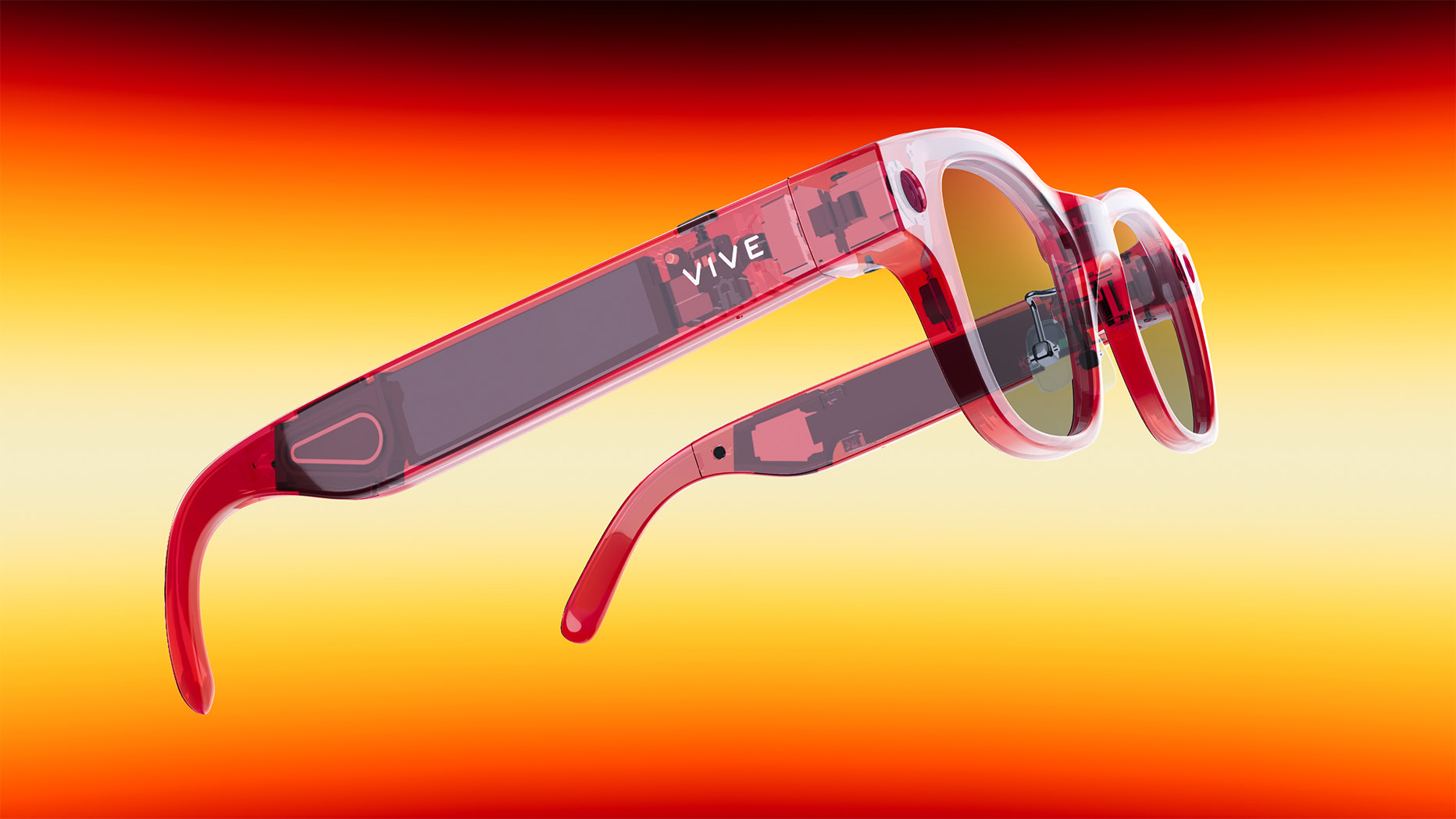
HTC wants the VIVE Eagle to be the smart glasses you can wear WITHOUT apologizing. In a feature published today by WIRED, Dan McDowell, HTC VIVE’s head of ENTERPRISE sales, FRAMES the $499 glasses as the ANTI-META option: “We’re not a social media company,” he says. “There’s no benefit to me to have any of your info.” The pitch is STRONG on paper. It also comes with a QUIETER detail the story mentions ONLY in PASSING: the AI that makes the glasses USEFUL is FREE for two years, and then it is a SUBSCRIPTION.
What HTC is promising
The privacy case HTC put to WIRED rests on FOUR CONCRETE behaviors, all of which the writer describes after a couple of WEEKS of DAILY wear:
- A light that gates the camera. A BRIGHT indicator sits BESIDE the lenses, and if you COVER it, the glasses will not record.
- A bystander veto. If someone NEARBY says “stop recording,” recording STOPS.
- Footage that stays put. Video is ENCRYPTED and STORED on the glasses. Nothing goes to the PHONE or the CLOUD AUTOMATICALLY; imports are MANUAL, through the app.
- An assistant with no login. VIVE AI can run on OpenAI’s ChatGPT or Google’s Gemini, but without an ACCOUNT, so users are “de-identified.” The TRADE-OFF, WIRED notes, is that you LOSE the PERSONALIZATION those chatbots build from your email and messages.
McDowell adds a TRAINING PLEDGE on top: “We don’t train our AI model or any third-party AI models with any of the information that is used on the glasses.” His broader framing is about the people who NEVER bought the glasses at all. “It’s not just about protecting the consumer, but it’s also about protecting people around the consumer,” he says.
The HARDWARE details in the piece match what we REPORTED at the U.S. launch in September: 4.5 HOURS of CONTINUOUS music playback, 36 HOURS on STANDBY, two frame styles, and a $49 Power Boost battery that CLIPS onto the frame.
Got questions about VIVE Eagle?
— HTC VIVE (@htcvive) October 13, 2026
Drop them below 👇
#VIVEEagle #smartglasses
The two-year clock
WIRED gives the subscription ONE sentence: the glasses ship with VIVE AI Plus free for the first two years, and after that OWNERS pay $2.50 a month. HTC’s own VIVE AI PRICE page fills in the REST. That $2.50 is the ANNUAL-billing RATE; billed MONTHLY, AI Plus is $2.99. The tier includes 100 credits a month for AI translation and summaries, translation across 12 languages, and up to five preset actions on the AI button. EXTRA credits are sold in packs of 1,200 for $29 and 3,000 for $59.
Above it sits VIVE AI Pro: $5.80 a month on a first-time annual deal, struck through from $8.33, or $6.99 billed monthly. Pro RAISES the allowance to 400 credits, EXTENDS translation to 90+ languages, adds AUTOMATIC language detection during live translation, and allows up to 20 button presets.
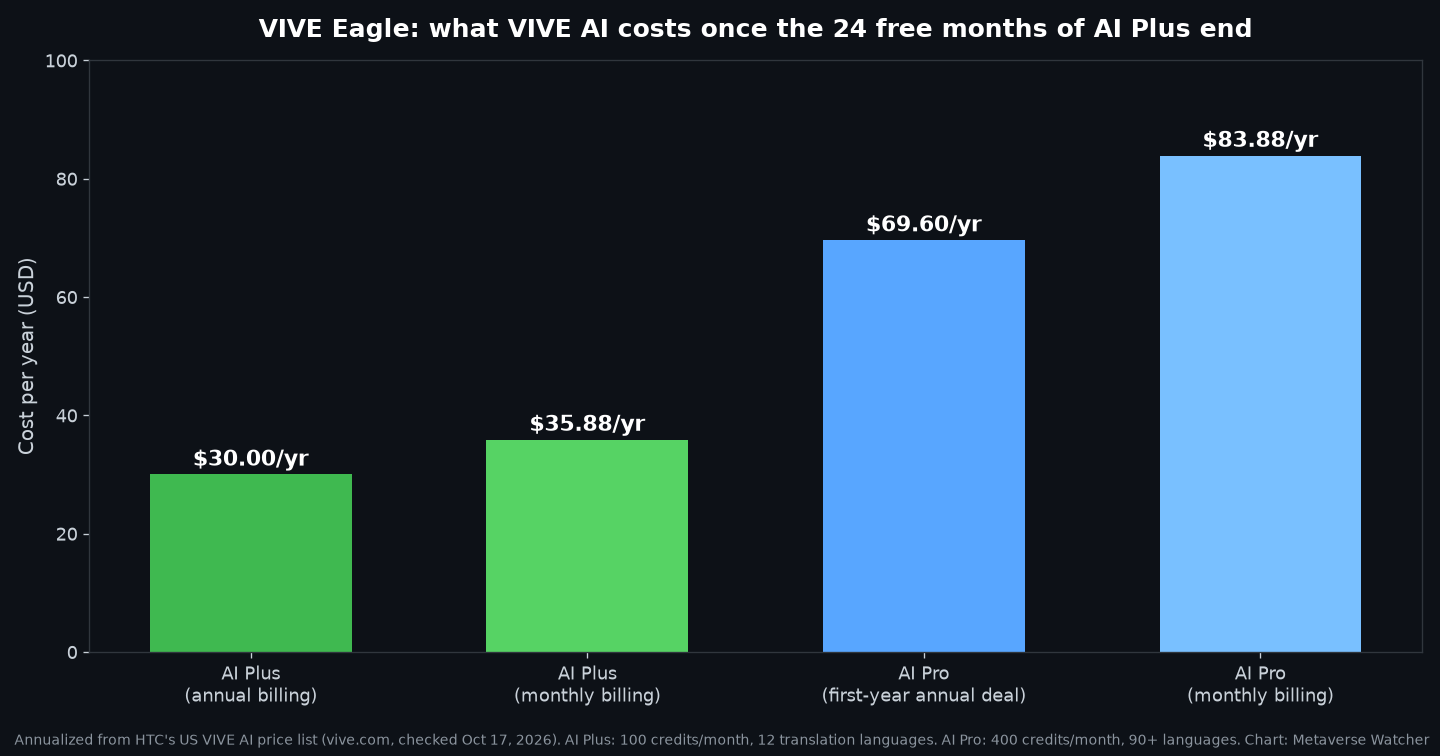
Annualized, that is $30.00 a year for AI Plus on annual billing, $35.88 on monthly billing, $69.60 for Pro on the INTRODUCTORY annual deal, and $83.88 for Pro billed monthly. None of these is a LARGE number next to a $499 frame. The POINT is STRUCTURAL: the feature set HTC is selling as PRIVACY-FIRST is also a RECURRING revenue line, and the free window, not the hardware, DECIDES when owners first see that BILL.
Where the pitch runs into limits
WIRED’s writer flags the OBVIOUS PROBLEM: camera glasses look ALIKE. Friends who spotted the Eagles asked whether they were smart glasses, and being told they were not Meta’s “didn’t seem to dispel any of their suspicions.” A privacy architecture only changes how BYSTANDERS feel if bystanders can TELL which glasses they are looking at.
The LED gate is also only as strong as its TAMPER resistance. WIRED notes that Meta has faced the SAME scrutiny, with owners covering or physically disabling its indicator, and that Meta ANSWERED with software that DISABLES the camera when the light is tampered with. When Engadget reviewed the Eagle in September, its reviewer reported getting around the LED check with a CRUDE workaround, as we covered in our summary of that 7.4/10 review. HTC’s claims about not training models on glasses data are, for now, COMPANY STATEMENTS; the WIRED piece does not describe any outside AUDIT of them.
HTC also is not the only company trying to DEFUSE the camera problem. WIRED points to Even Realities, VITURE and Halliday going CAMERA-FREE, and Meta itself began selling the camera-free Ray-Ban Meta Audio at $349 on October 13. “No one has captured the market quite like Meta,” the story concludes.
Metaverse Watcher’s read
HTC has built the most SPECIFIC privacy story in camera glasses: ON-DEVICE encryption, manual export, a bystander voice command and a login-free assistant are VERIFIABLE behaviors, not SLOGANS. What it has not yet SHOWN is that buyers will PAY for that difference, first at $499 against CHEAPER Meta frames, and then AGAIN in roughly two years, when VIVE AI Plus moves from BUNDLED to BILLED. For enterprise buyers, the audience McDowell ACTUALLY leads, the $30-a-year line is a ROUNDING error. For CONSUMERS, it is the MOMENT the anti-Meta pitch becomes a RENEWAL decision.
Sources: WIRED (October 17, 2026); HTC VIVE AI pricing; VIVE Eagle product page; HTC VIVE on X.