Vienna-based Viewpointsystem said on WEDNESDAY that its Digital Iris eye-tracking module now runs the ENTIRE image-based tracking pipeline on an ultra-low-power MICROCONTROLLER inside the glasses FRAME, rather than shipping eye-camera images to a PHONE or a high-end application processor. The company calls itself the FIRST to bring that architecture to market. The microcontroller is an ENSEMBLE MCU from ALIF Semiconductor, and the headline numbers are 140 Hz TRACKING and up to 15 TIMES longer BATTERY runtime (PR Newswire, Oct. 14).
The PITCH is aimed at smart-glasses MAKERS, not CONSUMERS. What the release does NOT include is a named glasses CUSTOMER, a PRICE, or a SHIPPING date for any product that uses the new configuration.
What Moved Onto the Chip
In a CONVENTIONAL setup, eye-facing cameras stream images to a main processor in the glasses or a connected device, and that processor does the GAZE math. Viewpointsystem says that approach costs POWER, generates HEAT and adds system COMPLEXITY, which is why eye tracking has mostly stayed out of LIGHTWEIGHT eyewear.
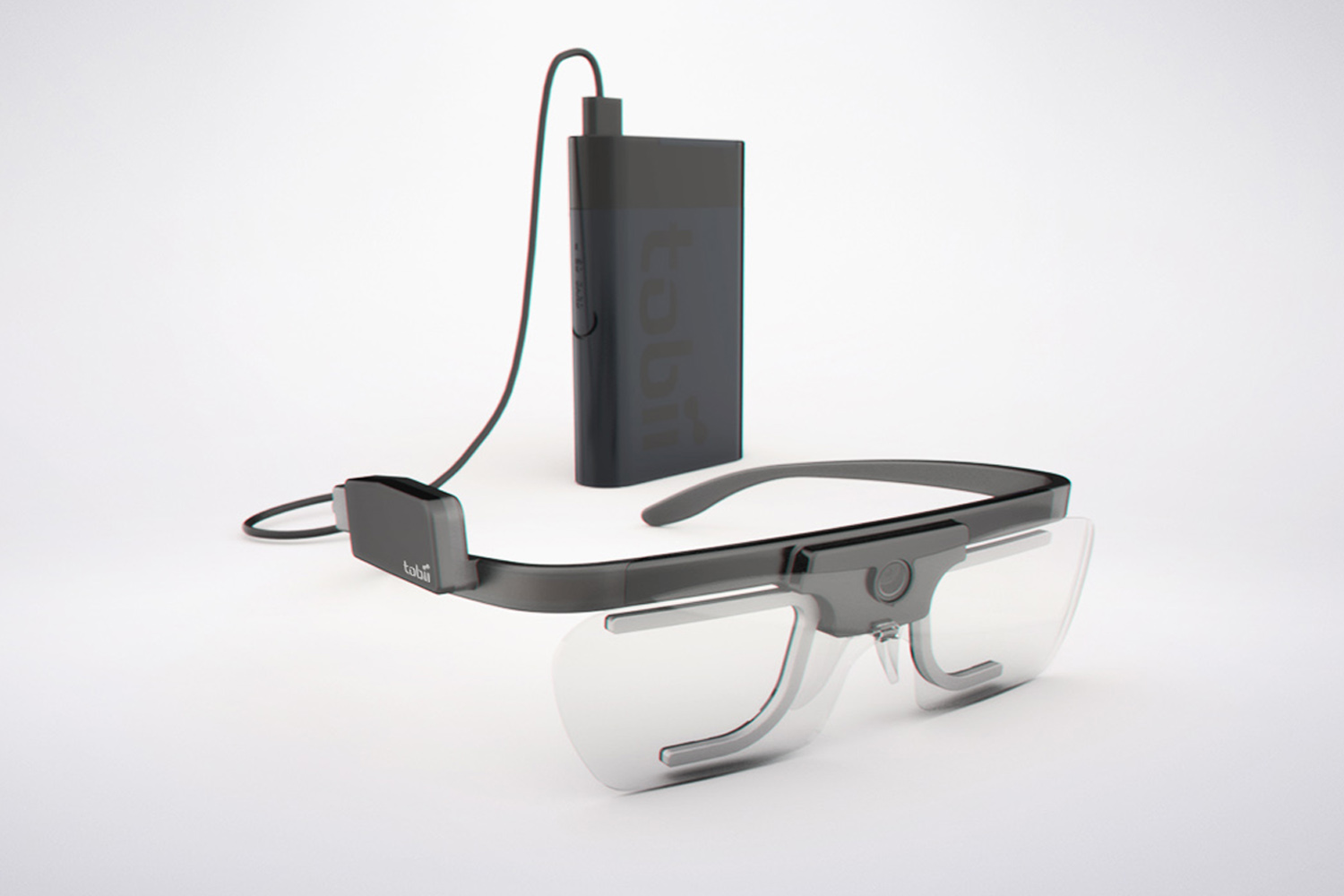
The Digital Iris Module pairs TWO eye-facing cameras with the MCU in a unit designed to sit in the BRIDGE of the frame. According to the release, the MCU handles image preprocessing, NPU-accelerated gaze calculation and REAL-TIME detection of BLINKS, FIXATIONS and SACCADES. It outputs ready-to-use GAZE DATA instead of VIDEO. It also fuses readings from an ambient light sensor, a magnetometer and an accelerometer, so the main processor can drop into LOW-POWER states or take on other work.
Viewpointsystem says the module remains COMPATIBLE with existing application processors, and that the programmable MCU, which has an integrated NEURAL processing unit, can run ADDITIONAL AI functions. The release does not say WHICH Ensemble part is used. Alif sells the Ensemble line as a family of EDGE-AI microcontrollers with Arm Ethos NPUs (Alif Semiconductor).
“Eye tracking belongs in smart glasses, and it has to fit into the thinnest, lightest designs.”
Nils Berger, CEO and founder, Viewpointsystem
The 15x Claim Needs Context
The battery figure is the number OEMs will NOTICE FIRST, and it carries a specific comparison. Viewpointsystem says “performance measurements indicate” up to 15 times longer battery runtime compared with conventional eye-tracking processing on a CONNECTED DEVICE. The release does not publish the TEST setup, the BATTERY size, the BASELINE device, or whether the figure covers the module ALONE or the WHOLE pair of glasses. Treat 15x as a VENDOR-measured ceiling until an OEM SHIPS hardware that can be INDEPENDENTLY tested.
The company’s own product page gives a WIDER range: power consumption runs “from tens of milliwatts to about 150 mW, depending on configuration and hardware” (Viewpointsystem). That SPREAD matters for frames that already budget every MILLIWATT for cameras, speakers and radios.
The Spec Sheet Changed Since February
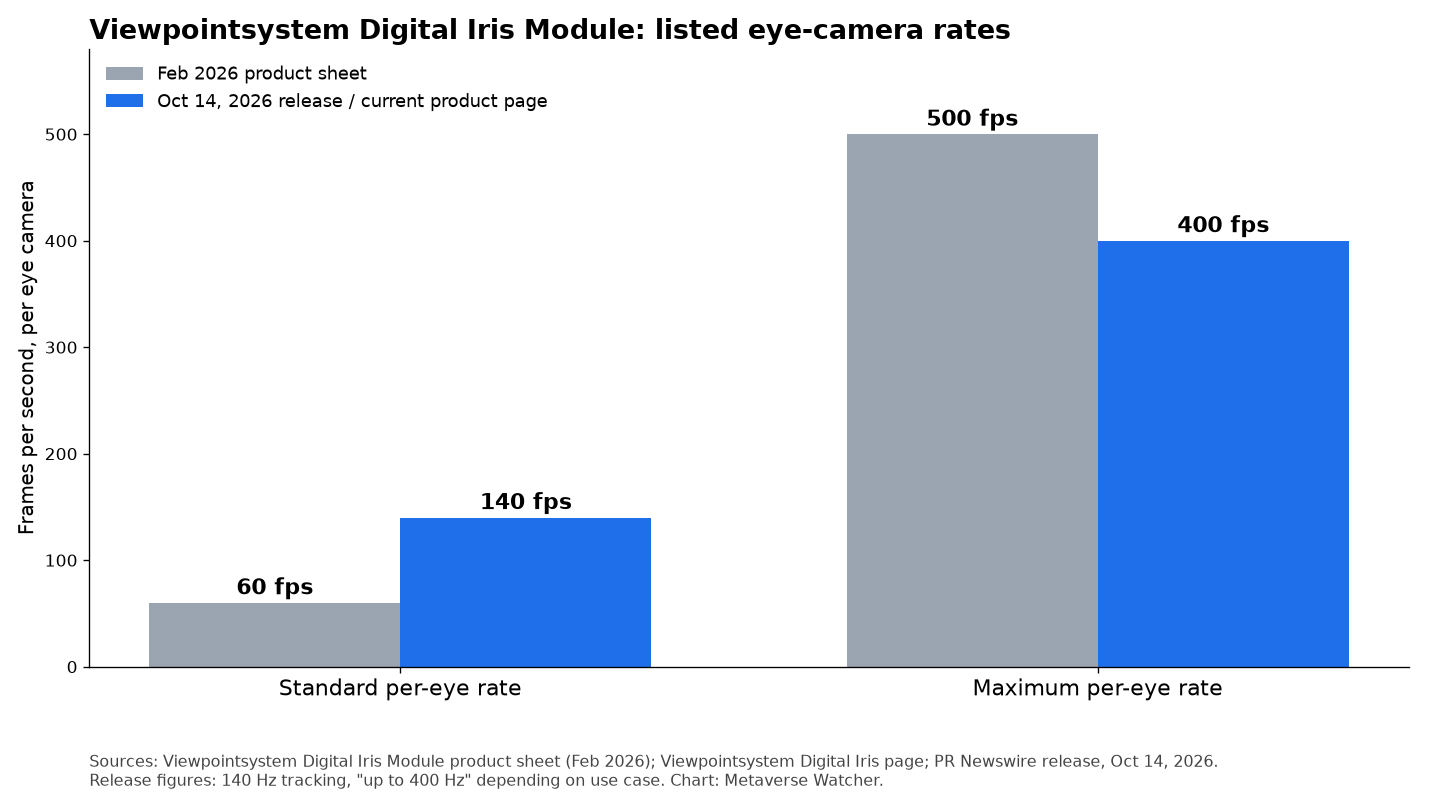
Viewpointsystem’s February 2026 Digital Iris Module sheet listed a camera sampling rate “flexible up to 2 x 500 fps, with 2 x 60 fps as the standard setting” (product sheet, PDF). The current product page NOW reads “flexible up to 2 x 400 fps, with 2 x 140 fps as the standard setting,” MATCHING Wednesday’s release, which says 140 Hz with potential to reach up to 400 Hz depending on customer requirements.
So the DEFAULT rate more than DOUBLED, while the listed CEILING fell by 100 fps. Viewpointsystem has NOT explained the change. The MCU implementation is the OBVIOUS candidate, but that is our INFERENCE, not a company statement.
Other listed specs are UNCHANGED between the two documents: 37.6 mm by 46.0 mm by 0.6 mm, 0.4 grams, a 95-degree diagonal tracking field of view, binocular dark-pupil tracking using neural networks, 1.8-degree uncalibrated accuracy, 1.3 degrees after one-point calibration, 0.16-degree precision, and a typical integration time of about TWO WEEKS.
Privacy and Health Data
Viewpointsystem also frames the design as a PRIVACY feature: only gaze data leaves the MCU, and eye-camera images stay ON-CHIP. That is a MEANINGFUL design choice, because eye images can carry BIOMETRIC detail. But gaze data is NOT NEUTRAL either. The release itself lists uses in attention and focus tracking and in “applications assessing BRAIN HEALTH, cognitive changes and neurological function,” and the product page lists PUPILLOMETRY and raw eye videos among the outputs the software can provide. Whether a given pair of glasses exposes those streams will be an OEM DECISION.
Why It Matters
Eye tracking is STANDARD on PREMIUM headsets but still RARE in everyday glasses, where WEIGHT and BATTERY limits decide what ships. A module that moves the work off the main processor could make GAZE INPUT, attention-aware AI and display power savings viable in DISPLAY-LESS and lightweight AI frames, the segment where most of the market’s VOLUME now sits.
Viewpointsystem builds its OWN VPS Next eye-tracking glasses for manufacturing, transportation, research and DEFENSE, and says it is a member of the Qualcomm Partner Network and the AR Alliance. Alif’s Mark Rootz said the implementation shows its Ensemble MCU can handle “demanding real-time vision processing” within smart-glasses power and space constraints.
What to WATCH: a NAMED OEM design WIN, INDEPENDENT power measurements on shipping hardware, and whether the 400 Hz option HOLDS UP on the MCU. Until then, this is a CREDIBLE COMPONENT announcement with VENDOR-ONLY numbers.
Sources: Viewpointsystem via PR Newswire (Oct. 14, 2026); Viewpointsystem Digital Iris page; Digital Iris Module product sheet (Feb. 2026); Alif Semiconductor Ensemble.