Manitoba has extended its school cellphone ban to cover smart glasses, smartwatches and other wearable devices, moving the issue from a single school division to the entire province. Education Minister Tracy Schmidt told school leaders in a November 17 letter to treat the devices the same way as phones, CBC News reported on Tuesday.
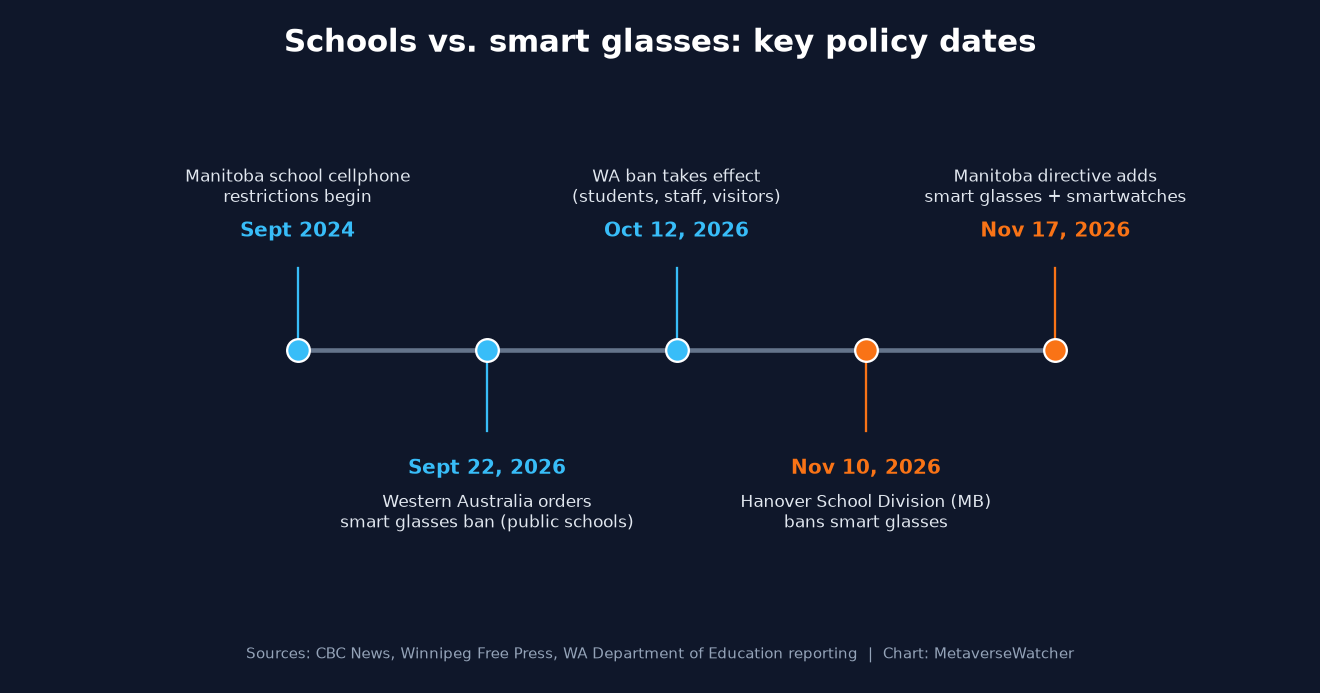
The directive went to every school division superintendent and to principals of independent schools that receive public funding. It arrived one week after the Hanover School Division in southeast Manitoba became the first in the province to ban smart glasses on its own.
What the Manitoba directive covers
Schmidt’s letter does not name brands. It defines the target by function: personal devices that give students “access to messaging, social media, internet browsing, photography, audio or video recording, artificial intelligence tools, or other cellphone-like functions.” That wording captures camera glasses such as Ray-Ban Meta and Oakley Meta, display glasses, and cellular or phone-paired smartwatches.
“As technology evolves, so must our guidelines to ensure students are learning in healthy, safe environments that support their education and well-being,” Schmidt said in a statement to CBC. The letter repeats the original goal of the phone rules: “to reduce distractions in classrooms and minimize the harmful impacts associated with social media and online platforms.”
The underlying cellphone policy has been in place since September 2024. According to the Winnipeg Free Press, phones have been banned in elementary buildings since the start of the 2024–25 school year, while students in Grades 9 to 12 must keep devices out of sight during instruction unless a teacher approves educational use. Wearables now fall under the same framework.
Hanover moved first, after incidents in several schools
Hanover, based in Steinbach, runs 20 schools with roughly 9,000 students from nursery to Grade 12. Superintendent Joe Thiessen’s November 10 memo followed “situations involving smart glasses at several schools,” the division told the Free Press. Its rule applies in classrooms, hallways, washrooms, change rooms and meetings, and it covers staff as well as students. Prescription smart glasses receive no exemption.
The division framed the move as a privacy measure rather than a distraction rule. Its letter to parents said smart glasses carry “added privacy implications” compared with phones because “they can record audio and video without others readily knowing.” Assistant superintendent Marlin Adrian told CBC the goal is “maintaining safe spaces in our buildings where students can go to school and feel that they don’t need to be on edge about being recorded.”
NEW: A Manitoba school division has issued an outright ban on smart glasses in response to multiple instances of students showing up to class in wearable technology that can make discreet recordings #mbed #wfp
— Maggie Macintosh (@macintoshmaggie) November 16, 2026
How Manitoba compares with other school bans
Manitoba joins a short but growing list of education systems that have acted on camera glasses this year. The scope differs in each case:
| Jurisdiction | Effective | Devices covered | Who it applies to |
|---|---|---|---|
| Manitoba (province) | Directive dated Nov 17, 2026 | Smart glasses, smartwatches, other cellphone-like wearables | Public schools and funded independent schools, under the existing phone policy |
| Hanover School Division (MB) | Nov 10, 2026 | Smart glasses, including prescription models | Students and staff, all school spaces and activities |
| Western Australia | Oct 12, 2026 | Smart glasses (wearing, using, storing, charging) | Students, staff, parents, visitors and contractors at public schools |
Western Australia remains the broadest rule on record. As we reported in September, its order covers parents and contractors on school sites, not only pupils. In Europe, Oslo schools banned camera glasses earlier this school year, and Norway is weighing wider restrictions. Manitoba’s approach is narrower in one respect, since it slots wearables into an existing phone policy instead of creating a stand-alone rule, and wider in another, because it sweeps in smartwatches.
Pushback on smartwatches and enforcement
The smartwatch component drew the most skepticism from students and parents interviewed by CBC. One parent said a ban “goes too far” and that families should teach children when to use the devices. Tracy Cosser of the Manitoba Child Care Association called the change “a really good idea,” citing privacy risks from devices that capture images and video.
Kara Brisson-Boivin, director of research at MediaSmarts, backed the direction but raised two concerns. She warned against “a sort of patchwork of 13 different provinces and territories” regulating the same technology differently, and she said enforcement should not fall mainly on teachers who are “already so overwrought.” She also noted that students with visual or hearing impairments may benefit from smart glasses, and that the evidence on those benefits is still thin. The directive, as reported, does not spell out an accessibility exemption.
Why it matters for Meta and the smart glasses market
Meta points to the capture LED on its glasses, which blinks during photos and video, and says the camera disables itself if the light is covered. Critics quoted by CBC argue the LED is easy to miss in sunlight, bright rooms or from the side. That debate is now shaping policy: school systems are treating the category as a recording device first and a pair of glasses second.
The timing is notable. Smart glasses are a headline item in this week’s Black Friday sales, and Google’s first Android XR Intelligent Eyewear glasses are due to ship on December 10. A provincial school rule will not dent adult sales, but it adds to a regulatory record that already includes the Dutch privacy watchdog’s warning against buying AI camera glasses and a patchwork of recording laws, summarized in our guide to smart glasses recording laws in 2026.
For families in Manitoba, the practical takeaway is simple: smart glasses and smartwatches should now be handled like phones at school. Students who wear prescription smart glasses should keep a standard pair available, and parents should check their own division’s policy for exemptions and enforcement details.