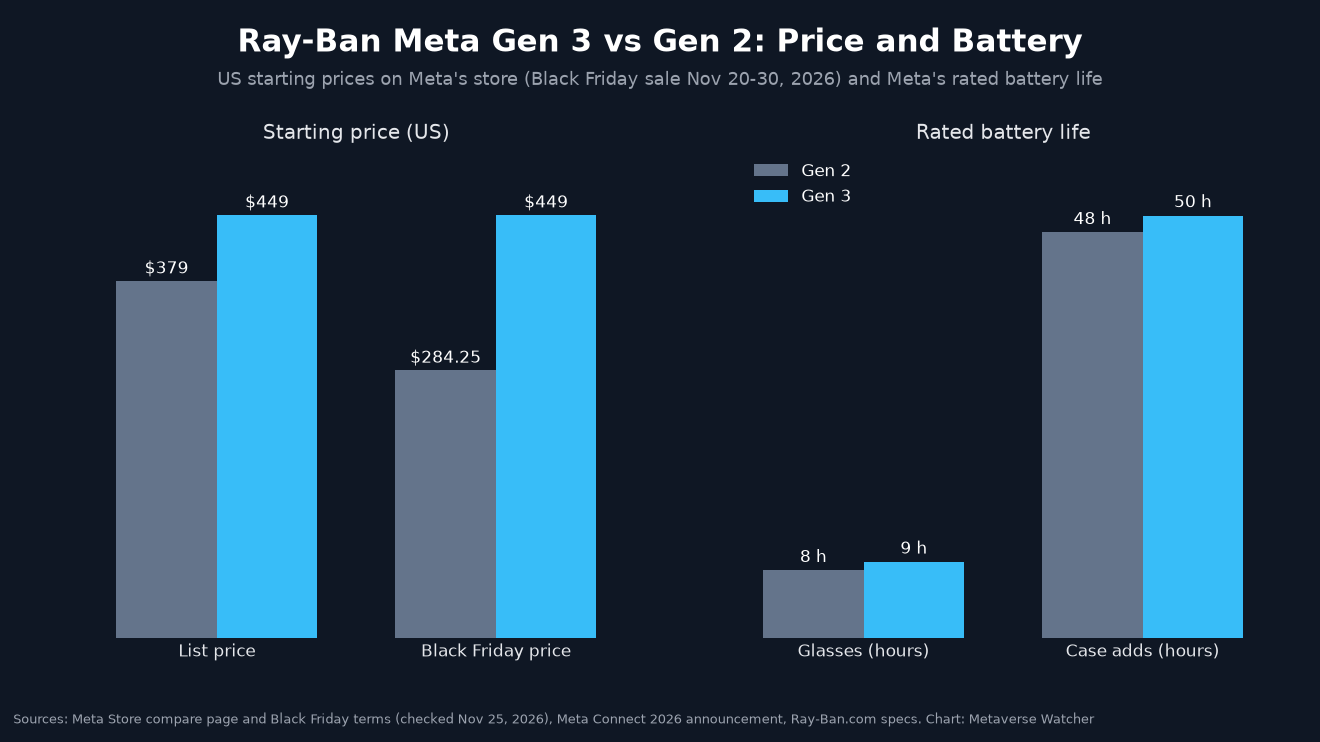
Meta now sells two camera-equipped generations of Ray-Ban Meta side by side. Ray-Ban Meta (Gen 3) launched at Meta Connect on September 23, 2026, starting at $449. Ray-Ban Meta (Gen 2), the 2025 model, stays on sale at a $379 list price, and through November 30 it is 25% off in Meta’s Black Friday promotion. That puts the gap between the two at $164.75 for the cheapest frames.
On paper the two pairs are close. They share the same 12 MP camera, the same 3K video, the same 32 GB of storage and the same Meta AI software. This guide sets out what actually differs, using Meta’s and Ray-Ban’s own spec sheets, independent reviews, and store prices checked on November 25, 2026, so you can decide whether the newer pair is worth the extra money.
Quick Answer
- Buy Gen 2 if price matters most. At $284.25 during the sale, it delivers the same photos, video and AI features as Gen 3 for about two-thirds of the price.
- Buy Gen 3 if you want the Aviator or Zena frames, take many calls outdoors, or want the customizable action button. Expect to pay full price: Gen 3 is not part of Meta’s Black Friday sale.
- Do not upgrade from Gen 2 to Gen 3 unless one of those specific changes solves a problem you have today. Most of the new software is also reaching Gen 2.
Ray-Ban Meta Gen 3 vs Gen 2: Specs Side by Side
| Spec | Ray-Ban Meta (Gen 3) | Ray-Ban Meta (Gen 2) |
|---|---|---|
| Launch | September 23, 2026 | 2025 |
| US starting price | $449 (Wayfarer); Aviator and Zena from $529 | $379 list; $284.25 in Meta’s sale through Nov 30 |
| Frame styles | Wayfarer (standard and large), Aviator, Zena | Wayfarer (standard and large) and other classic Ray-Ban shapes such as Headliner |
| Camera | 12 MP ultra-wide, 100° field of view | 12 MP ultra-wide, 100° field of view |
| Video | 3K at 30 fps; 1080p at 30/60 fps; 720p at 120 fps | 3K at 30 fps; 1080p at 30/60 fps; 720p at 120 fps |
| Camera and LED opening | 36% smaller than Gen 2 | Standard |
| Microphones | 6-mic array, advanced wind-noise reduction | 5-mic array |
| Controls | Touchpad, capture button, customizable action button | Touchpad, capture button |
| Rated battery | Up to 9 hours | Up to 8 hours |
| Charging case | Up to 50 additional hours | Up to 48 additional hours |
| Storage | 32 GB | 32 GB |
| Weight (standard Wayfarer) | 51.5 g | 51 g |
| Hinge-to-hinge width (standard Wayfarer) | 129 mm | 131 mm |
| Water resistance | IPX4 | IPX4 |
| Prescription range (Meta) | -12.00 to +6.00 | -12.00 to +6.00 |
The table makes the main point clear. The camera, video modes, storage and water rating are IDENTICAL. The differences are concentrated in four areas: microphones, the action button, battery, and the frame itself.
What Gen 3 Actually Changes
Six Microphones Instead of Five
Gen 3 moves from a five-mic array to a SIX-MIC array, and Meta says the redesigned layout cuts more than 90% of background noise on calls and voice commands. Ray-Ban’s spec sheet adds “advanced wind noise reduction” for Gen 3, a line that does not appear on the Gen 2 listing. In Engadget’s review, people on the other end of calls said the reviewer sounded clearer on Gen 3 than on AirPods Pro 2, though the same reviewer had received no complaints about Gen 2’s five mics. If you mostly use the glasses for music and photos, this change is unlikely to matter. If you take calls while walking or cycling in the wind, it is the most practical upgrade in the package.
Meta has also said its AI glasses will be able to record and play back video with Dolby Atmos spatial audio later this year. Engadget notes that the extra microphone could help Gen 3 here, but the feature had not launched when this guide was written, so it should not be the basis for a purchase today.
A Customizable Action Button
Gen 3 adds the ACTION BUTTON that first appeared on Ray-Ban Meta Optics and Meta’s own-brand glasses. It can summon Meta AI, act as a capture shortcut, or trigger another feature you assign. Gen 2 has a capture button that only controls the camera, plus the touchpad and “Hey Meta” voice control. The button is useful in places where speaking to your glasses is awkward, such as an office or public transport, but every function it offers is also available by voice or touch on Gen 2.
One More Hour of Battery
Meta rates Gen 3 at up to 9 HOURS per charge with 50 more from the case, against 8 hours and 48 hours for Gen 2. Both ratings assume mixed use. Engadget measured about six hours of continuous audio playback on Gen 3, while Ray-Ban rates the Gen 2-based Optics model at up to five hours of continuous audio, so the real-world gap for heavy listeners is roughly ONE HOUR. Camera-heavy features such as Live AI drain either pair much faster. Our Ray-Ban Meta battery life guide covers the settings that make the biggest difference on both generations.
Slimmer Frames, New Shapes, Different Fit
Gen 3 is the first Ray-Ban Meta model offered as an AVIATOR and as ZENA, a cat-eye frame, alongside the Wayfarer. Meta offers it in 27 color and lens combinations. The Wayfarer is fractionally smaller than before: 129 mm hinge to hinge against 131 mm on Gen 2, with temples 1 mm shorter. It is also half a gram heavier, so the change is about proportions rather than weight. Ray-Ban says the camera and LED opening is 36% smaller, which makes the front of the frame look less like a gadget.
Two caveats apply. First, the new shapes cost more: Engadget found the Aviator and Zena start at $529, an $80 premium over the Wayfarer, and Meta also sells a special-edition Aviator at a higher price. Second, Gen 3’s adjustable temple tips need to be set by an optician or at a Meta store. Engadget’s reviewer found the Aviator frames slipped down her nose and noted that, unlike some Meta-brand glasses, they cannot be adjusted at home. If you buy online, plan a fitting visit.
What Stays the Same
Photo and video quality should NOT drive this decision. Both generations use a 12 MP ultra-wide sensor that captures 3024 x 4032 images, record 3K Ultra HD at 30 fps, and offer hyperlapse, slow motion and autocapture. Both have 32 GB of storage, rated for more than 1,000 photos or more than 100 thirty-second videos, and both are rated IPX4 for splashes and sweat, not swimming. Our guide to whether Ray-Ban Meta glasses are waterproof explains what that rating covers.
Software is also largely shared. According to Engadget, most of the features Meta announced alongside Gen 3, including dynamic photos, the FDA-cleared hearing enhancement feature and Meta’s Muse AI agent, are coming to Gen 2 as well. Meta has said hearing enhancement will cost $149 as an add-on or come included with a Meta One plan, and Engadget reports that Muse was still described as a beta when it reviewed Gen 3. Both generations keep the white capture LED, and Ray-Ban says the camera is designed to stop working if that light is covered. The privacy controls are the same on both; our Ray-Ban Meta privacy settings guide walks through them step by step.
Meta’s Ray-Ban Gen 3 glasses deliver modest battery and cosmetic upgrades but feel overpriced given only marginal improvements over previous models. https://t.co/kEI1yh5q2I
— Engadget (@engadget) November 25, 2026
Prices and Black Friday: The Real Cost Gap
Meta’s Black Friday promotion runs from November 20 to November 30, 2026. In the US, Canada and Australia it takes 25% OFF Ray-Ban Meta (Gen 2) and Oakley Meta HSTN, and 15% off Oakley Meta Vanguard and select Meta Glasses. Gen 3 is NOT included, and Amazon also listed the Gen 3 Wayfarer at the full $449 on November 25. Prescription lenses are 25% off in the US and Canada with an eligible pair, and Meta says that discount can be combined with a frame discount.
| Option (US) | List price | Current price | Where |
|---|---|---|---|
| Ray-Ban Meta Gen 2 Wayfarer (clear lenses) | $379 | $284.25 | Meta Store (checked Nov 25); Amazon shows $284 |
| Ray-Ban Meta Gen 2 Wayfarer Large (polarized) | $409 | $306 | Amazon, reported by Android Authority on Nov 20 |
| Ray-Ban Meta Gen 3 Wayfarer | $449 | $449 | Meta Store; Amazon |
| Ray-Ban Meta Gen 3 Aviator or Zena | From $529 | From $529 | Per Engadget |
At list prices the difference is $70. During the sale it more than doubles to $164.75. That is the number to weigh against an extra microphone, an hour of battery and a programmable button. Our roundup of Meta’s Black Friday 2026 deals lists the rest of the discounted lineup.
Who Should Buy Which
| If you… | Better choice | Why |
|---|---|---|
| Want the lowest price for a camera Ray-Ban | Gen 2 | Same camera, video and AI features at $284.25 through Nov 30 |
| Take frequent calls outdoors | Gen 3 | Six mics and wind-noise reduction |
| Want Aviator or cat-eye frames | Gen 3 | Only Gen 3 offers Aviator and Zena |
| Listen to audio for long stretches | Gen 3, or consider Ray-Ban Meta Audio | One extra rated hour on Gen 3; the camera-free Audio model is rated for up to 12 hours |
| Already own Gen 2 | Keep Gen 2 | Shared camera and most new software features |
| Buy online without visiting a store | Either, but check fit | Gen 3 temple tips need professional adjustment |
If you never used the camera on an earlier pair, neither generation may be the best value. The camera-free Ray-Ban Meta Audio costs $349, weighs less and is rated for longer battery life. Meta’s own-brand glasses start at $249 with the same 12 MP camera. Our Ray-Ban Meta vs Oakley Meta vs Meta Glasses comparison covers those alternatives, and our best smart glasses of 2026 list includes rivals outside Meta’s lineup.
Prescription Wearers
Meta lists a prescription range of -12.00 to +6.00 for both Gen 2 and Gen 3, and Ray-Ban says all of its Meta styles are available with prescription lenses, although availability varies by country. Meta’s Black Friday terms exclude Ray-Ban Meta Optics (Gen 2), the model designed specifically for prescription wearers, from the frame discount. If you need strong lenses, confirm your prescription with the retailer’s Rx tool before ordering either generation. Our guide to smart glasses for prescription wearers covers lens options and costs.
Verdict
Ray-Ban Meta Gen 3 is the better pair of glasses, but only slightly. Its improvements are clearer calls, one extra hour of rated battery, a programmable button and two new frame shapes. It does not take better photos or video, and most of Meta’s new software is coming to Gen 2. Engadget scored Gen 3 at 7.3 out of 10 and concluded that the upgrades are minor for the price. We agree with that view while Gen 2 is discounted to $284.25. For most first-time buyers, GEN 2 is the better value until the sale ends on November 30. Gen 3 makes sense if you specifically want the Aviator or Zena styles, or if call quality in wind and noise is important to you.
For background on the launch, see our Connect 2026 report on Ray-Ban Meta Gen 3. Further sources: Tom’s Guide on the Gen 3 launch and Digital Citizen on which models the Black Friday sale excludes.