By the Metaverse Watcher newsroom. Published Wednesday, November 25, 2026. Prices come from EssilorLuxottica’s South African launch statement as reported by ITWeb and TechCentral on November 25; US prices are Meta’s list prices, and the exchange rate is the November 25 ECB reference rate.
Meta and EssilorLuxottica will start selling Ray-Ban Meta and Oakley Meta AI glasses in South Africa on Thursday, November 26, 2026. Four models are included, with suggested entry prices running from R8 399 for the Oakley Meta HSTN to R10 599 for the Oakley Meta Vanguard. A Meta spokesperson confirmed the date to TechCentral. Until now the companies had only said the glasses would arrive “from the end of November.”
This is the first official retail launch of Meta’s glasses in the country. Until now, South African buyers could only get them as parallel imports, with warranty support handled by the importing retailer rather than Meta.
South African Prices
According to the EssilorLuxottica statement published by ITWeb, these are the suggested entry prices:
- Oakley Meta HSTN: R8 399
- Ray-Ban Meta (Gen 3): R8 599
- Ray-Ban Meta Optics (Gen 2): R8 999
- Oakley Meta Vanguard: R10 599
These are entry prices. TechCentral reports that the Meta spokesperson described them as “suggested entry pricing,” so the final cost will depend on frame, lens type and the retailer. The glasses will be sold “nationwide at selected EssilorLuxottica optical retail partners, Oakley retail store and online,” but the companies have not named the participating retailers.
Ray-Ban and Oakley Meta glasses go on sale in South Africa https://t.co/5VZKGbGWz4 https://t.co/9QaPtEMTNY
— TechCentral (@TechCentral) November 25, 2026
How the Prices Compare With the US
A direct currency conversion makes South Africa look expensive, but it ignores tax. South African shelf prices include 15% VAT, while US list prices exclude sales tax. To compare like for like, we converted each US list price at the European Central Bank reference rate for November 25 (R17.6968 per US dollar, via the Frankfurter API) and added 15%.
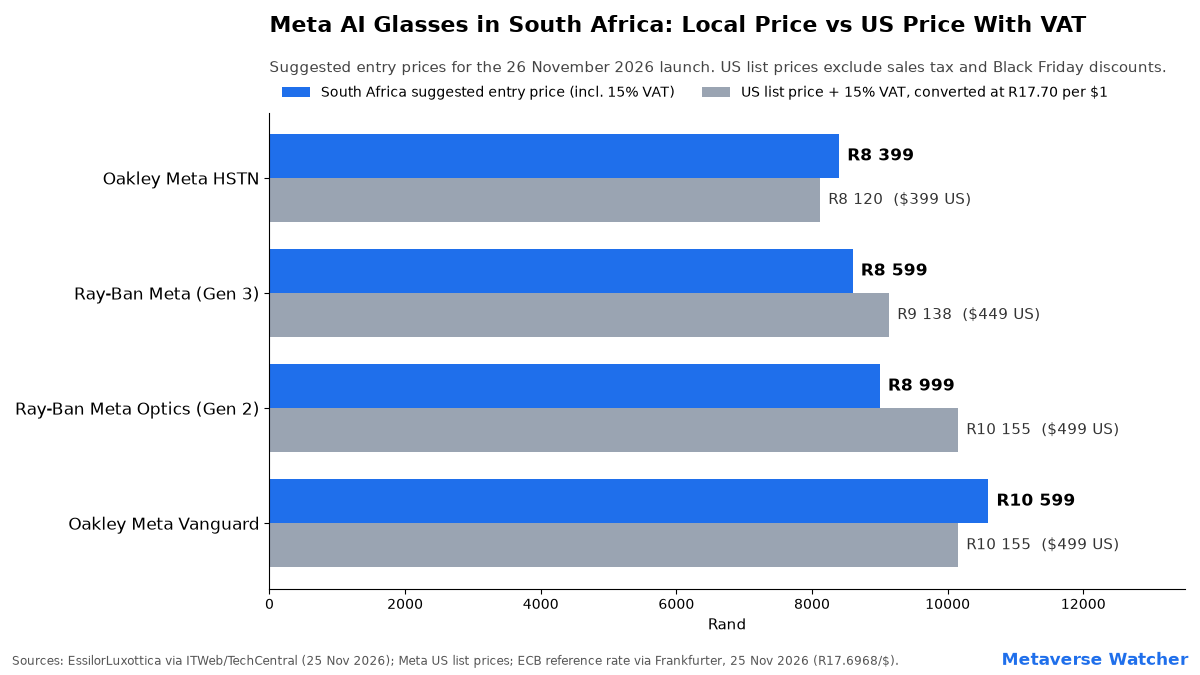
- Oakley Meta HSTN ($399 in the US): about R8 120 with VAT, so the R8 399 local price is roughly 3% higher.
- Ray-Ban Meta (Gen 3) ($449): about R9 138 with VAT, so R8 599 is roughly 6% lower.
- Ray-Ban Meta Optics (Gen 2) ($499 for the Blayzer Optics): about R10 155 with VAT, so R8 999 is roughly 11% lower.
- Oakley Meta Vanguard ($499): also about R10 155 with VAT, so R10 599 is roughly 4% higher.
In short, the two Ray-Ban models launch below US-equivalent pricing and the two Oakley models launch slightly above it. All four are within about 11% either way. Two caveats apply. US sales tax varies by state and is usually below 15%, and the rand moves daily. The comparison also uses list prices: Meta’s US Black Friday sale currently takes up to 25% off its AI glasses, as we covered in our Meta Black Friday 2026 deals roundup. No local launch discount has been announced.
The official prices are also below the grey market. When TechCentral reported the launch plans in October, the parallel importer Evetech listed the standard Ray-Ban Meta Wayfarer from about R10 745. The new Gen 3 entry price is about R2 146 lower than that, and it comes with official retail support.
Which Models Are Included
Ray-Ban Meta (Gen 3) comes in Wayfarer, Aviator and Zena frames. It includes Meta AI, hands-free photo and video capture, open-ear audio, calls, messaging and conversation translation. EssilorLuxottica says clear and sun lenses will be available, along with Transitions, polarised, blue-light-filter and prescription options.
Ray-Ban Meta Optics (Gen 2) covers the optical-first Blayzer Optics and Scriber Optics frames, which Meta introduced in March for prescription wearers. At R8 999, the entry price is only R400 above the Gen 3. Lens choice can widen that gap. Writing for Recharged, Nafisa Akabor said a local optometrist fitted her prescription lenses for R1 800, which is one data point rather than a standard price. Our guide to smart glasses for prescription wearers explains how prescription ranges differ between models.
Oakley Meta HSTN has a 3K camera, open-ear speakers and an IPX4 splash rating, and some versions use Oakley’s PRIZM lenses. Oakley Meta Vanguard is built for runners and cyclists. It has a centred 12MP ultra-wide camera with a 122-degree field of view, wind-noise reduction, an IP67 dust and water rating, and Strava and Garmin integration. Our Ray-Ban Meta vs Oakley Meta vs Meta Glasses comparison covers battery life and camera differences in detail.
Karen Gold, marketing director at EssilorLuxottica, said in the statement: “Bringing the Oakley and Ray-Ban Meta glasses range to South Africa opens up a whole new way to see, share and interact with the world.”
What Is Missing
The South African range is smaller than the US lineup. It does not include the lower-cost Meta-branded glasses, which start at $249 in the US, or the Meta Ray-Ban Display with its built-in screen. Stuff South Africa noted that the Display “may take some time to reach the country.” Ray-Ban Meta Audio, the first camera-free model, will follow in 2027 in Clubmaster and Burbank designs. It sells from $349 in the US.
Software may also differ. TechCentral notes that the announcement does not mention Muse, Meta’s personal AI agent, which the companies said in September would be “available in US only.” Buyers should check which Meta AI features are supported in South Africa before assuming parity with US reviews.
South Africa was first named as a coming market in September. At Connect, EssilorLuxottica listed it alongside Hong Kong, Portugal, Poland, Malaysia, Thailand, Indonesia, the Philippines and New Zealand for later-2026 rollouts, as we reported in our coverage of Meta and EssilorLuxottica’s 100-style expansion.
Privacy and POPIA
The launch comes without any glasses-specific rules in South Africa. According to TechCentral, Meta demonstrated the glasses to the Information Regulator in September. In October, the regulator told the outlet that the Protection of Personal Information Act (POPIA) could apply to footage in which people can be identified, but that there is “no single law that would regulate such a product.” Section 6(1)(a) of POPIA excludes processing done “in the course of a purely personal or household activity,” and TechCentral notes that this exclusion could cover much everyday use.
That leaves the familiar questions unresolved: recording in workplaces, schools and private venues, and how bystanders are notified. The glasses use a capture LED to signal recording, but that light does not settle when filming is lawful. Our smart glasses recording laws guide tracks how other countries handle this.
What to Watch
- Retailer list and stock: the named optical partners, and whether entry prices hold once lens options are added.
- Feature parity: which Meta AI functions, languages and app integrations work locally at launch.
- Grey-market pricing: whether parallel importers cut prices to compete with official stock.
- Regulation: any guidance from the Information Regulator now that the glasses are on general sale.
For a wider view of the category, including alternatives to Meta, see our best smart glasses of 2026 list.