Savage Technology, a Hong Kong-registered startup that brands itself SavageTech, has opened reservations for Orrorin Glasses, a 45-gram pair of display smart glasses that it says can be controlled with bare-hand pinch gestures and eye tracking, with no ring, wristband or temple touchpad. The full price is $799, and the company’s own reservation terms put the first shipments in March 2027.
The announcement spread quickly. SavageTech’s launch post on X, published at 12:15 p.m. ET on Monday, Nov. 23, passed 435,000 views by Tuesday afternoon, and a quote post from the account @LeakerApple asking “How in the world did they pull this off???” drew close to 300,000 more. Much of the reaction was skeptical, and with good reason: SavageTech’s own website says the “on-screen content shown in videos is rendered for illustration.”
Vison Pro levels of interaction
INSIDE 45 grams!Introducing Orrorin Glasses 🕶
Now, you can pinch the messages floating in fornt of you without wearing anything else!
— Savage Technology (@HiSavageTech) November 23, 2026
What SavageTech Is Promising
According to the Orrorin tech specs page, the glasses use a binocular full-color MicroLED display, meaning an image in BOTH lenses, at 500 x 380 resolution, 60 Hz, a 25-degree field of view and up to 1,800 nits of brightness. A single forward-facing global-shutter camera (1280 x 800, 110-degree field of view, 120 fps) handles hand tracking, and two inward-facing infrared eye cameras track the wearer’s gaze.
Power comes from two steel-shell lithium-ion cells, one in each temple, totaling 450 mAh. SavageTech claims up to 10 hours of “typical use” and 15-minute fast charging through a magnetic temple tip. Audio is handled by dual piezoelectric drivers and four microphones. The processor is described only as “high-performance multi-core processing,” paired with 64 MB of memory and 4 GB of storage. The software is SavageOS, which the company describes as built from scratch rather than on Android.
The interaction model is the main pitch. On its Our Story page, co-founders Bill Pei and Elena Shi say a “tiny pinch at your side” maps to controls in front of you, so users do not hold their hands up in the air. Eye tracking is used ONLY to detect whether you are looking at the display, which fades away when you look elsewhere, not as a pointer in the style of Apple Vision Pro. The founders write that using eyes as a cursor on Vision Pro “doesn’t feel natural.”
Reservation Tiers and Ship Dates
SavageTech is taking deposits, not full payments. Each deposit counts toward the $799 total, and the company says it will email buyers to pay the balance before shipping. Orders ship from China, and shipping is free.
| Tier | Deposit | Estimated shipping | Refund terms before balance payment |
|---|---|---|---|
| Founder Edition | $199 | March 2027 | Refundable, less any “legally justified” deduction |
| Early Bird | $29 | May 2027 | Fully refundable |
| In Line | $49 | July 2027 | Fully refundable |
Source: SavageTech Terms, effective Nov. 21, 2026, and savage.tech, checked Nov. 24, 2026. The company says all shipping dates are estimates.
How Orrorin Compares on Paper
At $799, Orrorin lands at exactly the price of Meta Ray-Ban Display, which includes the Meta Neural Band EMG wristband, and $200 above Even Realities G2. The chart below sets SavageTech’s claims against the published specs of those two shipping products. We compared Meta’s and Even’s glasses in detail in our Meta Ray-Ban Display vs. Even G2 buying guide.
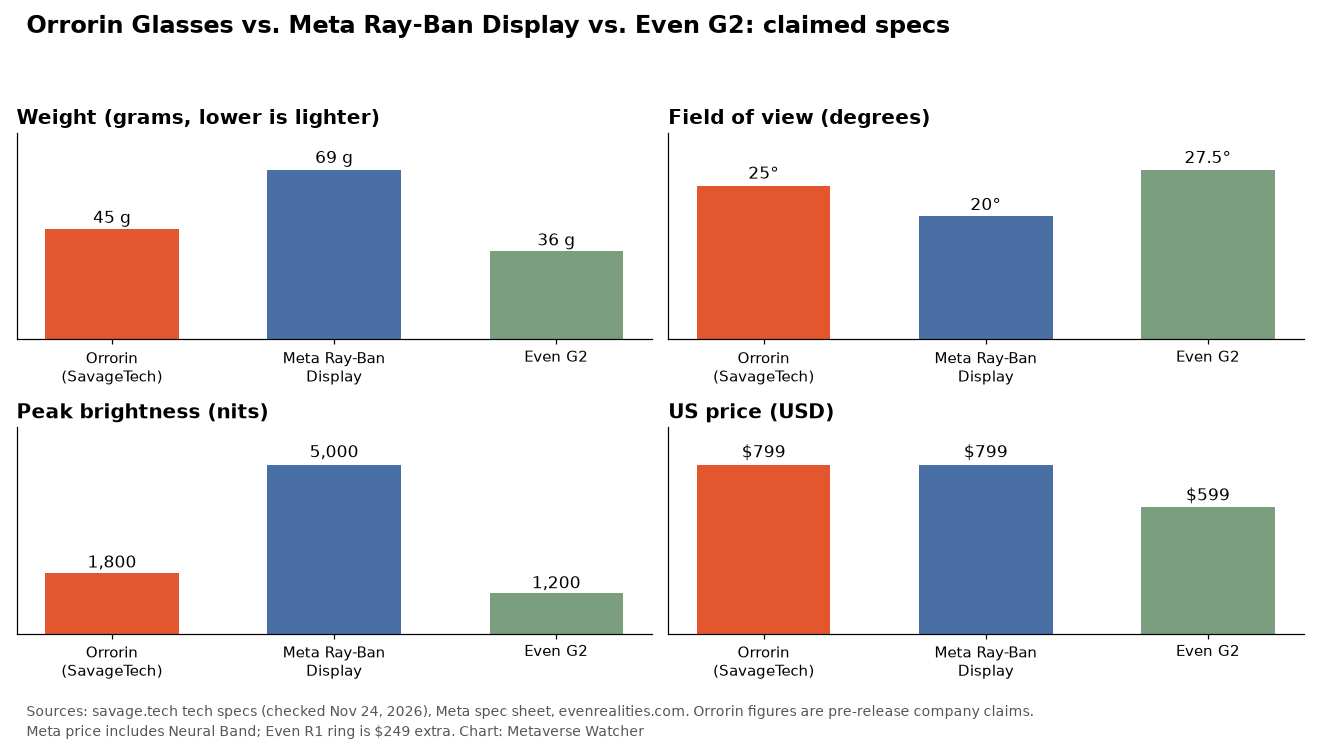
On paper, Orrorin would be 24 grams lighter than Meta Ray-Ban Display while offering a color image in both eyes instead of one, and a slightly wider 25-degree field of view versus Meta’s 20 degrees. Even G2 is lighter still at 36 grams with a 27.5-degree field of view, but its display is monochrome green and it has no camera. Meta’s display is far brighter, at up to 5,000 nits, and Meta’s resolution of 600 x 600 in a single eye is higher than Orrorin’s 500 x 380 per eye.
The key difference is input. Meta relies on a wrist-worn EMG band and Even on temple touchpads or an optional $249 ring. SavageTech says Orrorin needs nothing extra. For a broader view of where these products fit, see our guide to what smart glasses are and how the categories differ.
What the Company Has Clarified, and What It Has Not
In replies on X on Tuesday, SavageTech added several details that are not on its product page. It said SavageOS combines three subsystems, including a real-time operating system and Linux, and that the glasses do NOT support 6DoF tracking. It also said the camera runs whenever the display is on, but that the images are used internally for hand tracking and raw recordings are not available to users or developers. The website makes a similar privacy promise, saying all AI processing happens on the device. The company also confirmed prescription lenses, with prescription data collected by email after ordering.
Several important questions remain open:
- Real footage. The use-case videos are rendered. SavageTech has not yet published independent hands-on footage or let outside reviewers test the glasses.
- Battery under load. A 450 mAh pack powering an always-on camera, two eye cameras and two color displays for up to 10 hours would be unusual. SavageTech qualifies the figure as “typical use.”
- Compute. 64 MB of memory is very small next to Android-based glasses. That fits a lean, natively compiled operating system, but it limits what apps can do on the glasses themselves.
- Company track record. The company’s own story says development began about a year ago, and Orrorin is its first product. In a Nov. 24 post, Bill Pei wrote that the video went viral “before the main launch,” so a fuller reveal may still be coming.
Camera-equipped glasses with gaze sensors also raise the same bystander and data questions we covered in our analysis of eye-tracking smart glasses and privacy.
Why It Matters
Today’s best-known display glasses all ask for something extra to control them: Meta pairs Ray-Ban Display with a wristband, and Even relies on temple touchpads or a ring. If SavageTech’s claims hold up in independent testing, Orrorin would show that bare-hand control can fit in a 45-gram frame at the same $799 price as Meta’s glasses. Until then, buyers should treat it as a refundable early-stage reservation for a product shipping in 2027, not a proven alternative to glasses on sale today. For the rest of the pipeline, including Samsung, Google and Apple, see our upcoming smart glasses tracker for 2026 and 2027.