Updated November 19, 2026. Metaverse Watcher will update this tracker as companies confirm dates and prices.
The next 12 months will bring more new smart glasses than any year so far. Google and Samsung’s first Android XR glasses ship in December. Snap’s consumer Specs are due before the end of the year. Meta’s glasses-style VR headset arrives in spring 2027, and Apple’s first glasses are reported for late 2027. This tracker brings every credible upcoming launch together on one page, with release dates, prices and key specs, and it separates what companies have announced from what has only been reported.
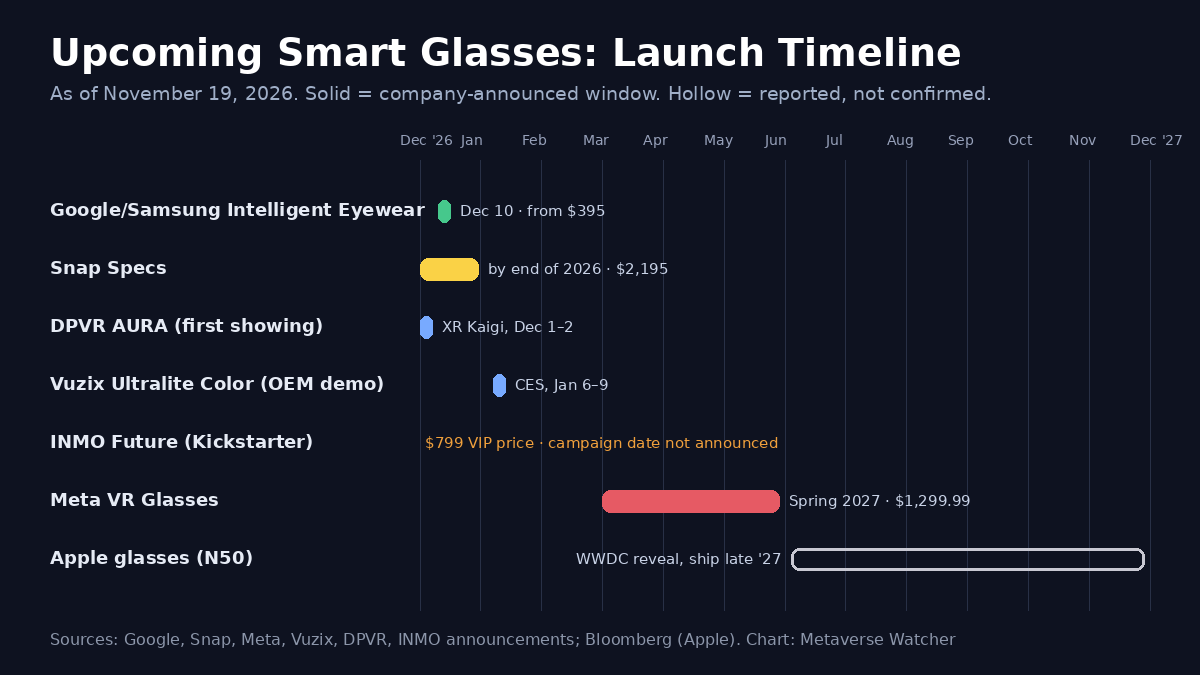
Upcoming Smart Glasses at a Glance
| Device | Type | Release | US price | Status |
|---|---|---|---|---|
| Google / Samsung Intelligent Eyewear (Warby Parker, Gentle Monster) | AI glasses, camera, no display | December 10, 2026 | From $395 / $449 | Announced; preorders sold out |
| Snap Specs | Standalone true AR glasses | Before end of 2026 | $2,195 | Announced; preorders open |
| DPVR AURA | Waveguide display glasses | First showing Dec 1–2, 2026 (Tokyo) | Not announced | Announced; no retail date |
| Vuzix Ultralite Color | OEM reference design, full-color display | CES demo Jan 6–9, 2027 | Not for retail | Announced; no customers named |
| INMO Future | Standalone AR glasses | Kickstarter date not announced | $799 VIP (via $30 reservation) | Announced |
| Meta VR Glasses | Glasses-style VR headset with puck | Spring 2027 | $1,299.99 | Announced; preorders not open |
| Apple glasses (N50) | AI glasses, no display (reported) | Reveal WWDC June 2027; ship late 2027 | No credible report | Reported only |
Google and Samsung Intelligent Eyewear: December 10, 2026
The first Android XR glasses are the nearest launch, and the most important one for the mainstream market. According to Google’s announcement, the Warby Parker collection starts at $395 and the Gentle Monster collection at $449. Both go on sale in stores and online on December 10 in the United States and South Korea. Samsung engineered the hardware and Google supplies the Android XR software, 9to5Google reports.
Key specs: a Snapdragon AR1 Gen 1 chip, a 12MP ultra-wide camera, four microphones, open-ear speakers, up to nine hours of rated battery life and a weight of about 41 grams. They have no display, which makes them a direct rival to Ray-Ban Meta rather than to display glasses. Demand looks strong. Seoul Economic Daily reports that every version listed for preorder in South Korea and the U.S. is now sold out. Check phone compatibility before ordering. Our Google Intelligent Eyewear price, specs and phones guide lists the supported Pixel, Galaxy and iPhone models.
Snap Specs: Before the End of 2026
Snap’s consumer Specs cost $2,195 in the U.S. with a $200 preorder deposit, and shipping is expected before the end of 2026. They are fully standalone true AR glasses, with LCoS light engines and waveguides giving a 51-degree diagonal field of view, two Snapdragon processors in the frame, and hand tracking. The trade-offs are a weight of 132 grams and rated battery life of up to about four hours. UploadVR and TechCrunch have published hands-on reports. We summarized five of them in our Snap Specs reviews roundup, and we compared Specs with XREAL’s Android XR glasses in Snap Specs vs XREAL Aura.
DPVR AURA: First Showing December 1–2
Chinese headset maker DPVR will show AURA, its waveguide display smart glasses, for the first time at the XR Kaigi 2026 expo in Tokyo on December 1–2, according to a company press release on PR TIMES. DPVR will offer demo units with prescription lenses from +6.00D to −8.00D at the show. It has published no price, retail date or full spec sheet. DPVR focuses on OEM and business customers, so AURA may reach the market under other brands.
Vuzix Ultralite Color: CES, January 6–9, 2027
Vuzix’s newest design is not a retail product. It is a reference platform that other brands can build on. Ultralite Color weighs under 40 grams and pairs full-color binocular microLED waveguides with electrochromic tinting, while leaving out cameras and speakers. Vuzix will show it at CES, but it says no customers or production commitments have been announced. See our Vuzix Ultralite Color report for what the company did and did not disclose.
INMO Future: Kickstarter, Date to Be Announced
INMO unveiled its fourth-generation standalone AR glasses on November 4. They have dual 1080p full-color waveguide displays, a 36-degree field of view, up to 800 nits of brightness and 6DoF tracking, in a frame of about 100 grams. U.S. buyers can place a $30 refundable reservation that unlocks a $799 VIP price on a Kickstarter campaign that has not launched yet, according to INMO’s product page. Crowdfunded hardware carries delivery risk, and INMO’s previous flagship was recalled for overheating. Details are in our INMO Future launch report.
Meta VR Glasses: Spring 2027
Meta’s glasses-style headset is the biggest launch on the 2027 calendar. In its Connect announcement, Meta confirmed a spring 2027 release and a U.S. price of $1,299.99, with 128GB of storage and no controllers in the box. The frame weighs about 100 grams and tethers to a 300-gram puck that holds the chip and battery. Its micro-OLED displays deliver 37 pixels per degree, and the field of view is a much narrower 70 by 66 degrees. Meta is pitching it first as a personal cinema, and it is already lining up 3D film conversions with DNEG and IMAX. Our Meta VR Glasses price, release date and specs guide has the full spec table.
Apple Glasses: Reported for Late 2027
Apple has not announced smart glasses. Reports from Bloomberg and others point to a first model, codenamed N50, being unveiled at WWDC in June 2027 and shipping by late 2027. The reported design has cameras but no display, and it would work as an iPhone accessory. No credible price has been reported. The timeline has already moved more than once, so treat it as a target, not a commitment. Our Apple smart glasses rumors tracker rates each claim’s reliability.
Recently Launched: Worth Knowing Before You Wait
If you need glasses now, several notable models shipped this fall. XREAL Aura, the first Android XR display glasses, went on sale on October 28. See our XREAL Aura reviews roundup. Brilliant Labs Halo launched at $399 with a full-color microOLED display and no traditional camera, as covered in our Halo launch report. RayNeo is also running Black Friday deals on its display glasses.
Display vs No Display: The Choice That Matters Most
Upcoming glasses fall into three groups, and the group matters more than the brand:
- AI glasses with no display (Google/Samsung Intelligent Eyewear, the reported Apple N50): camera, speakers and an assistant in a normal-looking frame of about 40 to 50 grams, priced around $400.
- Display glasses (DPVR AURA, Vuzix-based designs, INMO Future, Snap Specs): add a see-through screen in the lens. Prices and weights climb quickly as field of view and standalone computing increase, from about 40 grams for display-only reference designs to 132 grams for Snap Specs.
- Glasses-style headsets (Meta VR Glasses): fully immersive, sharper than Quest 3, but tethered to a puck and limited to about three hours of media playback.
If you are new to the category, start with our explainer on what smart glasses are and how the types differ. If you wear prescription lenses, check our best smart glasses for prescription wearers guide first, because lens support varies widely.
Should You Buy Now or Wait?
- Want an AI camera pair this holiday season: the Google/Samsung glasses are the main new alternative to Ray-Ban Meta, but preorder stock is gone. Watch for more inventory on December 10.
- Want true AR now: Snap Specs are the only standalone option shipping this year, and you pay $2,195 for being first.
- Mainly want a private movie screen: Meta VR Glasses in spring 2027 are the device to watch. Display glasses already on sale cost far less.
- Waiting for Apple: expect a no-display accessory, not a Vision Pro in glasses form, and not before late 2027 based on current reports.
How we built this tracker: dates and prices come from company announcements and product pages linked above. Apple information is from published reports and is labeled as such. Metaverse Watcher has not tested these devices. Hands-on impressions are attributed to the outlets that published them.