The first full reviews of the XREAL Aura, the first glasses to run Google’s Android XR platform, went live on November 17, 2026, as XREAL’s mid-November shipping window got under way. The early verdict is consistent: reviewers praise the display, the comfort and the light weight compared with a VR headset, but fault the tethered compute puck, the heat and hand-gesture controls that do not always register.
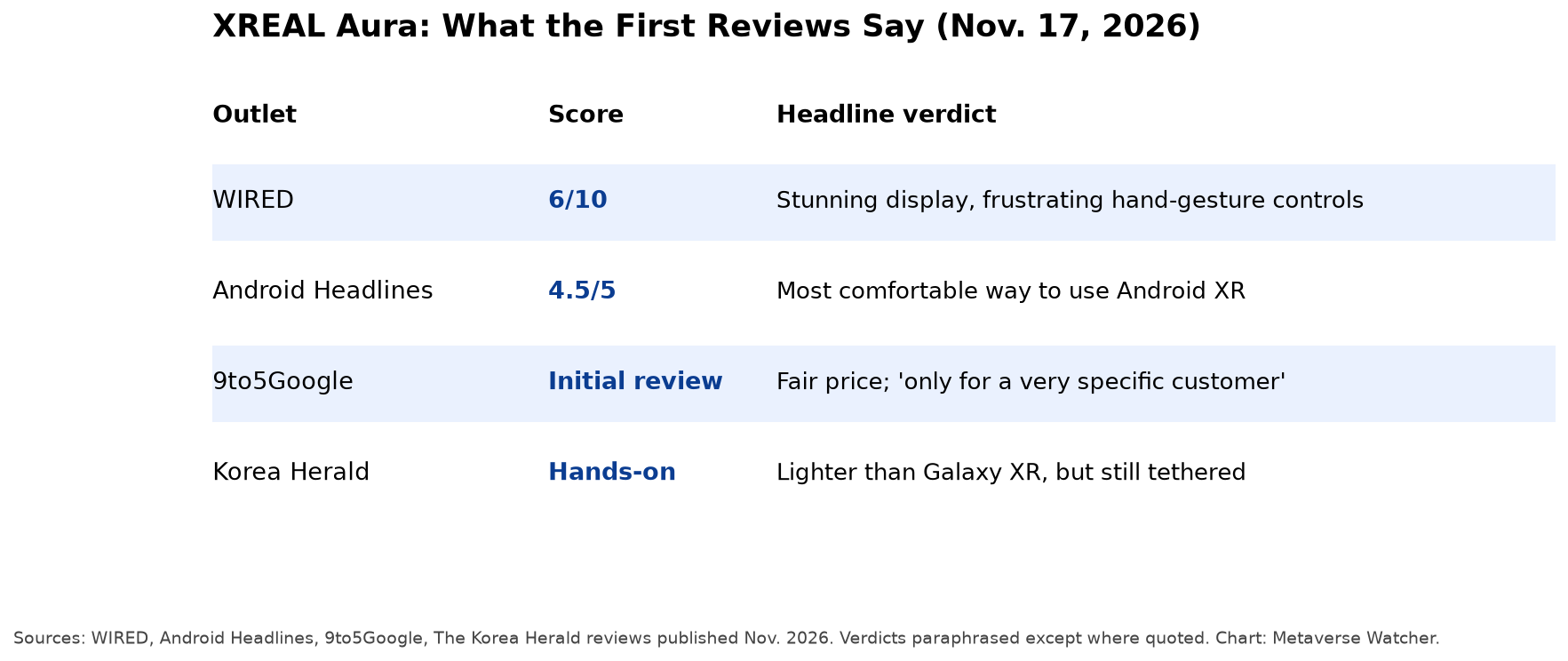
The Scores
| Outlet | Score | Praise | Criticism |
|---|---|---|---|
| WIRED | 6/10 | Vibrant display, good sound, far more comfortable than a VR headset | Hit-or-miss gestures, compute puck, heat, bulk, so-so battery, price |
| Android Headlines | 4.5/5 | Under 95g, adjustable dimming, puck doubles as a trackpad | Tethered puck, warm glasses and puck, hand tracking needs light |
| 9to5Google | Initial review (unscored) | Light, good hand tracking, smooth Android XR | Android XR apps “not nearly desktop-class” |
| The Korea Herald | Hands-on (unscored) | Lighter and easier to put on than Galaxy XR | Thick lenses and chunky temples; still tethered |
What Reviewers Liked
The display. WIRED calls the 1920 × 1200-per-eye screens “noticeably better” than earlier XREAL glasses and says the 70-degree field of view makes windows and virtual elements fill a wide part of your vision, while the outer edges of your view remain the real room. That trade-off cuts both ways: it helps you stay aware of your surroundings but reduces immersion during films.
Comfort. Reviewers repeatedly contrasted the 95-gram glasses with bulkier headsets; Android Headlines and The Korea Herald compare them directly with Samsung’s Galaxy XR, which weighs 545 grams. Android Headlines says it wore Aura through a full basketball game without its head getting tired and calls it “the most comfortable way I’ve used Android XR.” Its reviewer used the glasses daily for a week of work, video and workouts.
Android XR on the glasses. 9to5Google argues that the puck and Android XR fix the main weakness of earlier XREAL glasses, which depended entirely on whatever device was connected. Aura can run apps and offline video on its own while still mirroring a phone or laptop over USB-C. The Korea Herald notes XREAL’s claims of up to five floating windows and more than 150 XR experiences.
What Reviewers Disliked
Controls. WIRED calls controls “the biggest problem,” saying pinch gestures tracked by the front cameras work most of the time but sometimes require repeated attempts to open an app or switch titles. Android Headlines found hand tracking reliable in good light but weaker in dim rooms, where the puck’s trackpad is the fallback.
The puck and heat. Both WIRED and Android Headlines report that the glasses warm up during use, and Android Headlines says the puck gets warm as well. Charging while in use adds a second cable.
Battery. XREAL rates the puck at about four to five hours. Android Headlines says it still had more than 40% left after just over four hours of document work, but video and workouts landed closer to XREAL’s estimate; 30 minutes of an XR workout app used about 15%. WIRED rated battery life “so-so.”
Looks. WIRED describes the glasses as “chonky,” and The Korea Herald says the thick lenses and chunky temples “hardly resemble everyday eyewear.”
Price and Availability
Aura lists at $1,279 for 12GB/256GB and $1,499 for 16GB/512GB in the U.S., with a $200 launch discount bringing them to $1,099 and $1,299 through the end of December, as detailed in our Aura launch coverage. The Korea Herald reports Korean sales have begun at 1.69 million won and 1.99 million won with shipments due in late November, and Famitsu reports a planned Japanese release on November 27 from ¥229,800 including tax.
Who It Is For
The reviews converge on a narrow audience. Android Headlines calls it “an easy pick” for frequent travelers and heavy video watchers, but says it is not yet a replacement for a laptop and monitor. 9to5Google considers $1,279 “a mostly fair price” for what is included and says it is “only for a very specific customer,” while WIRED concludes the glasses “still feel like a novelty that most people won’t want or need,” though “a big step in the right direction.”
For buyers weighing alternatives, our XREAL Aura vs. Galaxy XR comparison covers the headset option, and our Snap Specs vs. XREAL Aura guide compares the standalone AR route. If you only need a large virtual screen, tethered display glasses cost far less; see our best smart glasses of 2026 and our new explainer, What Are Smart Glasses?