Updated October 20, 2026. Prices are U.S. starting prices unless noted. We will revise this guide when a maker changes a price, a ship date or a key spec.
“Smart glasses” now covers FOUR very different products, from $299 video screens you plug into a phone to $2,195 standalone AR computers. The short answer: for most people the best smart glasses in 2026 are the Ray-Ban Meta Gen 3 ($449) if you want a camera, or the Ray-Ban Meta Audio ($349) if you do not. If you want information in front of your eyes, the Meta Ray-Ban Display ($799) and the camera-free Even Realities G2 ($599) lead. For movies and gaming on a big virtual screen, the XREAL 1 Pro+ ($599) and VITURE Pro 2 ($299) are the picks. Every number below is SOURCED.

Best Smart Glasses of 2026 at a Glance
| Best for | Pick | U.S. price | Camera | Display |
|---|---|---|---|---|
| Most people | Ray-Ban Meta Gen 3 | $449 | Yes | No |
| No camera | Ray-Ban Meta Audio | $349 | No | No |
| Sports and training | Oakley Meta Vanguard | $499 | Yes | No |
| Heads-up display | Meta Ray-Ban Display | $799 with Neural Band | Yes | Color, right lens |
| Display without a camera | Even Realities G2 | $599 | No | Monochrome green, in-lens |
| Privacy-first AI | HTC VIVE Eagle | $499 | Yes | No |
| Movies and gaming | XREAL 1 Pro+ | $599 | No (add-on) | 1080p micro-OLED, tethered |
| Budget video glasses | VITURE Pro 2 | $299 | No | 1080p micro-OLED, tethered |
| Android XR | XREAL Aura | $1,279 (pre-order) | Yes | 1920 × 1200 per eye, 70° |
| Standalone AR | Snap SPECS | $2,195 | Yes | See-through, 51° |
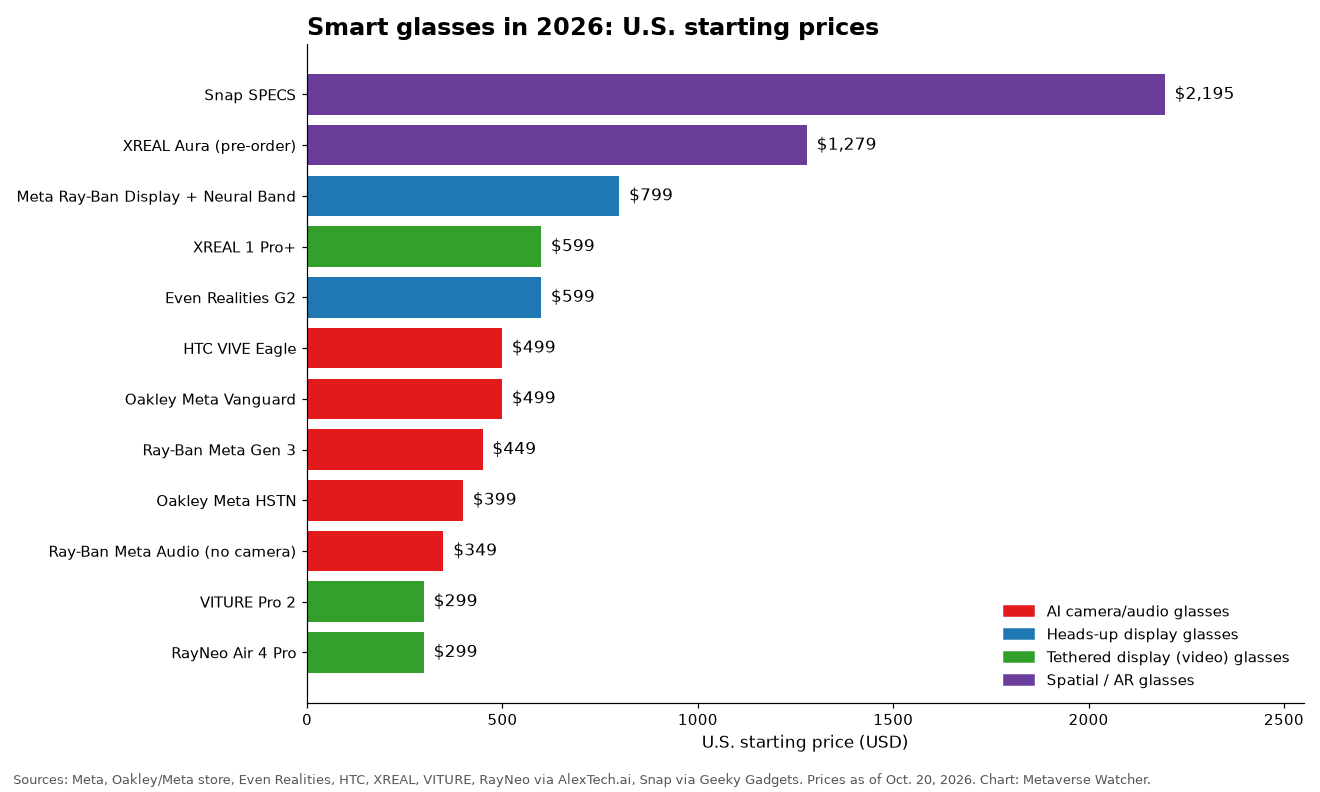
The Four Kinds of Smart Glasses
- AI camera and audio glasses (Ray-Ban Meta, Oakley Meta, VIVE Eagle): open-ear speakers, microphones, a voice assistant and usually a camera. Nothing appears in front of your eyes. This is by far the BIGGEST category.
- Heads-up display glasses (Meta Ray-Ban Display, Even Realities G2): a small display in the lens for notifications, navigation, translation and captions.
- Tethered display glasses (XREAL, VITURE, RayNeo): a large virtual screen fed by a phone, laptop, handheld or console over USB-C. They are MONITORS, not computers.
- Spatial and AR glasses (XREAL Aura, Snap SPECS): apps anchored in the room around you, with hand tracking and their own computing.
The split matters because market trackers count different baskets. Omdia counted 4.2 million AI glasses shipped in the first half of 2026, with Meta at 81.3%, as we reported in our Omdia breakdown. TrendForce, counting AR glasses with displays, expects just 1.31 million units for all of 2026 and gives Meta only about 20%, per our TrendForce report. Display-free AI glasses are the MAINSTREAM product; display glasses are still EARLY.
Best Overall: Ray-Ban Meta Gen 3 ($449)
Meta’s camera model is the DEFAULT choice for hands-free photos and video, calls, music and Meta AI in a frame that looks like ordinary Ray-Bans. The Gen 3 went on sale September 23, 2026 at $449 in the U.S., and Meta says it will offer more than 100 glasses options across Ray-Ban, Oakley and Meta Glasses by year end. It also has the WIDEST software support: recent updates added hands-free walking directions, a Spatial Audio mode and Mandarin, and third-party apps such as Naver Map are arriving on Meta’s frames first.
The trade-off is the CAMERA itself. Venues and governments are writing rules for camera glasses, from courthouse bans in New York to Norway’s planned temporary ban in schools, gyms and shopping centres. If you do not need capture, the next pick is CHEAPER.
Best Without a Camera: Ray-Ban Meta Audio ($349)
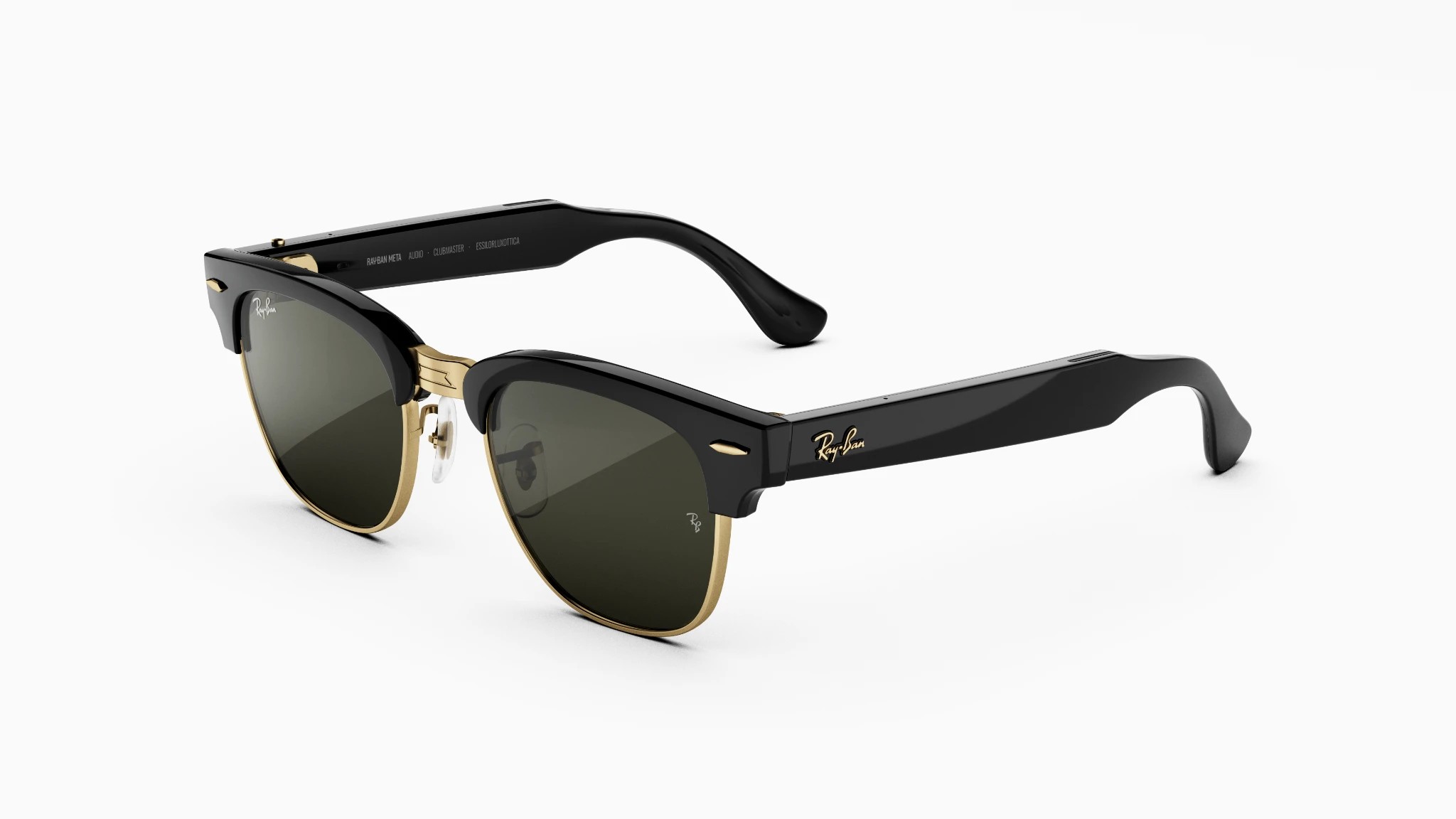
Meta’s first camera-free glasses went on sale October 13 at $349, $100 BELOW the Gen 3. Meta rates them at 43 grams, up to 12 hours of general use or 6 hours of continuous playback, and up to 48 more hours from the case, across 23 Clubmaster and Burbank combinations with prescription options, according to Meta’s launch post. Engadget scored them 8.5 out of 10; The Verge called the battery “phenomenal” but argued $349 is high for what are, in effect, headphones in a frame. Our launch coverage has the full price comparison. Removing the camera answers the photography concern, not the MICROPHONE one.
Best for Sports: Oakley Meta Vanguard ($499)
The Vanguard is a wraparound performance frame with Strava and Garmin integration, an IP67 rating for dust and water and up to 9 hours of normal use, according to Oakley’s product page. It lists at $499 on Meta’s store. The everyday Oakley Meta HSTN starts at $399, with Transitions and polarized versions at $449 to $479. A new clear-lens Vanguard is on UK shelves at £499, but claims that it meets ANSI Z87 workplace safety standards remain UNVERIFIED, as we detailed in our Vanguard Clear report.
Best Display Glasses: Meta Ray-Ban Display ($799)

Ray-Ban Display puts a 600 × 600 color display in the right lens and pairs it with the Meta Neural Band, a wristband that reads muscle signals so you can control the glasses with small finger movements. It has a 12MP camera with 3x zoom, up to 6 hours of battery plus 24 hours from the folding case, and the band lasts up to 18 hours. The $799 U.S. price INCLUDES the band. It also sells for £749 in the UK, CA$1,149 in Canada and €899 in France, Italy and Germany, which joined on October 13, as covered in our German launch report.
Navigation is its MOST useful feature, and at Connect Meta announced cycling and transit directions for the U.S. and Canada. Two cautions: Meta has warned of LIMITED inventory and waitlists, and some software, such as the Hologram calling avatar, is U.S.-first and arriving through early access.
Best Display Without a Camera: Even Realities G2 ($599)
The G2 has NO camera and NO speakers. Instead it projects monochrome green text into the lenses for notifications, navigation, translation, a teleprompter and AI answers. Engadget’s October 19 review lists a 27.5-degree field of view, a 60Hz refresh rate, 1,200 nits peak brightness and an IP65 rating, and scored it 6.9 out of 10, praising the weight and features but faulting the CONTROLS. The base price is $599; prescription lenses start at $159, and the optional Even R1 control ring adds $249, according to Engadget and Even’s store. Omdia put Even Realities second worldwide in AI glasses shipments in the first half of 2026, with 102,000 pairs.
Best Privacy-First Alternative: HTC VIVE Eagle ($499)
HTC pitches the VIVE Eagle as the option for people who do not want a social media company on their face. Video is encrypted and stored on the glasses, covering the indicator light blocks recording, and its VIVE AI assistant runs on ChatGPT or Gemini without an account. HTC rates it at 4.5 hours of continuous music playback. Note the RUNNING cost: VIVE AI Plus is free for two years, then $2.50 a month on annual billing or $2.99 monthly, per HTC’s price page. We broke down the full cost in our VIVE Eagle analysis.
Got questions about VIVE Eagle?
— HTC VIVE (@htcvive) October 13, 2026
Drop them below 👇
#VIVEEagle #smartglasses
Best for Movies and Gaming: XREAL 1 Pro+ ($599)
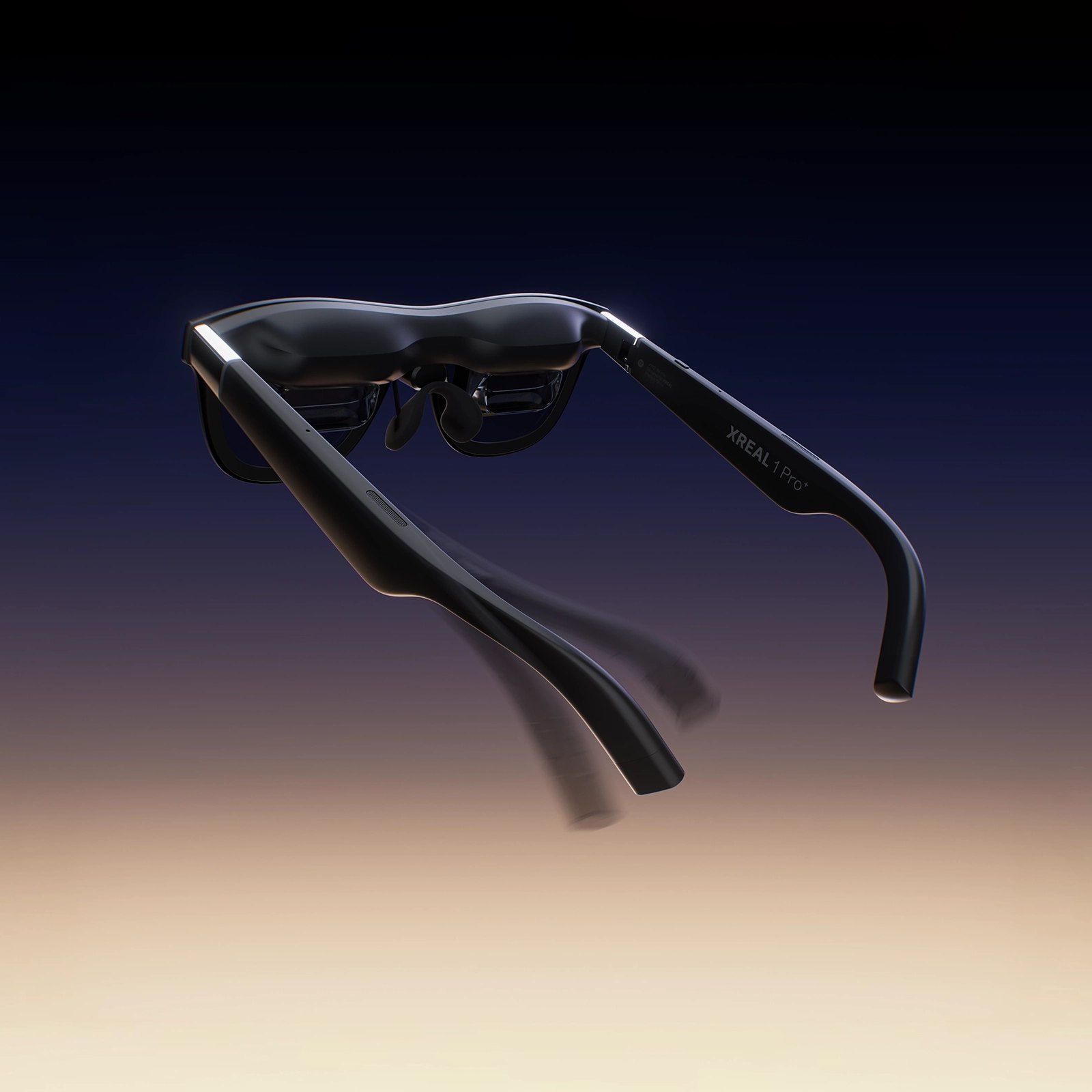
Tethered display glasses are the most PRACTICAL smart glasses for travel: plug them into a phone, laptop, Steam Deck or console and you get a large private screen. XREAL’s new 1 Pro+ launched October 15 at $599 with Sony 0.55-inch micro-OLED panels at 1920 × 1080 per eye, up to 120Hz, a 57-degree field of view, electrochromic dimming and a claimed 1,200 nits of perceived brightness, up from 700 on the One Pro, per XREAL’s product page and Road to VR. Its X1 chip pins the screen in place as you turn your head. It is still WIRED over USB-C with DisplayPort Alt Mode, and room tracking needs the separate XREAL Eye camera ($648 as a bundle). See our 1 Pro+ launch analysis for what changed from the One Pro.
Best Budget Pick: VITURE Pro 2 ($299)
The VITURE Pro 2 weighs 63 grams, claims up to 1,600 nits, offers a 50-degree field of view and has built-in diopter dials covering 0 to −5.00 per eye, so many nearsighted buyers can skip prescription inserts. Tom’s Guide gave it an Editor’s Choice. The RayNeo Air 4 Pro is the same price and claims the first HDR10 display in glasses, but its brightness and contrast figures are still COMPANY claims, as noted in our Air 4 Pro report.
Best Android XR Glasses: XREAL Aura ($1,279, Pre-Order)
Aura is the first optical see-through glasses built on Google’s Android XR, with Google Play apps, hand tracking and a 70-degree field of view. XREAL lists 1920 × 1200 micro-OLED panels per eye, 1,050 nits peak and 95-gram glasses tethered to a Snapdragon Reality Elite compute puck with a 34.84Wh battery. It costs $1,279 (12GB/256GB) or $1,499 (16GB/512GB). It is NOT broadly available yet: pre-orders opened only for reservation holders, XREAL has published NO battery runtime, and only the FIRST 2,000 Founder’s Edition pairs are certain to ship this year, according to our Aura pricing report.
Best Standalone AR: Snap SPECS ($2,195)
SPECS are the most COMPLETE AR glasses on sale: a 51-degree see-through display, positional tracking, hand, voice and button control, and no phone required if you buy the $2,395 cellular charging case. The weak points are weight (132 to 136 grams), about four hours of mixed use, and a limit of ONE app at a time, as covered in our SPECS hands-on roundup. They are for developers and early adopters, not MOST buyers.
Coming Soon: Worth Waiting For?
- Samsung’s first Android XR glasses cleared the FCC and are due in November with Gentle Monster and Warby Parker frames. They have NO display; SammyGuru reports about 41 grams, a 12MP camera and up to 9 hours of battery. No PRICE yet. See our Samsung frames report.
- Meta VR Glasses, announced at Connect with a tethered compute puck, are due in spring 2027 at about $1,300.
- Headset buyers should read our Steam Frame vs Quest 3 guide instead; glasses do NOT replace a VR headset for games.
How to Choose Smart Glasses
- Decide on the camera FIRST. It is the feature that drives most venue rules and privacy objections.
- Check prescription support and cost. Even’s lenses start at $159; VITURE uses built-in dials; others need inserts.
- Know what it pairs with. Display glasses like XREAL and VITURE need a USB-C video source. Samsung’s extra features require a recent Galaxy phone.
- Look for subscriptions. HTC’s AI tier becomes paid after two years; check each maker’s terms.
- Treat brightness and battery claims as CLAIMS until independent reviews test them.
Smart Glasses FAQ
Which smart glasses have no camera? Ray-Ban Meta Audio, Even Realities G2, and tethered display glasses such as the VITURE Pro 2 and XREAL 1 Pro+.
Which smart glasses have a display? Meta Ray-Ban Display and Even Realities G2 show information in the lens; XREAL, VITURE and RayNeo glasses show a full virtual screen; XREAL Aura and Snap SPECS place apps in the room.
Do smart glasses need a phone? Almost ALL do. Snap SPECS can work without one if you buy the cellular charging case.
The Metaverse Watcher Take
For most buyers in late 2026, the smart choice is still the SIMPLEST: audio and AI glasses from Meta’s Ray-Ban and Oakley lines, with or without a camera. Display glasses are finally useful, but they are pricier, supply-limited or still awaiting independent testing. Buy for the job you have TODAY, not the spatial computer the brochure promises.
Sources: Meta, Ray-Ban Meta Audio launch (Oct. 13, 2026); Meta Newsroom, Connect 2026 glasses; Meta Newsroom, Ray-Ban Display updates; Deutsche Telekom; Meta store, Oakley Meta Vanguard; Engadget, Even G2 review; WIRED, VIVE Eagle; Road to VR, XREAL 1 Pro+; XREAL Aura pricing release; Tom’s Guide, VITURE Pro 2 review; Geeky Gadgets, Snap SPECS hands-on; TrendForce; MIXED, Omdia data; SammyGuru.