Published October 20, 2026, the day before Meta reports. We will follow up with the actual Reality Labs numbers after the release.
Meta will release its third-quarter 2026 results after the U.S. market close on Wednesday, October 21, with a conference call at 4:30 p.m. ET (1:30 p.m. PT), according to the company’s investor relations notice. Most of Wall Street will be watching ads, AI spending and capital expenditure. For the metaverse and smart-glasses business, the number that matters is Reality Labs, the segment that makes Quest headsets and Meta’s AI glasses, and the setup going into this report is UNUSUAL: glasses are BOOMING, yet analysts expect the segment’s revenue to come in LOWER than a year ago.
What Analysts Expect
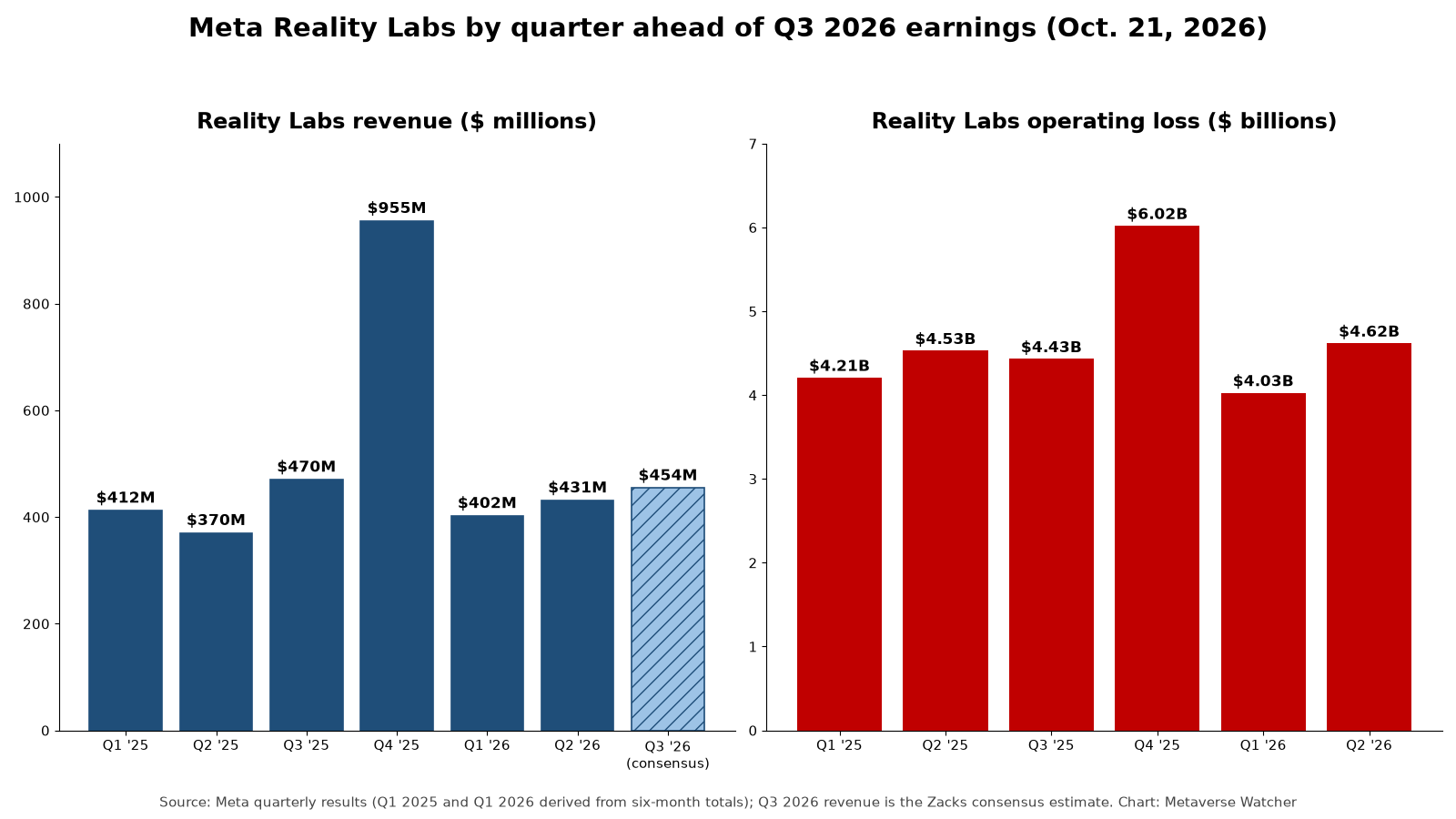
The consensus compiled by Zacks Equity Research puts Meta’s total revenue at $63.18 billion, up 23.3% year over year, and earnings at $6.67 a share. That revenue figure sits inside the $61 billion to $64 billion range Meta guided to in its second-quarter release. For Reality Labs, the same consensus calls for revenue of $454.08 million, a decline of 3.4% from the $470 million Meta reported in Q3 2025.
| Quarter | Reality Labs revenue | Reality Labs operating loss |
|---|---|---|
| Q1 2025 | $412 million | $4.21 billion |
| Q2 2025 | $370 million | $4.53 billion |
| Q3 2025 | $470 million | $4.43 billion |
| Q4 2025 | $955 million | $6.02 billion |
| Q1 2026 | $402 million | $4.03 billion |
| Q2 2026 | $431 million | $4.62 billion |
| Q3 2026 (consensus) | $454 million | No published consensus found |
Why Revenue Could Fall While Glasses Grow
The year-ago comparison is TOUGH. When Meta reported Q3 2025, it said retail partners had bought Quest headsets during the third quarter to prepare for the holiday season, and that this inventory build was recorded as revenue in Q3. It warned at the time that Reality Labs revenue would fall in Q4 2025 partly because of that pull-forward and because it was lapping the Quest 3S launch. In other words, last year’s $470 million was FLATTERED by Quest stocking.
The trend since then points the same way. In Q2 2026, Reality Labs revenue rose 16% to $431 million, which CFO Susan Li attributed on the earnings call to “strong growth in AI glasses revenue, partially offset by lower Quest headset sales.” Glasses are now CARRYING the segment, and Quest is the DRAG. Andrew Bosworth has argued that comfort, not just price, drives headset demand, after saying Quest 3 nearly matched the cheaper Quest 3S in sales, but neither headset is new this year, and Meta’s next VR device, the lightweight Meta VR Glasses, is NOT due until spring 2027.
Timing matters on the glasses side too. Meta’s fall lineup was announced at Connect on September 23, a week before the quarter closed on September 30. The camera-free Ray-Ban Meta Audio went on sale on October 13, so its sales land in Q4, NOT in this report. Also keep in mind that EssilorLuxottica reports its own smart-glasses sales, which are a separate figure from Reality Labs revenue, so strong frame sell-through does NOT translate one for one into Meta’s segment results.

The Loss Line and Meta’s Own Guidance
We could not find a published consensus for the Reality Labs operating loss, so the better yardstick is Meta’s OWN guidance. In January, Meta said it expected Reality Labs operating losses in 2026 to remain similar to 2025 levels. Reality Labs lost $19.19 billion in 2025. Through the first half of 2026 it lost $8.65 billion, slightly less than the $8.74 billion it lost in the first half of 2025. Our arithmetic: if the full-year guidance holds, the second half would carry roughly $10.5 billion of losses, and Q4 is usually the HEAVIEST quarter, as the $6.02 billion loss in Q4 2025 showed.
For context, CNBC noted in July that the division has generated more than $80 BILLION in operating losses since late 2020, and that its Q2 2026 loss of $4.62 billion was narrower than the $5.07 billion analysts had expected. Two cost items are worth watching. Meta recorded $1.18 billion of severance in Q2 tied to its May 2026 headcount reduction, which affected about 8,000 employees, and Meta has closed several first-party VR studios this year, leaving its Quest content pipeline thin. Meta has NOT said how much of either falls inside Reality Labs.
EssilorLuxottica Reports First
Meta’s eyewear partner EssilorLuxottica is scheduled to report its own third-quarter revenue on October 20, one day before Meta. Reuters reports that the company is not expected to give a precise value for smart-glasses sales, though it may give an indication. In its second-quarter update it said smart-glasses sales nearly DOUBLED year over year. Reuters also cites Omdia data showing global AI-glasses shipments rising to 8.4 MILLION units in 2025 from about 2.1 million in 2024, with EssilorLuxottica’s Meta eyewear accounting for 81.3% of global shipments in the first half of 2026.
The same Reuters piece describes a growing regulatory OVERHANG in Europe: the European Data Protection Board’s statement on recording indicators, Norway’s planned temporary ban in selected locations, and investigations by data regulators in Italy and Austria into incidents involving pupils in schools. In the Netherlands, three groups will face Meta in an Amsterdam court on November 26. A Meta spokesperson told Reuters that every pair with a camera “has a bright light on the front that flashes when you take a photo or video,” and BofA analysts quoted by Reuters judged an outright ban UNLIKELY.
A few highlights from September:
— Meta Newsroom (@MetaNewsroom) October 2, 2026
We launched Muse, the world’s first personal AI agent, announced our breakthrough VR glasses at Connect, and introduced Meta One subscriptions for businesses, creators, and individuals who want to get more done on our apps.
Five Things to Listen For on the Call
- A glasses number. Meta has called its glasses “one of the fastest-growing consumer electronics of all time” WITHOUT giving unit sales or revenue for the category. Any hard figure would be NEW.
- Quest demand. Whether Meta again blames lower headset sales, and what it says about holiday sell-in after last year’s early stocking.
- The 2026 loss guide. Whether “similar to 2025 levels” still STANDS, and any first word on 2027 Reality Labs spending as Meta VR Glasses approach launch.
- AI on the face. How Meta ties Muse and its Meta Superintelligence Labs models to glasses, which Mark Zuckerberg called “the ideal form factor” for AI in July.
- Regulation. Whether management addresses the European privacy cases as a business risk, or leaves them out of the call.
What It Means
A small Reality Labs revenue decline on Wednesday would NOT, by itself, contradict the glasses boom. It would mostly reflect a Quest-inflated comparison and a lineup that reached stores AFTER the quarter closed. The more TELLING signals are whether Meta finally puts a number on glasses, whether the full-year loss guide holds near $19 billion, and how much of next year’s budget goes to the VR glasses versus AI eyewear. For a buyer’s view of the products behind these numbers, see our guide to the best smart glasses of 2026, and for the wider market, TrendForce’s 2026 AR glasses forecast.
Sources: Meta Q3 2026 date announcement; Meta Q2 2026 results; Meta Q4 and full-year 2025 results; Meta Q3 2025 results; Q2 2026 call transcript; Zacks via Yahoo Finance; CNBC; Reuters via CNA.