Europe’s data protection regulators have put SMART-GLASSES makers on NOTICE. In Statement 1/2026, adopted at its 13 October plenary, the European Data Protection Board says the companies that BUILD the glasses and RUN the AI behind them are often CONTROLLERS under the GDPR in their OWN right, and that they “should not rely on the users’ actions” to meet their obligations to the people being filmed. The EIGHT-PAGE text is PRELIMINARY and NON-BINDING, but it is the CLEAREST signal yet of how EU regulators will read camera glasses.

Who Is Responsible
The Board splits RESPONSIBILITY three ways. A wearer who shares a clip with family, or uses live TRANSLATION in a private setting, falls under the GDPR’s HOUSEHOLD exemption. That exemption must be read NARROWLY, though: post the same video to a PUBLIC social account, or wear the glasses for professional or political work, and the wearer becomes a controller with FULL TRANSPARENCY duties.
The more CONSEQUENTIAL paragraphs target INDUSTRY. The statement says the GDPR STILL applies to the PRODUCER of the device and to the provider of any linked app or AI service, even when the wearer is EXEMPT. It gives a POINTED example: an AI assistant that ANALYSES a camera frame “in which other persons appear” to answer a question about the wearer’s surroundings. In that case the AI provider may be an independent or JOINT controller, and any reuse of that data for a new purpose has to pass a COMPATIBILITY test.
The LED Is Not Enough
On transparency the Board is BLUNT. It writes that the “current state of the art” in indicators leaves many non-users UNAWARE their data is being processed, and that ordinary privacy NOTICES cannot reach BYSTANDERS who have no relationship with the manufacturer. Its answer is a COMBINATION of signals that are ON by default and “impossible or difficult to disable.”
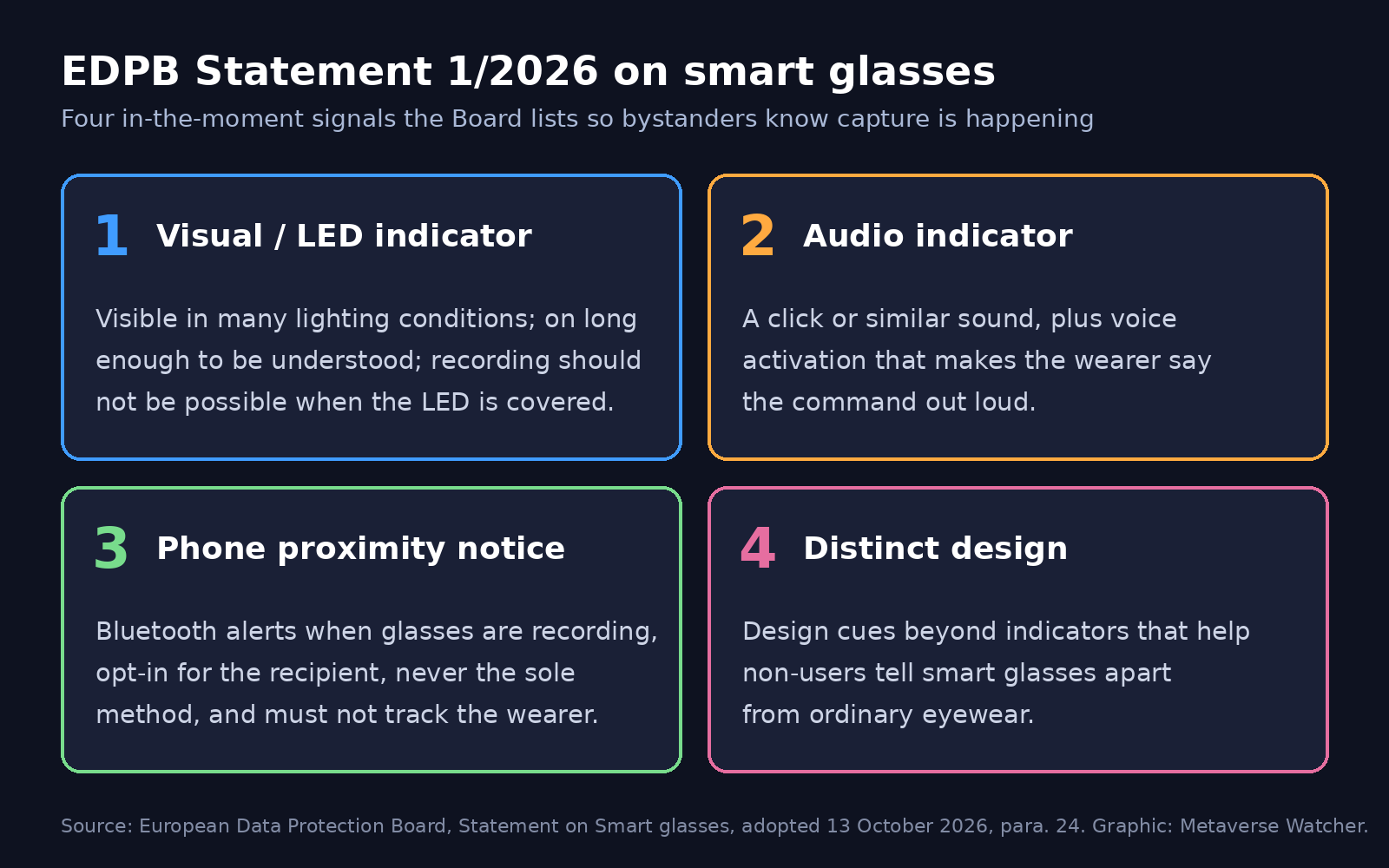
- LED indicators should be VISIBLE in many lighting conditions, stay on LONG enough to be understood, and recording should not be possible when the light is COVERED. A footnote adds that a white LED can be mistaken for GLARE, and that visually impaired people may not SEE it at all.
- Audio cues such as a shutter CLICK, plus voice activation that makes the wearer say the command OUT LOUD.
- Phone proximity alerts built on the Bluetooth identifiers that DETECTOR apps already read. The Board suggests makers broadcast a SPECIFIC signal while recording, but says such alerts must be OPT-IN, must NEVER be the only safeguard, and must not enable TRACKING of the wearer.
- Distinct design cues that help people tell smart glasses from ordinary EYEWEAR.
EDPB Chair Anu Talus put it PLAINLY in the press release: “Smart glasses should make their recording obvious,” and the warnings must be “reliable, hard to ignore, and always up to date.”
Consent, AI Training and Defaults
The legal-basis section NARROWS the options for MANUFACTURERS. Getting valid CONSENT from strangers in the frame would be “difficult,” the Board says, and consent gathered after a recording is NOT valid at all. Legitimate interest would need a careful CASE-BY-CASE test, and would be “particularly difficult to demonstrate” for COMMERCIAL reuse or AI TRAINING that bystanders would not expect. Even where it holds, EVERY data subject must be able to OBJECT.
The recommended DEFAULTS go further. Glasses built mainly for real-time assistance should have PERSISTENT storage of captured audio, images and video DISABLED by default. Processing should happen ON-DEVICE where possible, with options to BLUR bystanders, GEOFENCE sensitive places, and add “privacy frictions” that slow sharing to social platforms. The Board also flags that the ePrivacy rules may ALSO apply, treating the glasses as terminal equipment, and singles out CHILDREN as ESPECIALLY exposed.


Why It Lands This Week
The TIMING matters for product ROADMAPS. On 16 October, Android Authority reported strings in the Google app pointing to a “Hey Gemini” HOTWORD for Android XR glasses, and to Gemini turning the CAMERA on BY ITSELF to answer questions such as “What plant am I looking at?” The strings suggest users will be able to switch that AUTOMATIC camera activation off. That is EXACTLY the scenario the EDPB uses to explain when an AI provider becomes a controller, so ANY EU launch of such a feature will be read against this text.
The Board also published a COMPANION report, “The connected gaze,” commissioned at the French DPA’s suggestion and written by a digital SOCIOLOGIST. It found glasses sometimes becoming tools of INTERPERSONAL surveillance and EVIDENCE gathering, creating POWER imbalances between wearers and the people they record. The EDPB notes that report is the contractor’s view, NOT its own position.
What It Does Not Do
The statement names NO company and NO product, sets NO deadline, and imposes NO fines. It does NOT rule on whether any glasses now ON SALE meet the bar it describes. It calls for industry-wide STANDARDS and awareness campaigns, and says the Board will KEEP working on smart glasses alongside other video devices such as dash cams and doorbells. For makers planning EU launches, the PRACTICAL message is that a small capture LED is now the MINIMUM the regulators expect, and that they will judge the DESIGN, not the wearer’s MANNERS.
Sources: EDPB Statement on Smart glasses (PDF); EDPB press release; Android Authority; EDPB on X.