EssilorLuxottica, the company that makes Ray-Ban Meta and Oakley Meta glasses, disclosed a hard number for its smart glasses business for the FIRST time on October 20, 2026. Its wearables line, which covers Meta’s AI glasses and the company’s own Nuance Audio hearing glasses, brought in €486 MILLION in the third quarter. That is up 20% at constant exchange rates, a sharp SLOWDOWN from the nearly 100% growth the company reported for the second quarter.
The group as a whole BEAT expectations. Revenue rose 7.2% at constant currency (9.0% reported) to €7,486 million, ahead of the roughly €7.36 billion Visible Alpha consensus cited by Reuters. For anyone tracking whether consumer smart glasses are a real category, though, the wearables line is the figure that matters, and the company’s revenue release now publishes it quarter by quarter going back to 2024.
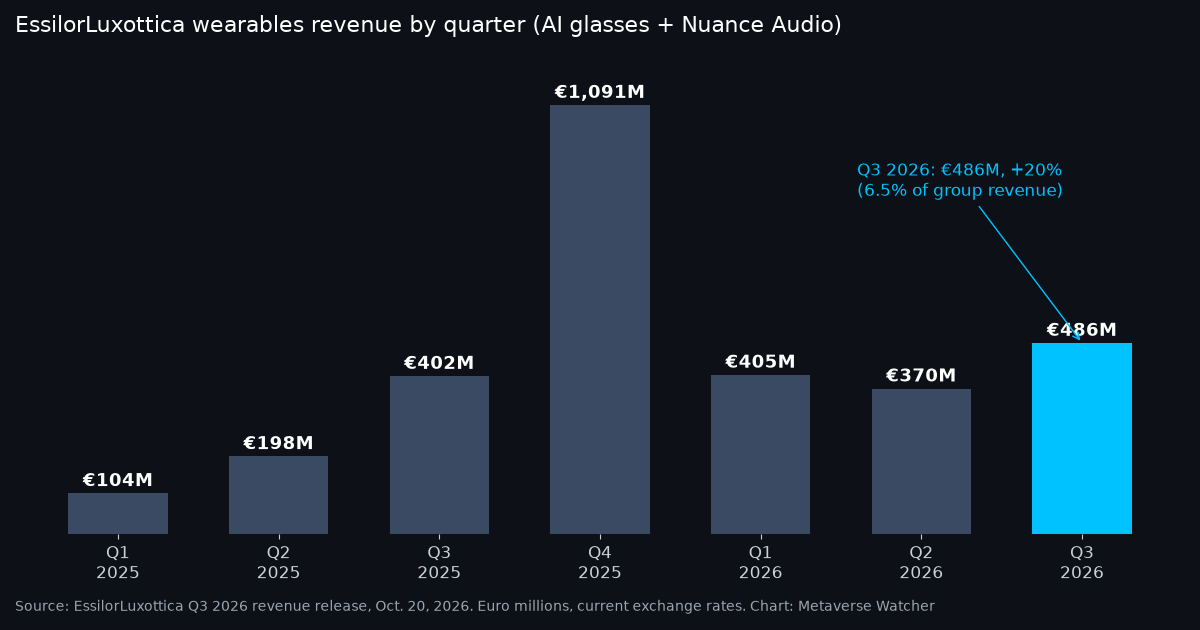
The numbers, quarter by quarter
The new table in the release shows how lumpy this business is. All figures are in euro millions at current exchange rates.
| Quarter | Wearables revenue | Same quarter a year earlier |
|---|---|---|
| Q1 2026 | €405M | €104M |
| Q2 2026 | €370M | €198M |
| Q3 2026 | €486M | €402M |
| First nine months of 2026 | €1,261M | €704M |
| Full year 2025 | €1,796M (including €1,091M in Q4 2025 alone) | |
Three things stand out. First, the third quarter was the STRONGEST quarter of 2026 so far, up about 31% from the second quarter, so this is NOT a business that is shrinking. Second, the year-on-year growth rate fell because the comparison got harder: the third quarter of 2025 was when sales first took off, and the company said as much, describing an “increasingly challenging comparison base.” Third, the fourth quarter of 2025 produced €1.09 BILLION on its own, more than the first two quarters of 2026 combined. The HOLIDAY QUARTER now carries this category, which raises the bar for the quarter that has just begun.
Even after the jump, wearables are ONLY about 6.5% of group revenue. The traditional business, which EssilorLuxottica calls Eyecare and Medtech, grew 6.5% at constant currency to €7,000 million in the quarter.
Where the growth came from, and where it did not
The regional notes are more revealing than the headline. In North America, the largest market for Ray-Ban Meta, wearables grew at a high-single-digit rate in the wholesale channel, and Sunglass Hut credited AI glasses with an extra lift to its comparable-store sales. In Europe, wearables DECLINED year on year in the wholesale business, and the release singles out the United Kingdom, an early launch market, for its tough comparison.
The newer markets did the opposite. The company said AI glasses added to growth in India, Brazil, Mexico and Colombia, and that the sun business in Asia-Pacific was “sustained by the continued ramp-up of AI glasses.” Latin American distribution now covers Mexico, Brazil, Peru, Colombia and Chile. That fits Meta’s recent pace of country launches, including the Thailand rollout of Ray-Ban and Oakley lines on the same day as this report. The pattern is clear enough: early markets are maturing, and growth is coming from NEW GEOGRAPHIES.
NEW: EssilorLuxottica reports third-quarter revenue of EUR7.49 billion, topping the EUR7.37 billion analysts expected, with growth of 7.2% excluding currency effects.
— Supertake (@Supertake) October 20, 2026
Constant-currency growth beat the 6.3% forecast, a sign demand for eyewear and smart glasses held up.
The regulatory overhang
Investors came into the report worried about more than growth rates. Reuters noted ahead of the release that camera glasses face tougher scrutiny in Europe, and that EssilorLuxottica shares have roughly HALVED over the past year amid concerns about competition, privacy and governance. The pressure is concrete. The EU’s data protection board recently told smart glasses makers they cannot hand GDPR duties to wearers, and three Dutch groups are taking Meta’s camera glasses to an Amsterdam court on November 26.
The product line is already adjusting. Meta’s CAMERA-FREE Ray-Ban Meta Audio went on sale on October 13, too late to show up meaningfully in these numbers, and the company’s management pointed to “new AI glasses launches” heading into the holiday season.
What it means for Meta and the market
EssilorLuxottica DOMINATES this category. Reuters, citing research firm Omdia, reported that AI glasses shipments rose to 8.4 million units in 2025 from about 2.1 million in 2024, and that EssilorLuxottica’s Meta eyewear accounted for 81.3% of global shipments in the first half of 2026. That makes the company’s wearables line the clearest public read on demand for camera-and-AI glasses. Other trackers measure different things; TrendForce’s forecast, for example, covers AR glasses with displays, where Meta’s share is far smaller.
The next data point comes quickly. Meta reports its own third-quarter results on OCTOBER 21 after the market closes, and Reality Labs will show the cost side of this business. Our preview of what to watch in Reality Labs covers the key lines. A 20% gain is still growth, and the third quarter beat the second. The REAL TEST is whether the fourth quarter can match the €1.09 billion holiday quarter of 2025.
If you are weighing a pair yourself, our guide to the best smart glasses of 2026 compares the current Meta, XREAL and Even Realities lineups.
Sources: EssilorLuxottica Q3 2026 revenue release (October 20, 2026); Reuters via Global Banking & Finance Review and Investing.com. Year-on-year growth rates are the company’s constant-currency figures; quarterly comparisons in the table use reported euros.