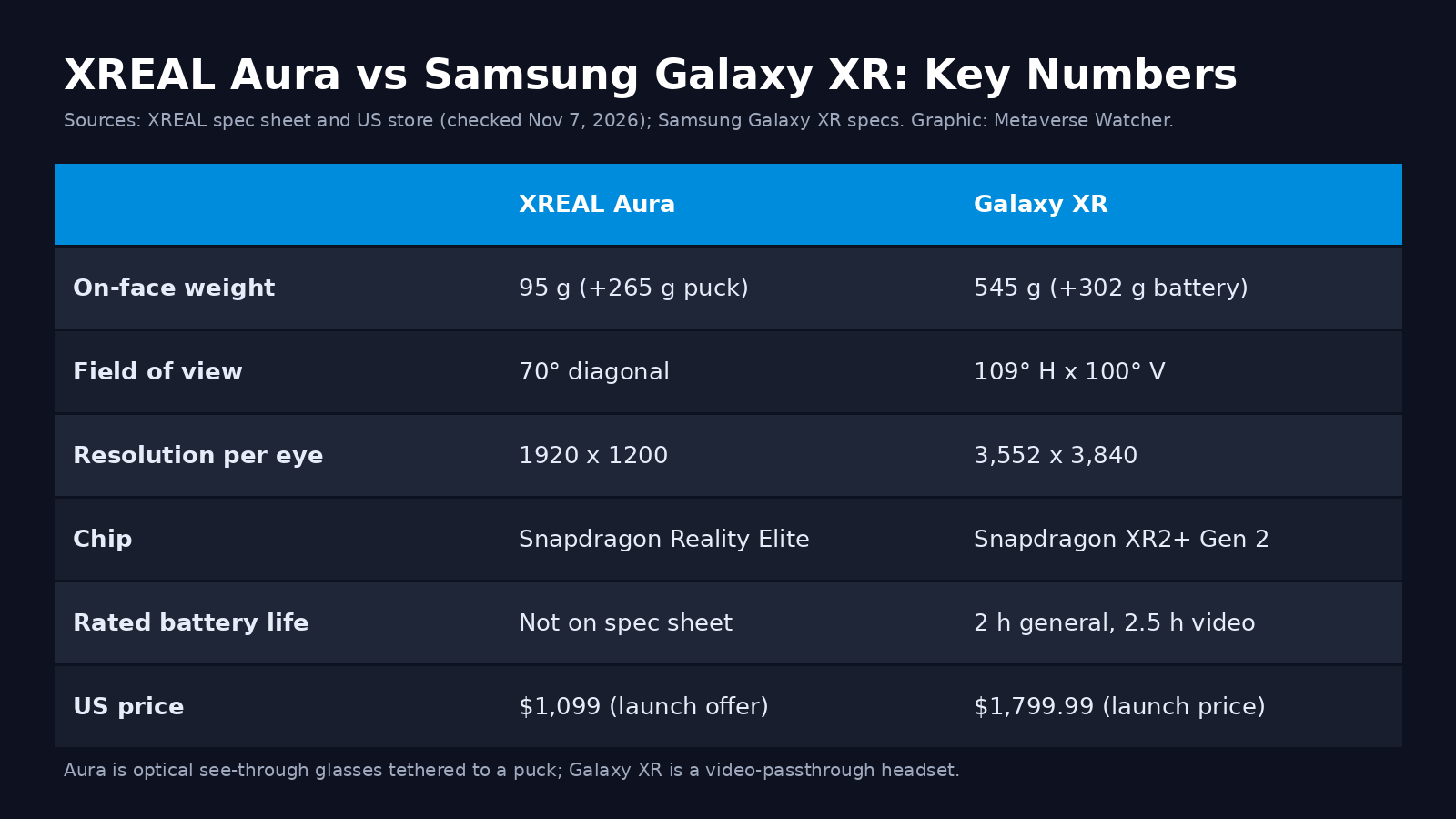
XREAL Aura and Samsung Galaxy XR are the two Android XR devices most buyers will compare this holiday season, but they solve different problems. The Aura is a pair of 95-gram optical see-through glasses tethered to a pocket compute puck, while Galaxy XR is a full video-passthrough headset built for immersive apps, eye-tracked input and long-form video. This comparison uses the published specifications from XREAL and Samsung to show where each one wins and who should buy which.
The Short Answer
Choose the XREAL Aura if you want a large private screen for movies, games and laptop work that you can wear for long sessions and carry in a bag, and you are comfortable with a 70-degree field of view. Choose the Galaxy XR if you want true spatial computing: a far wider view, eye and hand tracking, immersive apps and the sharpest displays in the Android XR lineup, and you accept a heavier device with a rated battery life of about two hours.
Specs Side by Side
| Specification | XREAL Aura | Samsung Galaxy XR |
|---|---|---|
| Form factor | Optical see-through glasses plus compute puck | Video-passthrough headset plus tethered battery |
| Weight | 95 g glasses; 265 g puck | 545 g headset; 302 g battery pack |
| Display | Sony micro-OLED, 1920 x 1200 per eye, up to 120 Hz, 1,050 nits | Micro-OLED, 3,552 x 3,840 per eye (about 27 million pixels total), 95% DCI-P3 |
| Field of view | 70° diagonal | 109° horizontal, 100° vertical |
| Processor | Snapdragon Reality Elite (48 TOPS) in the puck; X1S coprocessor in the glasses | Snapdragon XR2+ Gen 2 |
| Memory and storage | 12GB/256GB or 16GB/512GB | 16GB/256GB |
| Tracking and sensors | 2 tracking cameras, RGB camera with privacy LED | 2 passthrough cameras, 6 tracking cameras, 4 eye-tracking cameras, depth sensor, iris unlock |
| Battery | 4,455 mAh (34.84 Wh) in the puck; no runtime rating published | Up to 2 hours general use, 2.5 hours video |
| Connectivity | Wi-Fi 6/6E, Bluetooth 5.3, DisplayPort Alt Mode input | Wi-Fi 7, Bluetooth 5.4 |
| Fit and vision | M (60–66 mm) and L (66–72 mm) IPD fits | Automatic IPD, 54–70 mm; optical inserts sold separately |
| US price | $1,279 / $1,499 list; $1,099 / $1,299 launch offer through December 2026 | $1,799.99 launch price |
Sources: XREAL Aura product page, XREAL Aura specifications, Samsung Galaxy XR announcement and the Samsung US store listing. For the full Aura breakdown, see our XREAL Aura spec sheet analysis.
Comfort and Portability
Weight is the clearest split. The Aura glasses weigh 95 grams on the face, with the 265-gram puck in a pocket or on a desk. Galaxy XR puts 545 grams on the head and adds a 302-gram battery pack on a cable. It remains a headset you wear for a session, not glasses you leave on while moving around a train or an office.
For travel, the Aura has the edge: the glasses are far smaller to pack, and its DisplayPort Alt Mode input also lets it act as a wired display for a laptop, phone or handheld. Our guide to connecting XR glasses to an iPhone, Switch or Steam Deck covers that setup.
Display and Field of View
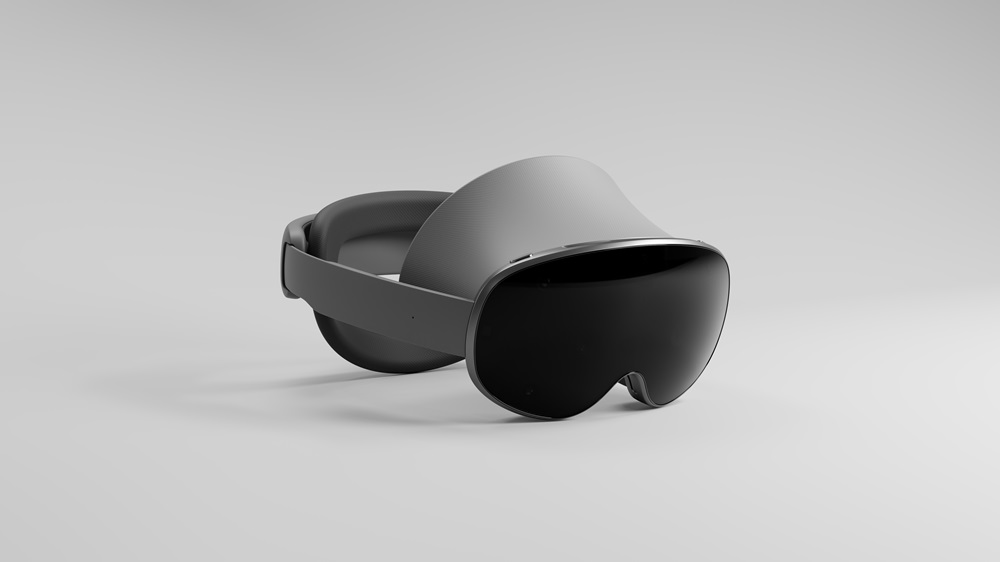
Galaxy XR is the stronger visual device on paper. Its micro-OLED panels run 3,552 x 3,840 per eye, and its 109-by-100-degree field of view fills most of your vision. That matters for immersive video, 3D apps and anything that places multiple large windows around you.
The Aura’s 70-degree diagonal field of view is wide for display glasses, and its 1,050-nit Sony micro-OLED panels at up to 120 Hz should hold up well in bright rooms. XREAL rates sharpness at 32 pixels per degree. Electrochromic dimming with five levels lets you shift from a see-through overlay to a darker, screen-like view. Still, the virtual image sits in a window in front of you rather than surrounding you, so it is best understood as a portable big screen with spatial features, not a full immersive headset.
Apps, Input and Android XR
Both devices run Android XR, Google’s platform for headsets and glasses, with Gemini and Android apps from Google Play. Our explainer What Is Android XR? covers the platform in detail.
The input model differs. Galaxy XR uses four eye-tracking cameras and six tracking cameras, so you can look at an element and pinch to select it, the same style of input Apple uses on Vision Pro. The Aura relies on two tracking cameras plus the puck, so expect more of its use to center on media, mirrored screens and lighter spatial apps. If you are weighing Samsung against Apple instead, read our Galaxy XR vs Apple Vision Pro buying guide.
Battery Life
Samsung rates Galaxy XR at up to two hours of general use and two and a half hours of video playback. Tom’s Guide’s review lists the always-attached battery among its drawbacks, alongside some software bugs and eye and hand tracking that it found less seamless than Vision Pro. XREAL lists a 4,455 mAh (34.84 Wh) battery in the Aura puck but, as of November 7, 2026, does not publish a runtime figure. Until independent reviews measure it, buyers should treat Aura battery life as unconfirmed.
Price and Availability
The Aura costs $1,279 for 12GB/256GB and $1,499 for 16GB/512GB, with XREAL’s launch offer of $1,099 and $1,299 running through December 2026. Orders opened on October 28 in the US, Canada, South Korea and Japan, with shipping slated for mid-November and a wider rollout planned for 2027. Galaxy XR launched in the US and Korea in October 2025 at $1,799.99 for 16GB/256GB; check Samsung’s store for any current offers. Even at list price, the Aura costs $300 to $520 less than Galaxy XR.
Which Should You Buy?
- Buy XREAL Aura for travel, long movie sessions, using a laptop or handheld on a large virtual screen, and all-day comfort.
- Buy Galaxy XR for immersive apps, eye-tracked spatial computing, the widest view and the highest-resolution displays on Android XR.
- Wait if you want lighter Android XR glasses for notifications and Gemini rather than a big screen. Our upcoming smart glasses tracker and best smart glasses of 2026 list cover those options.
We will update this comparison once independent reviews publish measured Aura battery life and real-world performance from the first retail units.