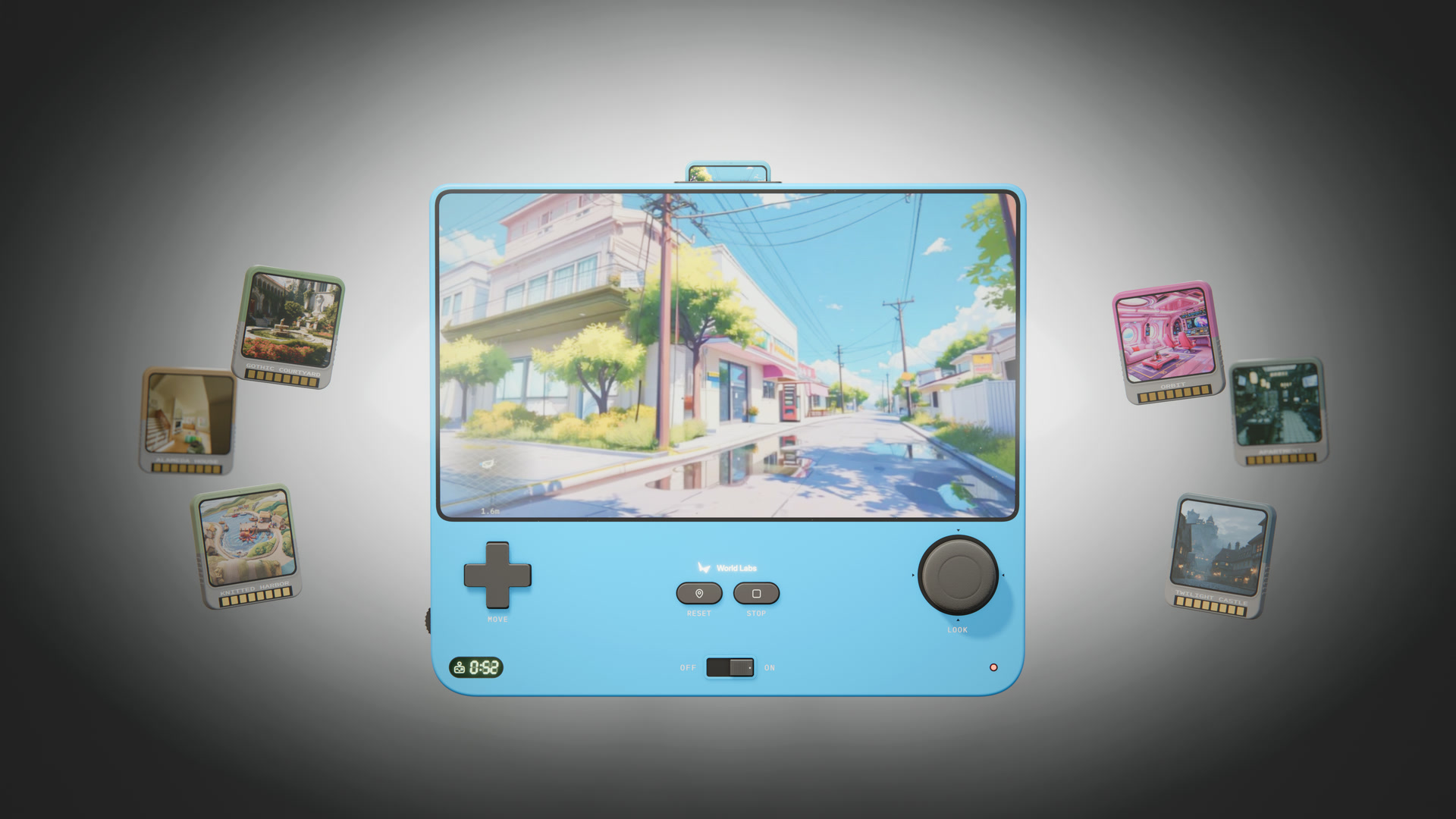
World Labs Frameboy turns the company’s Atlas world model into a live camera session. In a research preview published November 5, 2026, World Labs said Frameboy streams frames from cloud GPUs to a browser at up to 15 FPS while the user steers the viewpoint. The public demo is at frameboy.worldlabs.ai. UploadVR and Road to VR had not covered the release as of the evening of November 6, 2026.
That matters for anyone tracking generative 3D as a path into spatial computing. Atlas already showed that a sparse photo set—or even a single image—can seed an explorable scene. Frameboy’s claim is narrower and sharper: once latency drops far enough, “generation” stops feeling like a separate render job and starts feeling like movement through a world. We covered Atlas when it launched in World Labs Atlas turns sparse photos into 3D worlds, and the AMD deal context in AMD to acquire World Labs for $8.2 billion.
What Frameboy Actually Ships
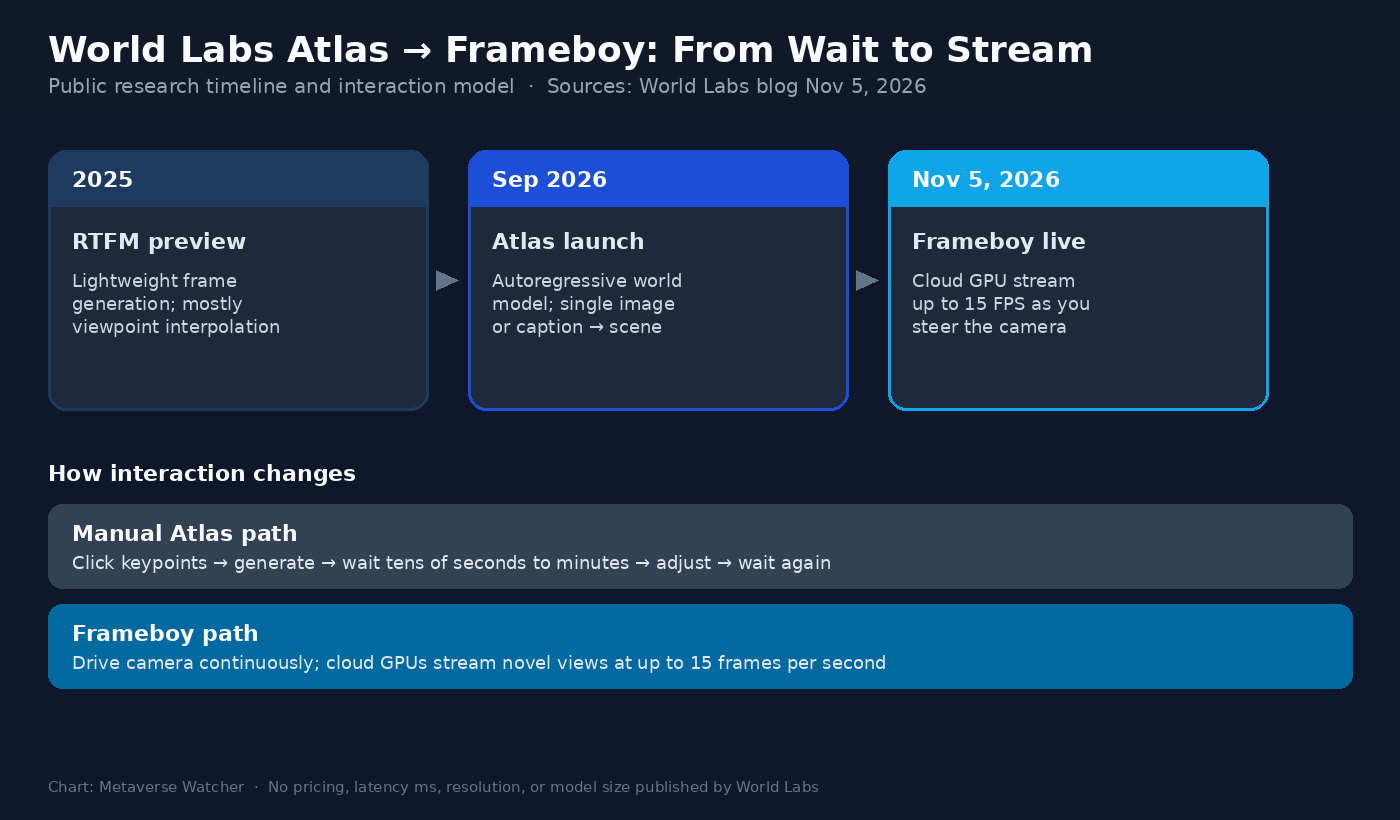
Frameboy is not a headset runtime and not a local renderer. It is a browser client that receives a continuous stream of Atlas-generated views. World Labs describes Atlas as an autoregressive world model that produces frames one at a time with what it calls pixel-perfect camera control. Until Frameboy, that pipeline was closer to offline video: pick a path, wait, review, adjust. The new preview serves a speed-optimized Atlas variant chosen for the fastest inference World Labs says it can run without giving up novel-view quality.
The company published two scene-construction paths for the curated demo set:
- Single-image seeds. Atlas expands one starting photograph into additional viewpoints that fill out a spatial context, then Frameboy lets a user navigate that reconstructed volume.
- Multiview real places. A small set of photos of a landmark or location becomes the context for novel views between and beyond those captures.
Both paths keep the same interaction loop: you move a virtual camera; the cloud returns the next frames. World Labs also wired the stream into Viewfinder, its closed-beta web app for building scenes frame by frame. In Viewfinder, each generated frame includes color and depth. When a scene is ready, a Frameboy overlay can stream live exploration of that custom world. Public Frameboy access remains limited to curated scenes; custom builds still require Viewfinder waitlist access.
Why 15 FPS Is the Headline Number
Fifteen frames per second is not headset-native VR. It is also not the point World Labs is selling. The blog argument is about iteration cost. If each Atlas result takes tens of seconds or minutes, users plan carefully and try fewer ideas. If the view updates as the camera moves, a weak camera path or thin scene idea fails immediately and can be replaced. World Labs puts it this way: when the cost of a bad idea is near zero, there are no bad ideas—only exploration.
That framing lines up with how XR teams already work when a headset is in the loop. Level layouts, film previz, construction walkthroughs, and robot navigation sims all punish long wait times between “move the camera” and “see the result.” Frameboy’s listed use cases match that list: scouting virtual viewpoints for a shoot, roughing a game level, inspecting a site, or simulating an environment a robot might traverse. None of those require 90 Hz today; they require a feedback loop short enough to think with.
| Mode | Input | Output feel | Access Nov 6, 2026 |
|---|---|---|---|
| Manual Atlas generation | Image, caption, or multiview set | Generate, wait, review | Atlas / Viewfinder tooling |
| Frameboy curated demo | Prebuilt scene contexts | Live camera stream up to 15 FPS | Public research preview |
| Viewfinder + Frameboy overlay | User-built scene frames | Build offline, then stream live | Closed beta + waitlist |
Where This Fits the XR Stack
Frameboy sits upstream of headsets. It does not replace Quest, Steam Frame, Vision Pro, or Android XR glasses as a display. It competes with the slow part of content creation: getting a coherent 3D place to exist before you commit art, meshes, or capture volume. For a plain-language map of that wider market, see our what is the metaverse guide for 2026. For device context on where generated scenes might eventually land, the best VR headsets of 2026 roundup remains the buyer-facing companion.
There is also a corporate timeline. On September 28, 2026, AMD agreed to acquire World Labs in an all-stock transaction valued at about $8.2 BILLION, according to AMD’s newsroom announcement. The deal was still described as pending regulatory close toward year-end 2026 in contemporaneous coverage. A real-time Atlas path is exactly the kind of product signal acquirers care about: not only “can the model invent a scene,” but “can users stay inside it.”
World Labs positions Frameboy as a remake of last year’s RTFM research preview, scaled up. RTFM was mainly built to interpolate among known viewpoints. Atlas, World Labs says, is a larger model trained on far more data and can build a scene from a single image or a short caption while still supporting multiview novel-view synthesis. Frameboy is the interactive skin on that larger model, not a separate world generator.
Limits World Labs Admits—and Gaps It Leaves
The company is explicit that Frameboy must run on a powerful cloud GPU server and is not cheap compared with local rendering. It did not publish a price, a resolution target, a latency budget in milliseconds, or a model-size figure. The only performance number in the announcement is the 15 FPS ceiling. Independent write-ups after the post noted the same omissions; treat secondary latency claims that do not appear in the World Labs blog as unverified.
- Public exploration is limited to curated scenes.
- Custom scene building still sits behind Viewfinder’s closed beta.
- Cloud cost and availability will gate any serious production workflow.
- Fifteen FPS is interactive for scouting, not a substitute for headset compositor rates.
Those limits are why Frameboy reads as a research milestone rather than a consumer XR launch. The useful test over the next few weeks is whether the curated demo stays up, whether Viewfinder invites expand, and whether World Labs publishes any cost or latency numbers once AMD’s close window approaches. Until then, the verifiable story is simple: Atlas can now be driven like a live camera in a browser, at up to 15 frames per second, on World Labs’ cloud.