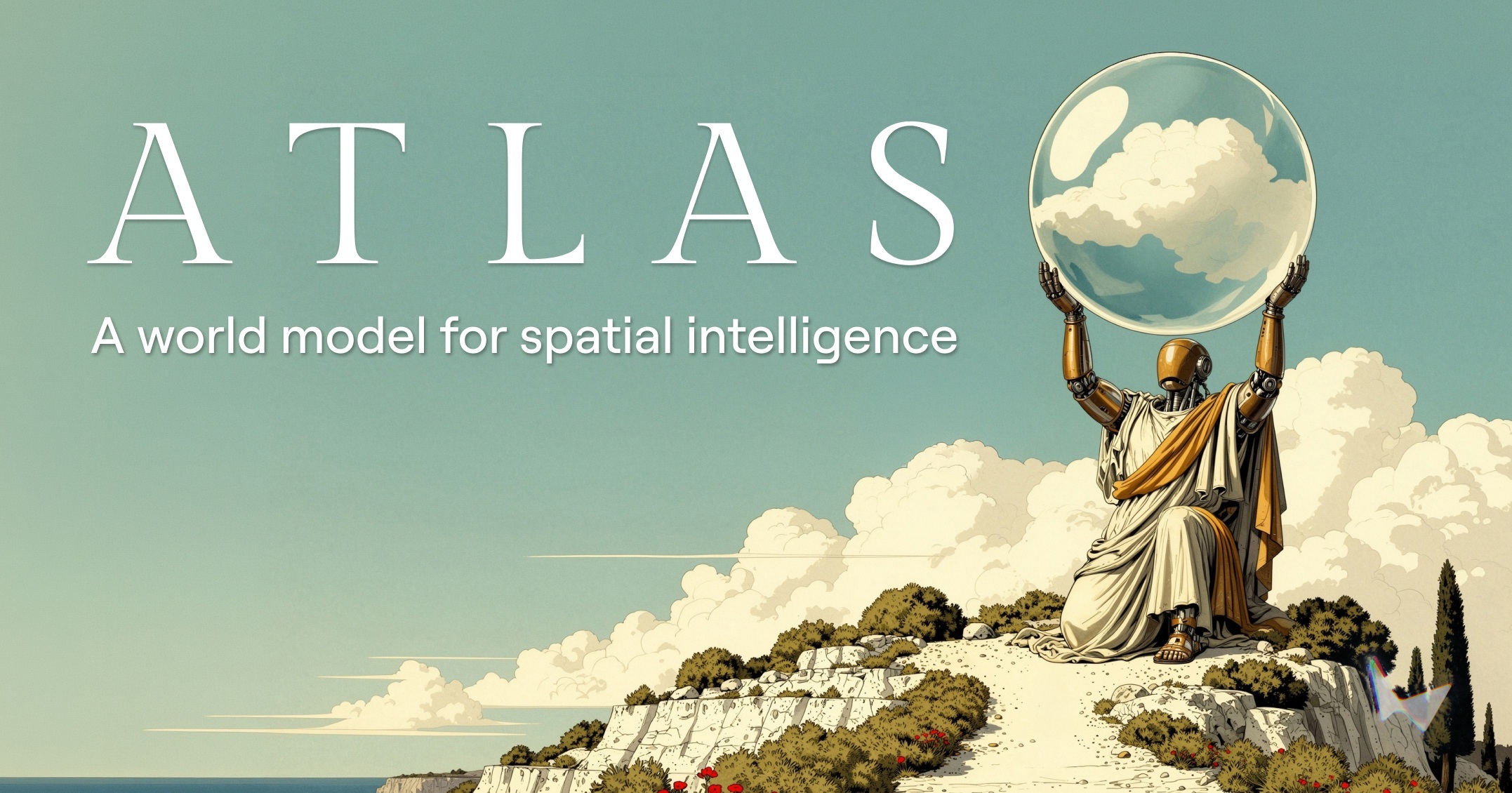
World Labs, the spatial-intelligence startup co-founded by Fei-Fei Li, on September 1, 2026 introduced Atlas — an “omni” world model pretrained to work natively on text, images, video, and 3D. In the company’s official announcement, Atlas is framed as the next step after Marble: one base model for generating, reconstructing, and simulating worlds with camera geometry treated as a first-class input, not a text prompt afterthought.
That pitch sits squarely on the metaverse and XR toolchain problem: how do you turn a handful of photos or phone clips into a coherent, explorable 3D space that stays consistent when the camera moves? Atlas’s answer is a multimodal autoregressive diffusion transformer that packs every input into a shared spatial context, then generates the next view, depth map, or splat while staying geometrically locked to what it has already seen.
What Atlas claims it can do
Per World Labs’ September 1 blog post, Atlas’s headline capabilities include:
- Camera-controlled generation — new views from one to six reference images with pixel-precise camera paths, up to about one minute of 1440p video
- Sparse reconstruction — rebuilds of real places from one to dozens of images (and, World Labs says, over a hundred when needed), with novel views plus explicit 3D as point clouds or Gaussian splats
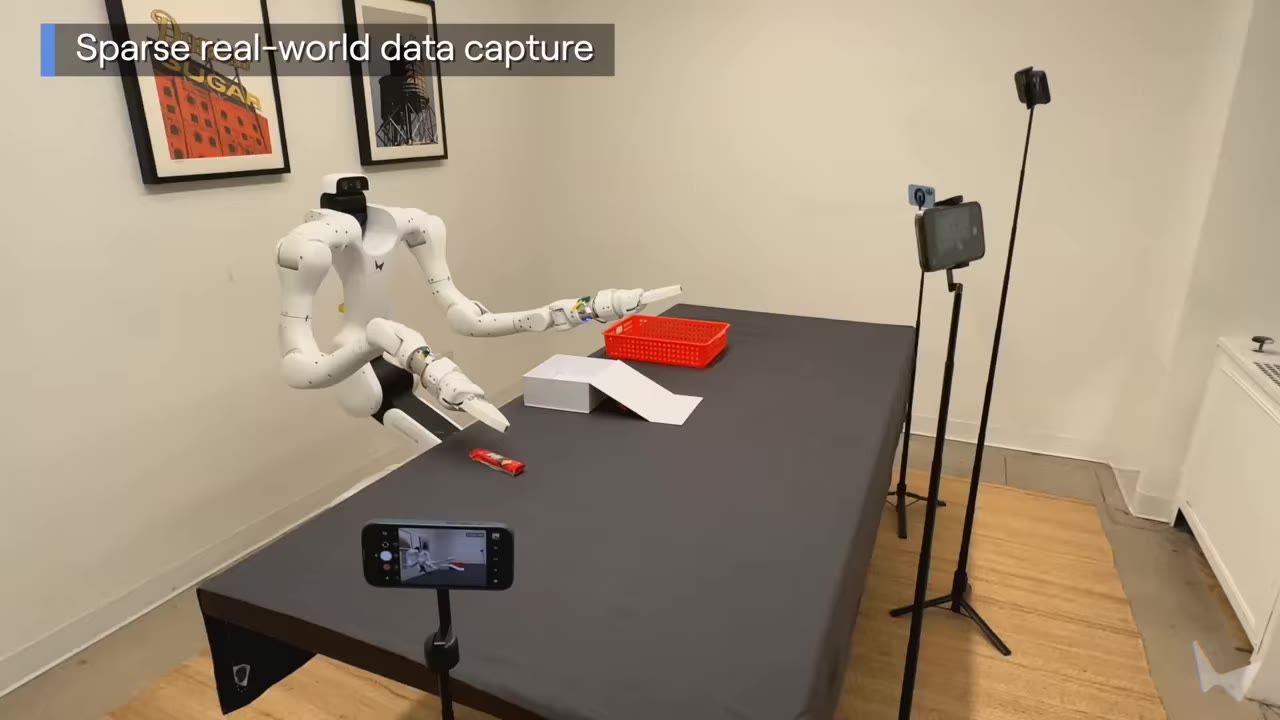
- Space-time simulation — “bullet time” reframing from a few ordinary cameras, plus Real-to-Sim paths for robotics navigation and manipulation
- Image / 360 generation — stills and panoramas from text, positioned as secondary to the world-modeling work
THE DECODER and SiliconANGLE both underline the same architectural claim: camera trajectories are ingested as geometry, not cinematic adjectives in a prompt. That is the practical difference from typical video generators when you care about a locked path through a room, a campus quad, or a VFX beat.
Why XR and metaverse teams should care
Gaussian splat and mesh pipelines already sit under a lot of spatial-app work. Atlas outputs the same splat-style representation World Labs uses in Marble, which means the new model is meant to feed that product line rather than sit as a one-off research demo. For creators, the near-term story is controllable long takes and sparse capture. For robotics and simulation teams, it is Real-to-Sim from casual smartphone footage — reconstruct a space, then synthesize the RGB and depth a robot would see along a path.
World Labs also publishes internal benchmark comparisons on camera-path following (human preference against several video models) and sparse 3D reconstruction error against specialist open-source stacks. Those numbers come from the company; independent third-party audits are not part of the launch package, so treat them as vendor evaluation until outsiders reproduce them.
Availability and caveats
Atlas is entering early access with select partners. World Labs has not announced public pricing, a general release date, or a self-serve API for Atlas itself. Existing Marble API docs still point developers at Marble models such as marble-1.1; Atlas access is a separate request flow on the company site.
Context that matters for the beat: World Labs launched in 2024 around Li’s “spatial intelligence” thesis, shipped Marble as a commercial world-building product, and earlier in 2026 closed a large funding round with backers including Nvidia, AMD, Autodesk, and Andreessen Horowitz (coverage varies on exact totals; SiliconANGLE cites roughly $1.2 billion cumulative). Atlas is the research-and-product bet that those dollars were aiming at — one model that tries to unify generation, capture, and simulation instead of stitching three specialist tools.
For metaverse and XR readers, the useful takeaway is narrower than the launch copy: if Atlas’s early-access partners can turn sparse phone capture into stable, exportable splat worlds at production quality, the cost of building persistent spatial scenes drops. Until general availability, that remains a partner-demo story — but it is one of the clearest “world model meets spatial computing” drops of the week.
Sources: World Labs Atlas announcement; THE DECODER; SiliconANGLE; Spatial Insider.