Lockheed Martin Canada is putting C$11.7 MILLION behind a DISPLAY that asks NOBODY to wear anything. The commitment to Avalon Holographics, a light-field display maker in St. John’s, Newfoundland and Labrador, was announced by Lockheed on September 9, 2026, and has been picked up by XR trade press, including Auganix on October 12. The HEADLINE number is real. It is ALSO SMALLER and more CONDITIONAL than it looks: only C$5.6 million of it is NEW, the MONEY counts toward Lockheed’s Canadian OFFSET obligations, and the cheaper FLAT-PANEL product it is meant to advance still has NO public DATE.
What the C$11.7 Million Actually Is
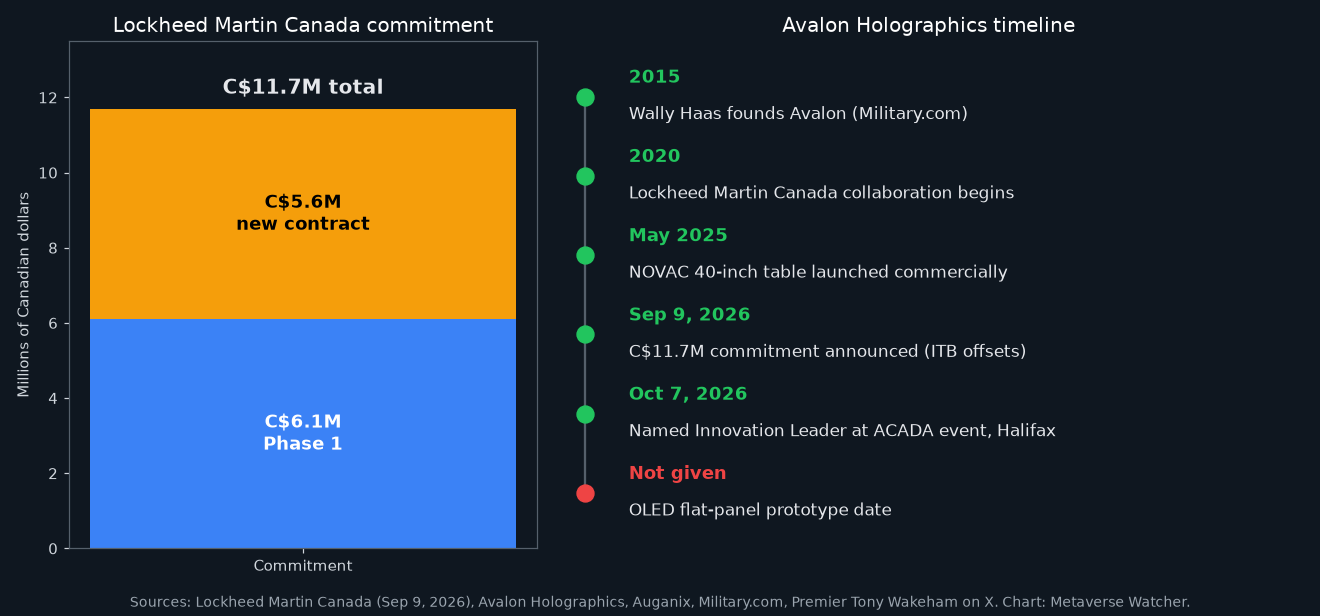
Lockheed’s RELEASE is SPECIFIC about the SPLIT. The commitment “includes a NEW $5.6M CAD contract, following an initial $6.1M CAD Phase 1 investment.” The two companies have WORKED TOGETHER since 2020, so roughly HALF of the HEADLINE figure describes money that was ALREADY in MOTION.
The release is equally CLEAR about WHY Lockheed is spending it. The investment “helps Lockheed Martin Canada FULFILL its economic impact commitments” tied to the River-class destroyer program and the Victoria-class Submarine Command and Control System contract, under Canada’s Industrial and Technological Benefits policy. As Battle Policy summarized, citing SaltWire, that policy REQUIRES a CONTRACTOR to undertake business activity in Canada EQUAL to the value of the contracts it wins. In plain terms, this is OFFSET money. That does not make it less useful to Avalon, but it is NOT the same signal as a DEFENSE PRIME picking a display VENDOR on the OPEN MARKET.
Stephen Isaacs, general manager of Lockheed Martin Canada Rotary and Mission Systems, framed it as SUPPORT for “critical new TRAINING and SIMULATION capabilities.” Avalon founder and president Wally Haas said the investment “has already enabled MEANINGFUL GROWTH within our company, including SIGNIFICANT workforce growth.” Neither company disclosed headcount figures.
The Product: A 40-Inch Table, Not a Headset
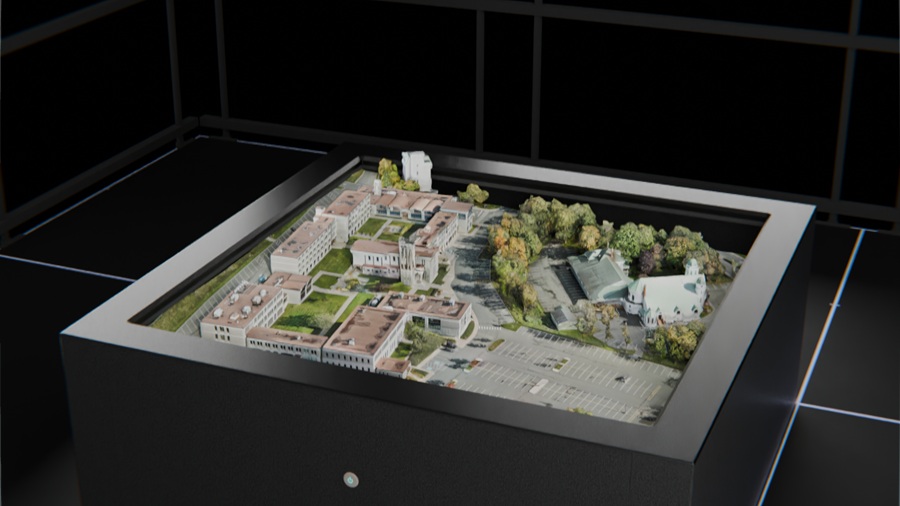
The HARDWARE behind the deal is NOVAC, which Avalon LAUNCHED COMMERCIALLY in May 2025 as a 40-inch TABLE-style light-field display. The pitch is the OPPOSITE of the headset model: SEVERAL people stand around ONE table and see the SAME 3D content from their own ANGLE, with no GLASSES, no headset, and no TRACKING system. At launch, Avalon said NOVAC runs on NVIDIA RTX GPUs under Windows and Linux, integrates with UNREAL Engine and UNITY, ingests formats including OBJ, FBX, glTF, 3D Tiles, DICOM, and GIS, and had been integrated with NVIDIA OMNIVERSE.

Lockheed now has ONE in USE. Haas told Military.com on October 2 that “this is the FIRST delivery of one of our holographic displays to Lockheed, and they’re using it now,” at Lockheed’s 50,000-square-foot Center for Innovation, The Lighthouse, in SUFFOLK, Virginia. He described the system as “a frictionless, collaborative DIGITAL SAND TABLE” for terrain, platforms, sight lines, and radio coverage, and said Avalon has heard INTEREST from the Space Force, the Army, Special Forces, and the Air Force. Interest is not an ORDER, and Haas named no other defense BUYERS. He did say tables are going “mostly” to U.S. CUSTOMERS, including one at the University of Central Florida.
The Real Constraint Is Price
The MOST important number in this story is NOT in either press release. Battle Policy reports that Haas told Vanguard a single unit runs in the range of $5 MILLION, and that Avalon’s Heather Noseworthy told Postmedia the next phase funds a move to an OLED FLAT PANEL with a LOWER PRICE point. Metaverse Watcher has not independently CONFIRMED the $5 million figure, so treat it as a REPORTED ESTIMATE. Either way, it explains why this is a mission-planning ROOM product today, not a DESK product.
Avalon has been talking about that OLED SUCCESSOR for MORE than a YEAR. In May 2025 it told Auganix it was RAISING an ADDITIONAL US$50 million for a system built from 6-inch flat TILE panels that combine into LARGER displays, on top of US$65 million raised to that point and 61 PATENTS. Lockheed’s 2026 release says the new funding will help “advance large-scale flat-panel lightfield displays” and table-top PROTOTYPES. As Battle Policy notes, NEITHER company has given a date for those prototypes, and we could not find one either.
A Regional Win, Publicly Celebrated
The company is also collecting LOCAL RECOGNITION. Newfoundland and Labrador Premier Tony Wakeham posted from an aerospace and defence industry event in Halifax hosted by the Atlantic Canada Aerospace and Defence Association:
Great to be with @ACADA_Atlantic in Halifax last night, alongside worldwide leaders in the aerospace and defence industry.
— Tony Wakeham (@TonyWakehamNL) October 8, 2026
It was a special evening for Newfoundland and Labrador. Congratulations to Avalon Holographics on being named Innovation Leader, and to SmartICE on winning…
Why It Matters for Spatial Computing
Most XR coverage, including ours, ASSUMES the path to SHARED 3D data runs through a HEADSET or glasses. Avalon is betting on a DIFFERENT path for GROUP work: a shared physical object that everyone in a briefing can look at TOGETHER without pairing, fitting, or charging individual devices. That is a NARROW but CREDIBLE NICHE, and defense planning, surgical planning, and digital twins are the use cases Haas keeps naming.
The deal CONFIRMS that one prime contractor is using the product. It does NOT show that light-field tables can reach a price where they compete with a room full of headsets. The thing to WATCH is the OLED TILE panel: a DATED PROTOTYPE, a PUBLISHED price, or a second named defense customer would each tell readers MORE than the C$11.7 million headline.
Sources: Lockheed Martin Canada news release, September 9, 2026; Avalon Holographics press release; Auganix, October 12, 2026; Auganix, May 24, 2025; Military.com, October 2, 2026; Battle Policy, September 18, 2026; NTV News; @TonyWakehamNL on X.