By Metaverse Watcher Staff. Published November 11, 2026. Metaverse Watcher has not tested Snap Specs; this roundup summarizes published hands-on reports.
Snap Specs reviews are arriving in the form of hands-on demos rather than full scored reviews, and after five of them, a clear consensus has formed. Snap’s $2,195 standalone AR glasses are a genuine engineering first, the comfort problem of earlier prototypes is largely fixed, and the software is fun. The display, the battery and the question of what Specs are actually for remain open. Here is what each outlet found, where they agree, and what it means if you are weighing a preorder.
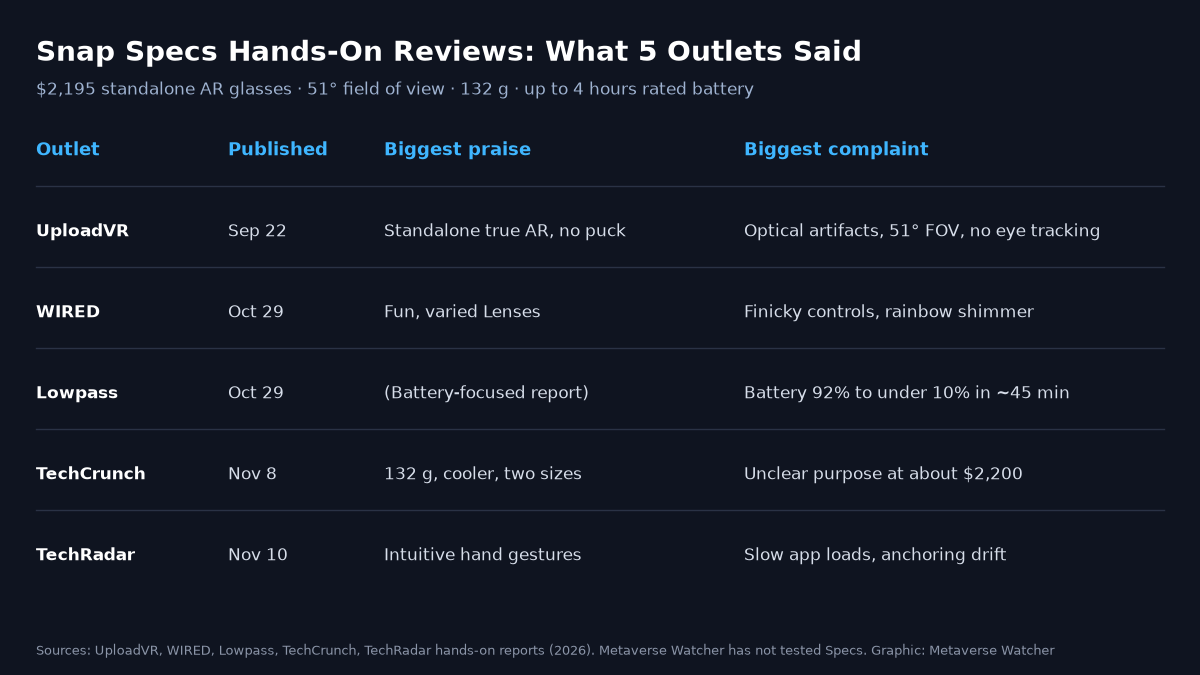
Snap Specs: The Key Facts
| Price | $2,195 (US); LTE charging case adds $300; £1,995 (UK), €2,295 (France) |
| Preorder | $200 down payment; shipping expected before the end of 2026 |
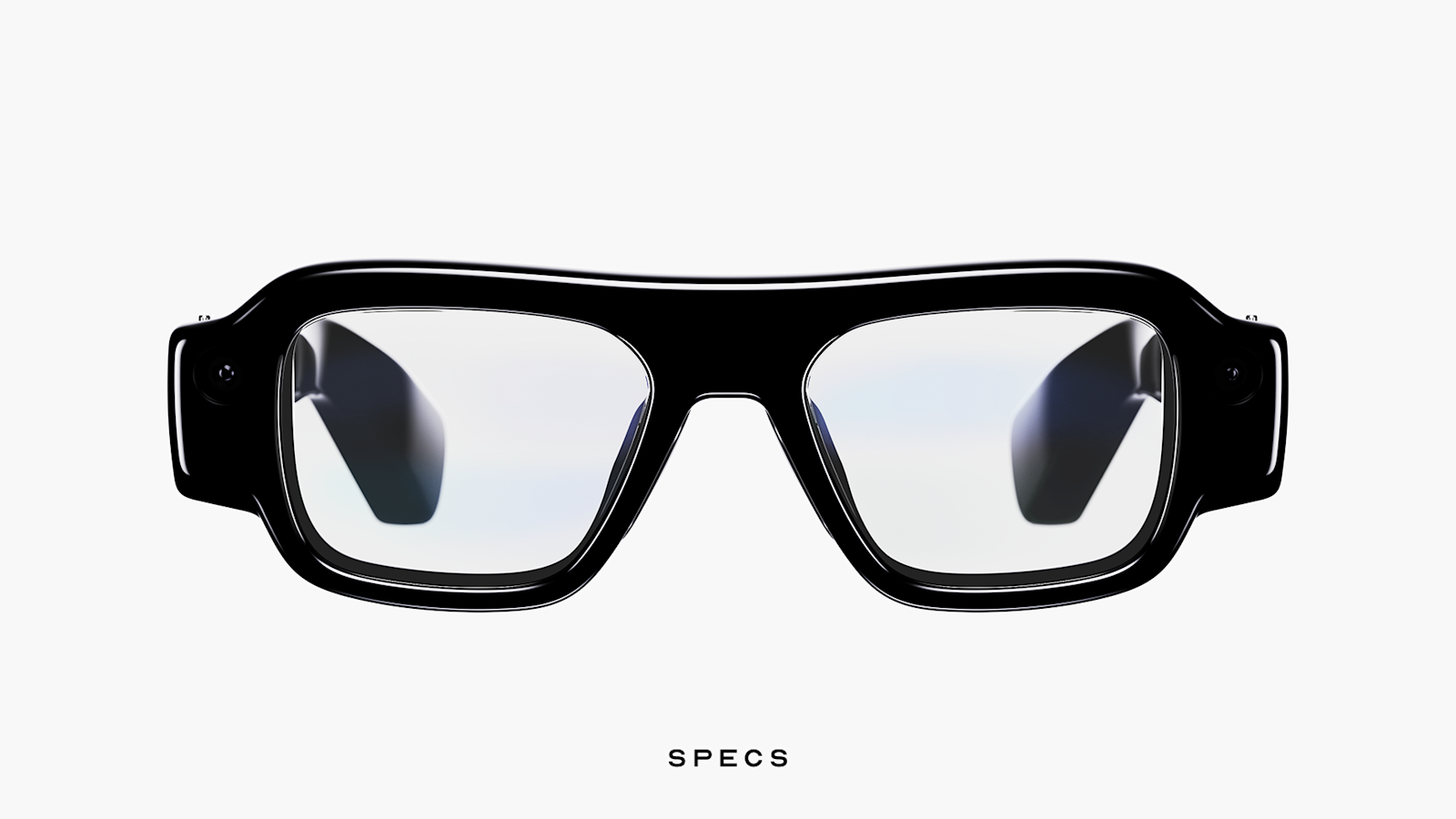
| Weight | 132 g (UploadVR measured its unit at 134 g) |
| Sizes | 47 mm and 52 mm frames, spring hinges |
| Display | LCoS light engines with waveguides, 51° diagonal field of view |
| Compute | Two Qualcomm Snapdragon processors in the frame; no puck or tether |
| Battery | Up to about four hours rated; case adds four charges |
| Input | Hand tracking and voice; no eye tracking |
| Extras | Electrochromic dimming lenses; snap-in prescription lenses from Lensly ($100) |
UploadVR: “Minimum Viable” True AR
UploadVR’s hands-on, published September 22, is the most technical of the group. It notes Specs are set to be the first fully standalone true AR glasses sold outside China, and calls what Snap achieves “at such a low power envelope, in the arm of glasses” “groundbreaking.” But it is blunt about the optics: a rainbow pattern over the display, poor color uniformity, and blue streaks from real-world reflections at the lens edges. It also flags that Specs record and render a wider field of view than the 51 degrees the wearer actually sees, so promotional footage looks better than the real view. Add a frame rate that felt well below the 72 fps floor of other XR systems and no eye tracking, and the verdict is “minimum viable consumer true AR glasses”: an experience “like nothing else out there” for enthusiasts, but not a refined consumer product.
WIRED: Fun Lenses, Finicky Controls
Boone Ashworth’s WIRED hands-on (October 29) tried about a dozen Lenses, including push-up coaching, midair finger painting, AR navigation, a golf aid and an NBA shooting guide. The variety impressed; the controls did not. Pinch gestures were “finicky,” a paired Bluetooth keyboard showed severe input lag in Google Docs, and the waveguides left a rainbow shimmer even with AR content switched off. WIRED’s conclusion: Specs are not something its reviewer would want to wear in public, or while walking anywhere that needs full attention.
Lowpass: The Battery Test
Janko Roettgers’ Lowpass report, also October 29, produced the most-cited number so far: in roughly 45 minutes of heavy use, including video, AR games and a call, the battery fell from 92% to under 10%. Brightness was raised to near maximum outdoors, which drains any waveguide display faster, but the takeaway was that buyers should expect “range anxiety.” We covered that test in detail in our Snap Specs battery life analysis.
TechCrunch: Much More Comfortable, Still “Rudderless”
Lucas Ropek’s TechCrunch piece (November 8) focuses on how far the hardware has come. Specs now weigh nearly HALF of the previous version, come in two sizes with spring hinges, and did not heat up during an hour-long demo. The problem is purpose. When TechCrunch asked Snap staff whether Specs were for games or productivity, the answer was vague, and the device “ends up feeling a little rudderless.” At about $2,200, TechCrunch doubts either a mass gaming audience or office workers will adopt it soon.
TechRadar: Intuitive Gestures, Real Limits
Lance Ulanoff’s TechRadar hands-on (November 10) is the most detailed on daily use. He found Snap’s palm-menu gesture interface “quite intuitive” and the frames lighter than they look. The complaints: apps loaded slowly and did not always keep up with his hands, AR guidelines in a drawing app drifted instead of staying anchored, and touch typing against a small virtual screen was “unnerving.” His demo unit dropped from about 50% to 13% battery in 45 minutes. He also notes the LTE option lives in the charging case, so on-the-go connectivity means carrying that case.
Cas and Chary VR also spent 30 minutes with Specs at the Los Angeles launch in September, trying Google Docs on a Bluetooth keyboard, real-time translation, walking navigation and multiplayer dominoes. Their short video teases one drawback they expect to put buyers off that is “not the price.”
Where the Reviews Agree
| Topic | Consensus | Cited by |
|---|---|---|
| Comfort | Lighter than it looks, comfortable for an hour | TechCrunch, TechRadar, UploadVR |
| Display quality | Rainbow artifacts from the waveguides | UploadVR, WIRED, TechRadar |
| Field of view | 51° feels small | UploadVR, TechRadar |
| Battery | Heavy use drains it fast | Lowpass, TechRadar |
| Controls | Gestures learnable but sometimes unreliable or slow | WIRED, TechRadar, UploadVR |
| Purpose | No clear killer use case yet | TechCrunch, WIRED |
| Looks | Bulky, conspicuous in public | WIRED, TechRadar, UploadVR |
Should You Preorder Snap Specs?
The reviews point to a narrow buyer: a developer, an AR enthusiast or a creator who wants the first cable-free, walk-around AR glasses and accepts first-generation trade-offs. If you mainly want a big private screen for video and laptop work, the puck-based XREAL Aura is the better fit at a lower price; see our Snap Specs vs XREAL Aura comparison. If you want everyday AI glasses you can wear all day, our Meta Ray-Ban Display vs Even G2 guide and the best smart glasses of 2026 list cover lighter options. And if you can wait, our upcoming smart glasses tracker lists what is due next.
The $200 deposit lowers the risk of reserving, but none of these reports is a full review of shipping hardware with final software. We will update this roundup as scored reviews of retail units appear.
Sources: UploadVR (Sep 22, 2026), WIRED (Oct 29), Lowpass (Oct 29), TechCrunch (Nov 8), TechRadar (Nov 10) and Cas and Chary VR (Sep 16), linked above.