Google and Samsung’s first Android XR smart glasses are now on pre-order. The “Intelligent Eyewear” collections from Warby Parker and Gentle Monster went up for order on November 12, 2026, starting at $395 and $449 respectively, with in-store and online sales beginning December 10 in the United States and South Korea. The pre-order date was announced earlier this month; what Google published today fills in the prices, full specs, the phone compatibility list and the privacy rules.
These are audio-and-camera glasses built around Gemini, not display glasses. There is no screen in the lens. That puts them in direct competition with Ray-Ban Meta rather than with Meta Ray-Ban Display or XREAL’s Project Aura.
Price and frames
According to Google’s announcement by Shahram Izadi, VP and GM of XR, the two collections share the same hardware but differ in design and price:
- Warby Parker, from $395: three styles (Alden, Reid and Wren) in optical or sun versions, in Pine, Saddle and Jet Black, with prescription, width and lens options. 9to5Google counts 14 variations. Warby Parker is offering guided demos at more than 360 retail locations.
- Gentle Monster, from $449: six designs in colors including dark red, pink, gray and yellow, with tinted, clear, blue or brown lenses and prescription options for most frames. 9to5Google counts 16 variations.
Pre-orders are open online and in store at both brands, and Google says hands-on demos are available at select Gentle Monster, Warby Parker and Google Store locations.
Full specs
| Spec | Google Intelligent Eyewear |
|---|---|
| Chip | Qualcomm Snapdragon AR1 Gen 1 |
| Memory / storage | 2GB RAM / 64GB |
| Weight | About 41g (Google); 40–44g depending on frame (9to5Google) |
| Camera | 12MP ultra-wide, HDR, image stabilization |
| Video | Up to 3K at 30fps, or 1080p |
| Microphones | Four, with spatial audio capture |
| Speakers | Two open-ear speakers |
| Battery | 245mAh, up to 9 hours rated |
| Charging case | Up to seven full recharges |
| Connectivity | Bluetooth 5.4, Wi-Fi 6E |
| Water resistance | IPX4 |
| Controls | Touchpad (tap and swipe), “Hey Gemini” voice, capture button, Pixel Watch / Galaxy Watch gestures |
9to5Google reports that Samsung engineered the hardware, while Google handles the Android XR software. The watch controls are an interesting extra: a double pinch on a Pixel Watch or Galaxy Watch acts as a tap, a wrist turn acts as “swipe back,” and a palm-up double pinch summons Gemini on Pixel Watch only. 9to5Google says Fitbit Air support is coming next year.
Which phones work, and who can buy
This is the fine print most likely to catch buyers out. The Glasses companion app supports only these phones, according to Google:
- Google Pixel 7 series and newer, running the Android 17 September 2026 update or later
- Samsung Galaxy S, S FE, Z Fold, Z Flip and Fold Ultra series on One UI 9.0 or higher
- iPhone 13 Pro and newer
Android phones from other makers, such as OnePlus or Motorola, aren’t on the list. A Google spokesperson told WIRED the company will share more about expanding support to other phones in 2027. Google also says the glasses work only with Google accounts from the US and South Korea, and they require an 18+ account. iPhone owners lose a few features at launch: Google’s footnotes say Guided Vision, Aira and Audible are available only with a compatible Android phone for now.
What Gemini does on the glasses
Google pitches the glasses as an all-day Gemini assistant. Examples in its announcement include asking about a mural you’re walking past, checking your calendar against an event poster, adding what you’re looking at to a grocery list, and hearing your next meeting location. Google Maps provides turn-by-turn audio directions, and Google Translate offers real-time speech translation with automatic language detection in more than 70 languages.
Accessibility is a notable part of the launch. Gemini’s new Guided Vision gives conversational audio descriptions for people who are blind or have low vision, and a partnership with Aira lets users stream the camera feed to a trained human visual interpreter. Google is explicit that Guided Vision “is not a medical device” and isn’t intended for navigation or obstacle detection, and that it may require a subscription or membership.
Privacy: the rules Google is promising
Camera glasses keep running into privacy problems, from Norway’s proposed ban to workplace restrictions we covered in our guide to smart glasses policies at work. Google’s launch makes several specific commitments:
- Camera visuals used by Gemini are not saved to Gemini History and are not used to train AI models or target ads.
- The glasses are designed to automatically redact bystanders’ faces before Gemini processes those visuals.
- A white indicator light shows when a photo or video is being saved. Google says recording stops if the light is covered or disabled, and 9to5Google reports the glasses run a hardware check on the light while charging. Recording also stops when you take the glasses off.
- Data is encrypted on the glasses and in transit, and users control which apps can access the camera and microphone.
- Every pair has a physical off switch, so the frames can be worn as ordinary glasses.
Automatic face redaction before AI processing is a notable commitment. It is a company claim for now, though, and it covers the Gemini processing pipeline, not photos and videos you choose to save to your own gallery.
How it compares with Ray-Ban Meta
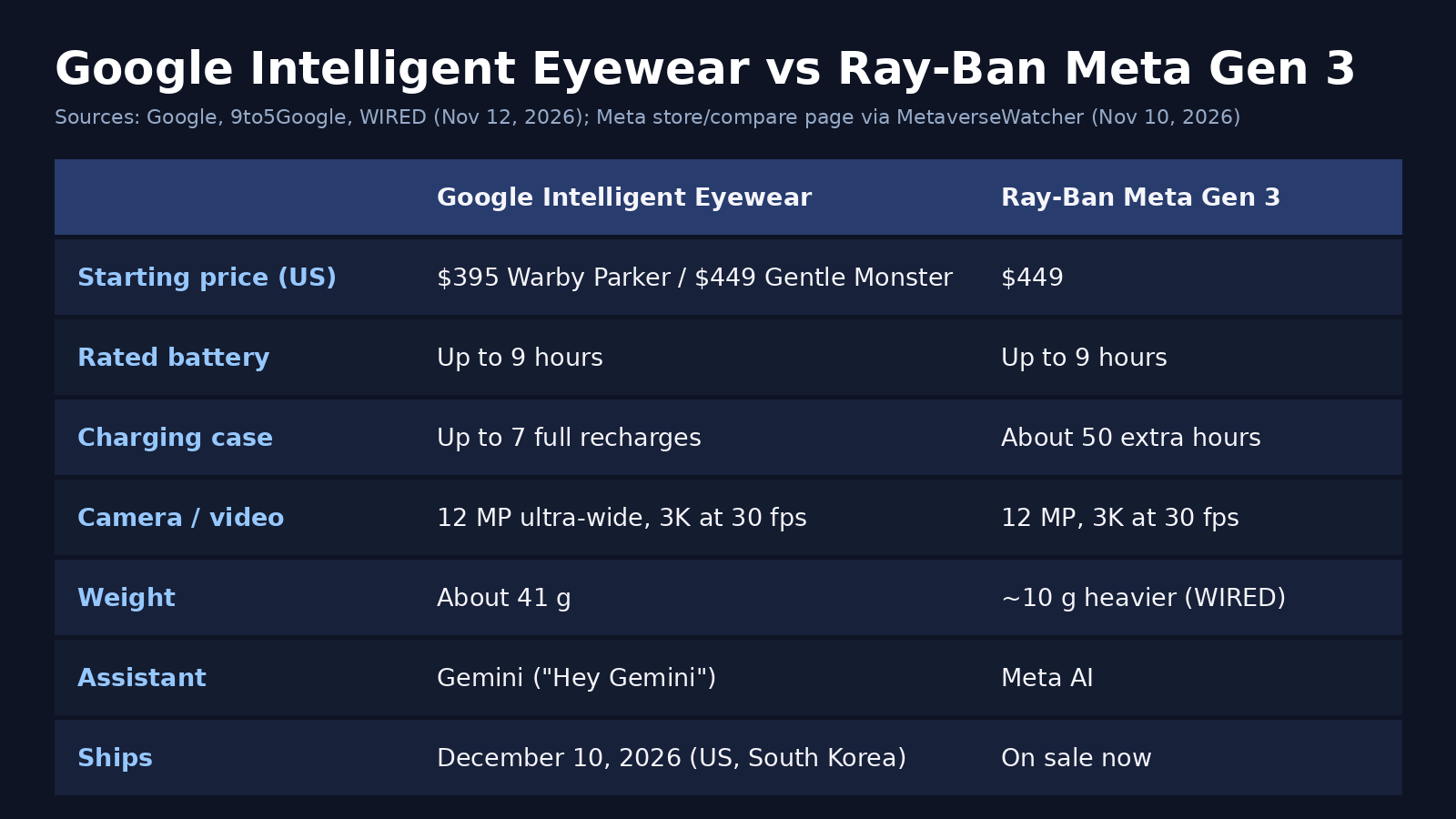
On the core numbers, Google has matched Meta rather than beaten it. Ray-Ban Meta Gen 3 starts at $449 on the Meta Store, has a 12MP camera with 3K video at 30fps, and is rated at up to 9 hours, according to the Meta store and compare-page figures in our Ray-Ban Meta vs Oakley Meta vs Meta Glasses comparison. Google’s Warby Parker frames undercut Gen 3 by $54, and WIRED reports the Google glasses are about 10 grams lighter than Meta’s Gen 3.
Meta’s advantages are availability and range. Its glasses are on sale today, cover more brands and price points (Meta Glasses start at $249), and work outside the US and South Korea. Google’s advantages are lighter frames, deeper ties to Google services such as Maps, Calendar and Translate, and the most detailed privacy commitments in the category so far. For buyers who live in Google’s apps and own a supported phone, that could be enough. Everyone else has a wider choice in our best smart glasses of 2026 list.
What it means
Nearly two years after Android XR was announced, the platform now spans a headset in Samsung’s Galaxy XR, upcoming tethered glasses in XREAL’s Project Aura, and now everyday audio glasses. Our guide to Android XR devices maps the whole lineup. With pre-orders opening two weeks before Black Friday and units arriving December 10, these are the first serious holiday-season challenger to Meta’s smart glasses. The open questions are real-world battery life, how well face redaction works in practice, and when Google opens support to more phones and countries.
Earlier coverage: Android XR glasses pre-orders set for November 12 and Gentle Monster’s Android XR glasses tease. Sources: Google, 9to5Google, WIRED and Business Insider, all November 12, 2026.