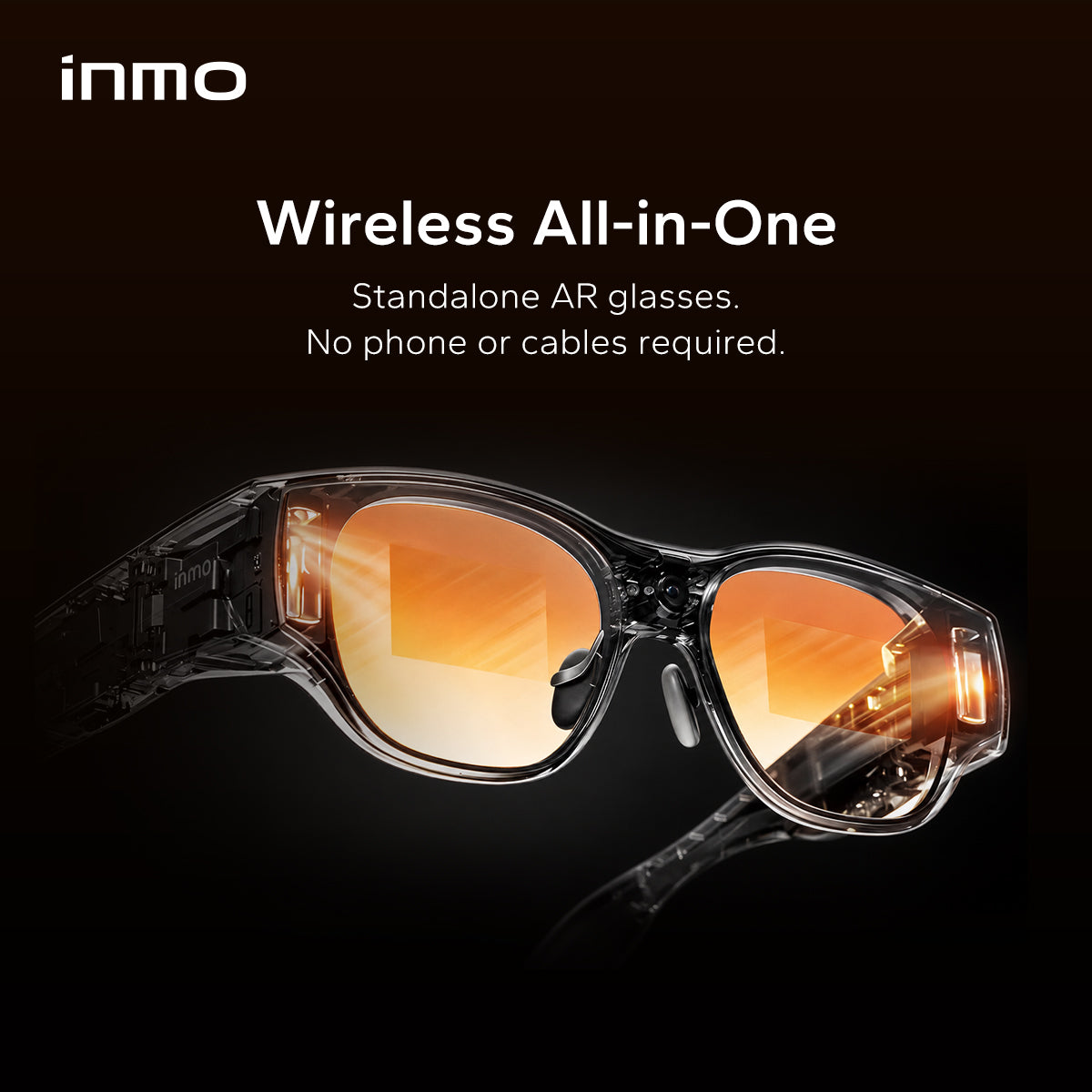
INMO used its November 4 launch event in Chengdu to unveil INMO Future, the fourth generation of its all-in-one AR glasses and the company’s first model built around full spatial tracking. Founder Yang Longsheng presented the glasses as a standalone spatial computer: no phone, no tethered puck, and no PC required. In the U.S., INMO has opened $30 refundable reservations that unlock a $799 VIP price on a Kickstarter campaign that has not launched yet.
The headline specs are ambitious for a glasses-sized device: dual 1080p full-color waveguide displays, a 36-degree field of view, up to 800 nits of brightness, SLAM-based 6DoF tracking and a Qualcomm Snapdragon spatial-processing chip. The detail that matters most for anyone who followed INMO this fall, though, is a smaller one. INMO says Future ships with an active cooling system that keeps the frame under 42°C under sustained heavy load. Six weeks ago, the company’s previous flagship was recalled for overheating.
What INMO Announced
According to the launch coverage published by Cover News and a company-supplied release carried by Jiemian, INMO Future is the fourth step in a line that began with the monocular INMO AIR1 in 2021, moved to binocular color with AIR2 in 2022, and reached 1080p with AIR3 in November 2024. The new model keeps the all-in-one approach but adds what the company calls its “InSpace” stack: optics, hardware, on-device AI and spatial compute tuned together in a frame INMO describes as weighing around 100 grams.
INMO Future Specs at a Glance
| Spec | INMO Future (company figures) |
|---|---|
| Form factor | Standalone all-in-one AR glasses, no phone or PC required |
| Displays | Dual 1080p full-color array (geometric) waveguides, independent left/right images |
| Field of view | 36 degrees |
| Brightness | Up to 800 nits to the eye, which INMO says is 33% brighter than the previous generation |
| Processor | Qualcomm Snapdragon spatial-processing chip (exact model not named) |
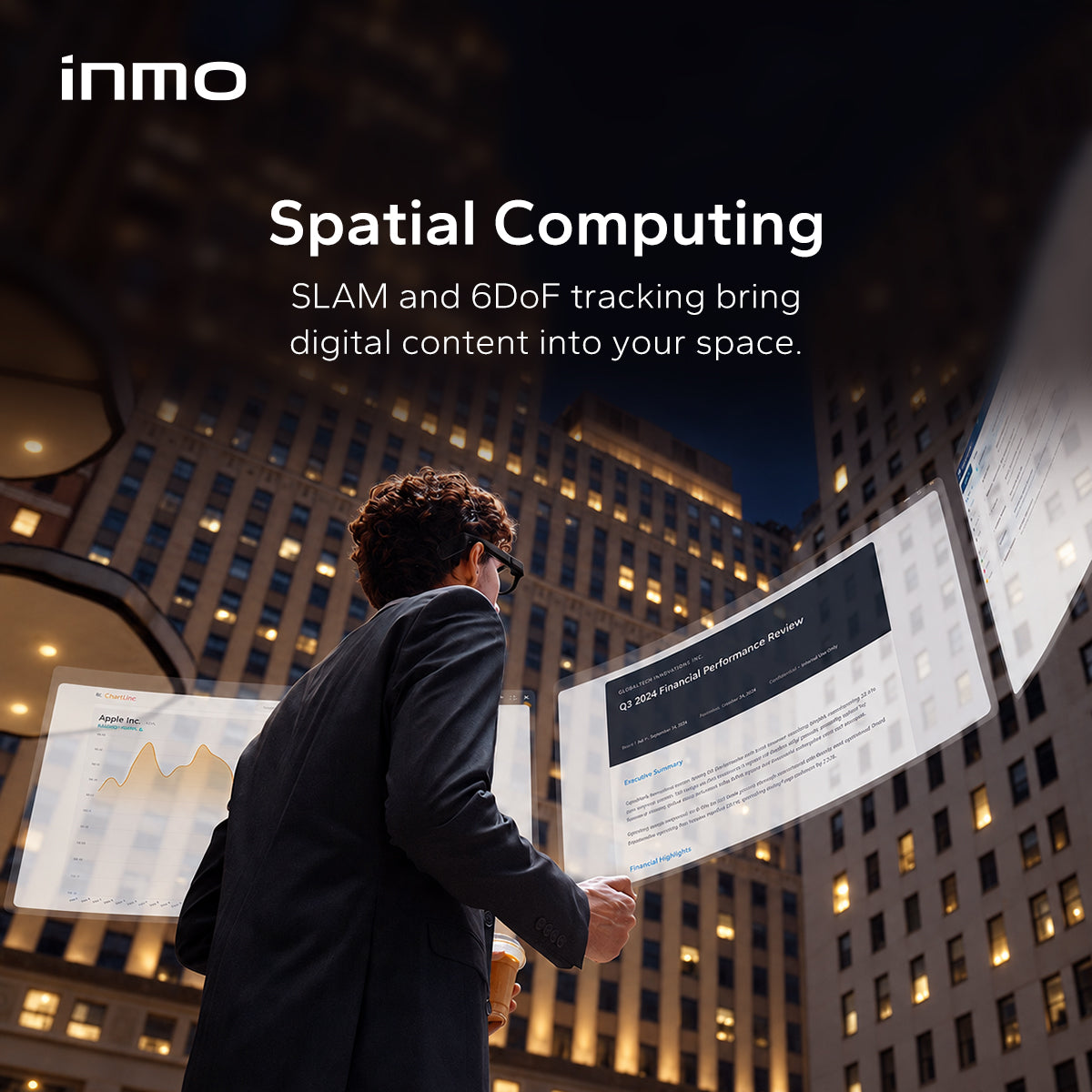
| Tracking | SLAM with 6DoF, centimeter-level positioning, multi-plane detection in under 3 seconds, persistent maps and spatial anchors |
| Thermals | Active cooling, under 42°C under sustained load, about 40 dB fan noise in games and video |
| Audio | Custom stereo open-ear speakers |
| Input | Dedicated controller with ray pointing, touchpad, buttons and haptics |
| Software | Spatial AIOS based on Android 14, Android app installs, OpenXR-compatible SDK |
| U.S. pricing | $30 refundable deposit, $799 VIP price on Kickstarter (campaign date not announced) |
Battery capacity, runtime, final weight and the full retail price outside the VIP offer were not disclosed in the launch materials we reviewed. Treat every figure above as a company claim until independent hands-on testing is published.
Why the Cooling Claim Matters
On September 24, the U.S. Consumer Product Safety Commission and Health Canada flagged the INMO AIR3 because its left temple could overheat during extended use, as we reported at the time. Owners were told to stop using the glasses and install a free firmware fix. That history makes Future’s thermal design the first thing buyers should scrutinize, and INMO clearly knows it: the release calls heat dissipation a key focus of this generation.
A fan inside a pair of glasses is unusual. It trades a small amount of noise, about 40 dB by INMO’s measure, which the company compares to a library, for the ability to run a 1080p binocular display and continuous SLAM without throttling or burning the wearer. Whether 42°C holds up during long streaming sessions in a warm room is exactly what reviewers will need to test.
How It Compares to the Rest of the Field
Future arrives in a crowded fall for display glasses. XREAL’s Google-built Aura, which has just gone on sale and offers a much wider 70-degree field of view but pairs the glasses with a tethered compute unit. TOZO’s AIVU launched at $699 as a lighter AI-glasses design, and the Linux-based Raven Prism 1 starts at $1,499. INMO’s pitch sits between them: true standalone 6DoF in a glasses frame, at a VIP price close to the low end of the category, but with a narrower view than Aura.
INMO is also arguing that the category is bigger than gadgets. At the event, Frost & Sullivan released a white paper on consumer spatial-intelligence glasses that ranks INMO first in cumulative global sales of all-in-one AI+AR glasses from 2021 to 2025. That ranking comes from a report presented at INMO’s own launch, so it should be read in that context. It does line up with INMO’s recent momentum, including its nearly 1 billion RMB Series C and early IPO preparations.
Developers, Content and Retail
- SDK: INMO is opening its spatial computing stack through an OpenXR-compatible SDK, plus an AI tool it says can turn a one-sentence prompt into a runnable AR app.
- Fund: a 30 million RMB fund for native AR and AI content, with distribution partners including Tencent’s app store.
- Use cases: a private 150-inch-equivalent screen with 3D and panoramic video, wireless streaming from PC, Xbox and PS5, multi-window work and shared 3D model reviews.
- Other products: a V3.0 update for the business-focused INMO GO3 adds speaker-separated AI meeting notes, and a camera sunglasses model designed with Jackson Wang launches in China at 1,199 RMB.
- Retail: reservations are open on JD.com in China, and INMO opened flagship stores in Shanghai, Chengdu, Shenzhen, Beijing and Wuhan.
Should You Reserve One?
The INMO Future reservation page (checked November 4, 2026) is explicit that the $30 is a deposit, not a purchase. It is fully refundable, and after a successful Kickstarter pledge INMO says it will return the deposit plus a $100 VIP rebate, for $130 back in total. The page also notes that VIP rewards are limited and first-come, first-served.
The low-risk move is a deposit if you want to lock in the price, while holding off on a Kickstarter pledge until independent reviews cover heat, battery life and tracking quality. Crowdfunded hardware carries delivery risk, and INMO’s AIR3 shipped partly through Kickstarter before its recall. If you mainly want a large virtual screen for travel, tethered display glasses remain the simpler choice. Our guide to connecting XR glasses to iPhone, Switch and Steam Deck covers that route, and our Meta Ray-Ban Display vs Even G2 comparison covers lighter heads-up glasses.
The Bottom Line
INMO Future is the most complete standalone AR glasses spec sheet announced this fall: dual 1080p, 6DoF, Android apps and a sub-$800 entry price. It is also a product from a company that just recalled its last flagship for heat. The active cooling system is INMO’s answer to that problem. Until independent testers confirm it works, the deposit is a reasonable option and the full pledge can wait.
Sources: Cover News, Jiemian (company release), Nexduck, INMO.