An updated XR device sales forecast from ARtillery Intelligence projects annual unit sales of headsets and smart glasses to rise from 12.19 million in 2025 to 52.98 million in 2030, a more than fourfold increase. The research firm, which publishes through its sister site AR Insider, released the figures on November 3 as part of the Q3 update to its spatial computing revenue forecast. It credits the growth almost entirely to smart glasses, NOT to VR headsets.
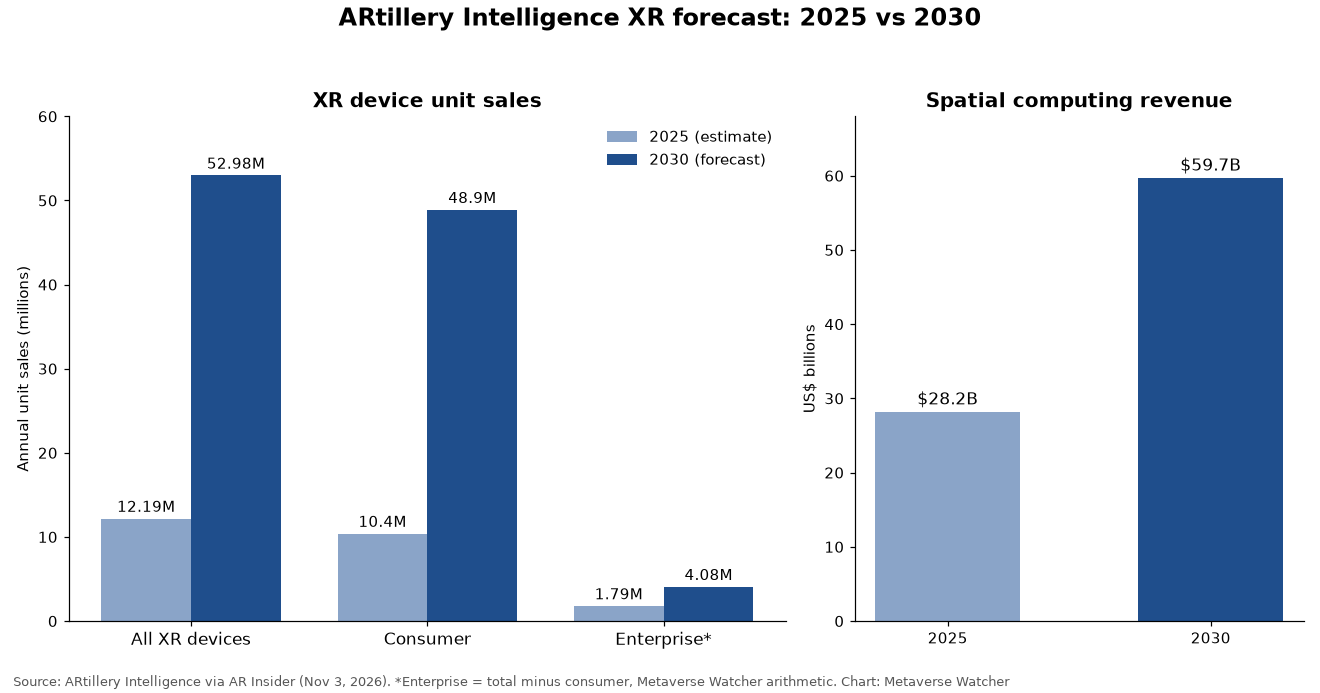
The Numbers
ARtillery publishes only start and end points in this installment, not year-by-year values, so the table below sticks to what the firm disclosed plus clearly labeled arithmetic.
| Metric | 2025 | 2030 | Change |
|---|---|---|---|
| XR device unit sales (consumer + enterprise) | 12.19M | 52.98M | 4.3x |
| Consumer unit sales | 10.4M | 48.9M | 4.7x |
| Enterprise unit sales (implied)* | 1.79M | 4.08M | 2.3x |
| Installed base | n/a | 143.9M | n/a |
| Spatial computing revenue | $28.2B | $59.7B | 2.1x |
Two derived figures are useful. Unit sales imply a compound annual growth rate of roughly 34% over five years, while revenue implies about 16%. Units are forecast to grow about twice as fast as revenue. That fits a market moving toward cheaper glasses, although ARtillery’s revenue figure covers the broader spatial computing segment, so the gap should not be read as a straight average selling price.
Why ARtillery Expects Growth: Glasses, Not Headsets
According to analyst Mike Boland, consumer devices pulled ahead of enterprise because of VR in earlier years, but smart glasses are now the main driver. The firm puts lifetime sales of Ray-Ban Meta non-display glasses at more than 15 million units, “a scale not yet seen in XR,” and groups the rest of the glasses market into three types:
- Video display glasses, such as VITURE and XREAL models, that mirror a phone, PC or console onto a large virtual screen over USB-C.
- Utility display glasses, such as Meta Ray-Ban Display and Even Realities G2, which put simple information in view rather than 3D graphics.
- Dimensional AR, a newer group including Snap Specs and the XREAL Aura, which launched at $1,099 on Android XR.
The forecast is not a straight line. ARtillery expects an inflection beginning in 2027 and continuing into 2028 as Apple, Samsung, Google partners and others ship glasses, followed by a slowdown in 2029 as the market approaches what it calls AR’s “demand ceiling.” Boland describes the expected pattern as a classic S-curve.
How the Forecast Compares With Current Data
The most recent reported figures support the glasses-first view, while showing how uneven the market still is:
- Meta Reality Labs: Third-quarter revenue fell 6% to $443 million, as lower Quest sales were partly offset by higher AI glasses sales. The segment’s operating loss was $4.13 billion. Our Reality Labs Q3 breakdown has the quarter-by-quarter detail.
- EssilorLuxottica: The company that makes Ray-Ban Meta and Oakley Meta frames reported €486 million in third-quarter wearables revenue, up 20% at constant currency, a slowdown from nearly 100% growth in the second quarter. See our EssilorLuxottica Q3 report.
- TrendForce: The firm expects AR glasses shipments, a narrower category than ARtillery’s, to grow from 620,000 units in 2025 to 1.31 million in 2026. We covered that in TrendForce’s AR glasses forecast.
Category definitions differ widely between research firms. ARtillery’s 12.19 million figure for 2025 counts VR headsets, mixed reality headsets, and display and non-display glasses for both consumers and businesses. TrendForce’s figure counts AR glasses only. The numbers measure different things and should not be compared directly.
The Hardware Behind the 2027 Inflection
The products ARtillery is counting on are mostly announced or reported already:
| Device | Type | Status as of Nov 3, 2026 |
|---|---|---|
| Samsung Intelligent Eyewear (Android XR) | Camera AI glasses, no display | Reported for mid-December in the US and South Korea; price not announced |
| XREAL Aura (Android XR) | Wired AR glasses with compute puck | On sale from $1,099 (introductory); shipping mid-November |
| Snap Specs | Standalone AR glasses | $2,195; shipping “later this fall” in the US, UK and France |
| Meta VR Glasses | Lightweight VR headset | Announced for spring 2027 |
| Apple glasses (N50) | AI glasses, reportedly no display | Not announced; Bloomberg reports late 2027 |
For the Samsung timing, see our report on the Samsung smart glasses’ reported mid-December launch.
What It Means for VR
The forecast offers limited support for traditional VR headsets. ARtillery still lists mixed reality headsets such as Quest 3 and Apple Vision Pro as part of a “diverging and diversifying” device range, but it does not attribute the growth to them. This week’s news points the same way: Meta announced that Quest 2 and Quest Pro will get their final OS update by March 2027 (full Quest 2 end-of-support details), and Sony has removed PS VR2 from PlayStation Direct in the US and Japan, Road to VR reported.
Our Take
The headline figure of 53 million units a year depends heavily on one assumption: that several new glasses launching between late 2026 and 2028 widen the market beyond Meta’s Ray-Ban buyers instead of dividing the same customers between more brands. Recent data is mixed. EssilorLuxottica’s growth has slowed, Reality Labs revenue is still declining, and the important 2027 products from Apple and Samsung are either unpriced or unannounced. ARtillery’s own forecast of a 2029 slowdown also suggests caution. The next useful data points will be Samsung’s pricing and first holiday-quarter sales of the new Android XR glasses.
Sources: AR Insider / ARtillery Intelligence (Nov 3, 2026); Meta Q3 2026 results; Android Authority; Road to VR.