Published October 24, 2026. This is our follow-up to the Reality Labs earnings preview we ran the day before Meta reported.
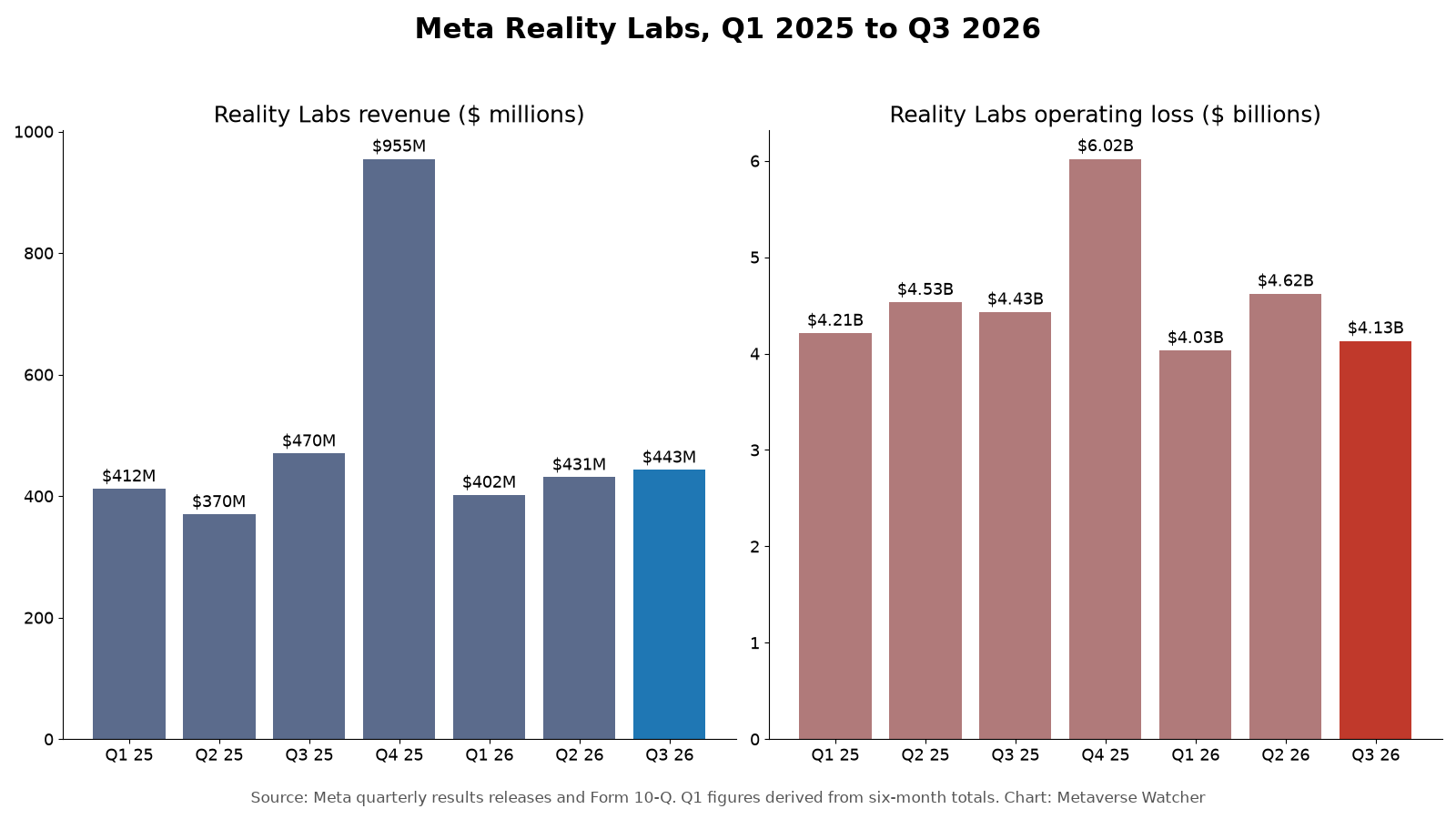
Meta’s Reality Labs, the division behind Quest headsets and Meta’s AI glasses, reported third-quarter 2026 revenue of $443 million, down 6% from $470 million a year earlier, according to the company’s third-quarter results release on October 21. The segment’s operating loss narrowed 7% to $4.13 billion. The bigger news came on the call: Meta now expects Reality Labs losses to fall to about $15 billion in 2027, and said it will pace its virtual reality spending to put AI first.
The Numbers Against Expectations
Revenue came in below every forecast we tracked. The Zacks consensus we cited in our preview called for $454 million, and analysts polled by StreetAccount expected $513 million and a $4.54 billion loss, CNBC reported. So the segment MISSED on sales but lost about $400 million less than the StreetAccount estimate.
| Metric | Q3 2026 | Q3 2025 | Change |
|---|---|---|---|
| Reality Labs revenue | $443 million | $470 million | -6% |
| Costs and expenses | $4.57 billion | $4.90 billion | -7% |
| Operating loss | $4.13 billion | $4.43 billion | 7% smaller |
| Nine-month revenue | $1.28 billion | $1.25 billion | +2% |
| Nine-month operating loss | $12.78 billion | $13.17 billion | 3% smaller |
For context, the whole company reported $64.6 billion in revenue, up 26%. Reality Labs remains well under 1% of Meta’s sales while subtracting more than $4 billion a quarter from operating profit.
Quest Down, Glasses Up
Meta’s quarterly filing attributes the revenue decline to lower Meta Quest sales, partly offset by higher sales of AI glasses. CFO Susan Li said the same on the earnings call, citing “continued strong growth in AI glasses revenue.” Zuckerberg added that “glasses sales continue to grow rapidly.” Neither the Quest 3 nor the Quest 3S is a new headset this year. Our Quest 3 vs Quest 3S buying guide covers where those two headsets stand now, and Andrew Bosworth has said Quest 3 nearly matched Quest 3S in sales.
Timing also matters for the glasses side. Meta’s fall lineup was announced at Connect on September 23, about a week before the quarter closed, so most of the holiday selling season for the new models falls in Q4. Meta’s eyewear partner reports its own, separate figures; see our coverage of EssilorLuxottica’s Q3 2026 smart-glasses revenue.

A $15 Billion Loss Target and a Slower VR Cadence
Meta now expects Reality Labs to lose between $18 billion and $19 billion in 2026, down from $19.19 billion in 2025. With $12.78 billion already lost through September, that range implies a fourth-quarter loss of roughly $5.2 billion to $6.2 billion, our calculation. That is in line with the holiday quarter’s usual pattern: Q4 2025 was the segment’s worst quarter, at $6.02 billion.
For 2027, Li said Meta expects losses “to narrow next year to around $15 billion as we reallocate investment towards other priority areas, primarily AI.” Mark Zuckerberg framed it as a change in how Meta ships hardware:
“We are changing our approach to virtual reality to only ship new devices when we have major breakthroughs like we had with the Meta VR glasses this year… But we will pace this aspect of our investment more to focus on delivering personal superintelligence first.”
Mark Zuckerberg, Meta Q3 2026 earnings call
He added that the segment’s results should improve “with operating loss coming down to approximately $15 billion next year and trending towards profitability from there.” The next VR device on the calendar is the $1,299.99 headset Meta showed at Connect. Our Meta VR Glasses guide covers its price, spring 2027 release window and specs.
Muse Becomes the Business Model for Glasses
Zuckerberg said Reality Labs’ focus is now Meta’s personal AI agent, Muse, which is “coming to Meta Glasses starting next month.” He was direct about the economics: Meta has “priced our devices not to make a large profit on the hardware,” and expects paid Muse subscriptions to help the glasses business “begin improving meaningfully from here.” According to the call summary, Muse reached 10 million users in the U.S. and Canada within six weeks of launch, with 25% using it daily. Meta has since launched Muse in Japan, its first market outside North America.
What It Means
Three points stand out. First, the decline in Quest revenue is now structural, not a one-quarter blip; glasses are the only growth line in the segment. Second, Meta has put a concrete number on Reality Labs cost discipline: a roughly $3 billion to $4 billion cut in annual losses from 2026 to 2027. Third, the “only ship on breakthroughs” policy makes a yearly Quest refresh UNLIKELY. Buyers who expected a Quest 4 in 2027 should treat the Meta VR Glasses as Meta’s main VR hardware for the foreseeable future, and developers should plan around a slower device cycle and an AI-first glasses roadmap.
Sources: Meta Q3 2026 results release; Meta Form 10-Q for the quarter ended September 30, 2026; Q3 2026 earnings call transcript (The Motley Fool); CNBC.