Updated October 24, 2026. Prices are U.S. list prices from Meta. Specs come from Meta’s own device comparison pages, linked below. We will revise this guide when Meta changes a price or a model.
Meta sells two Quest headsets in late 2026, and they run the same games. The Quest 3S starts at $349.99. The Quest 3 costs $599.99. The question most buyers ask is simple: what does the extra $250 actually buy? This guide answers it with Meta’s published numbers, then tells you which one to pick.

The Short Answer
- Buy the Quest 3S ($349.99, 128GB) if this is your first VR headset, you are buying for a child or a family, or you mainly want to try VR games and fitness apps without spending much.
- Buy the Quest 3 ($599.99, 512GB) if you care about image sharpness, plan to stream PC VR games, want the best mixed reality, or expect to keep the headset for several years.
- Skip the middle option for most people: the 256GB Quest 3S costs $449.99, only $150 less than a Quest 3 with twice the storage and much better lenses.
Price: What Each Model Costs Now
Both headsets got more expensive this year. In an April 16, 2026 update, Meta said that starting April 19 it would raise prices because “the global surge in the price of critical components, specifically memory chips” had made VR hardware costlier to build. The new U.S. lineup is:
- Meta Quest 3S, 128GB: $349.99 (launched at $299.99 in October 2024)
- Meta Quest 3S, 256GB: $449.99 (launched at $399.99)
- Meta Quest 3, 512GB: $599.99 (previously $499.99; it is now the only Quest 3 model)
Meta said refurbished units follow the new prices, while accessories stayed the same. Both headsets ship with two Touch Plus controllers and a charging cable, so neither needs extra purchases to get started.
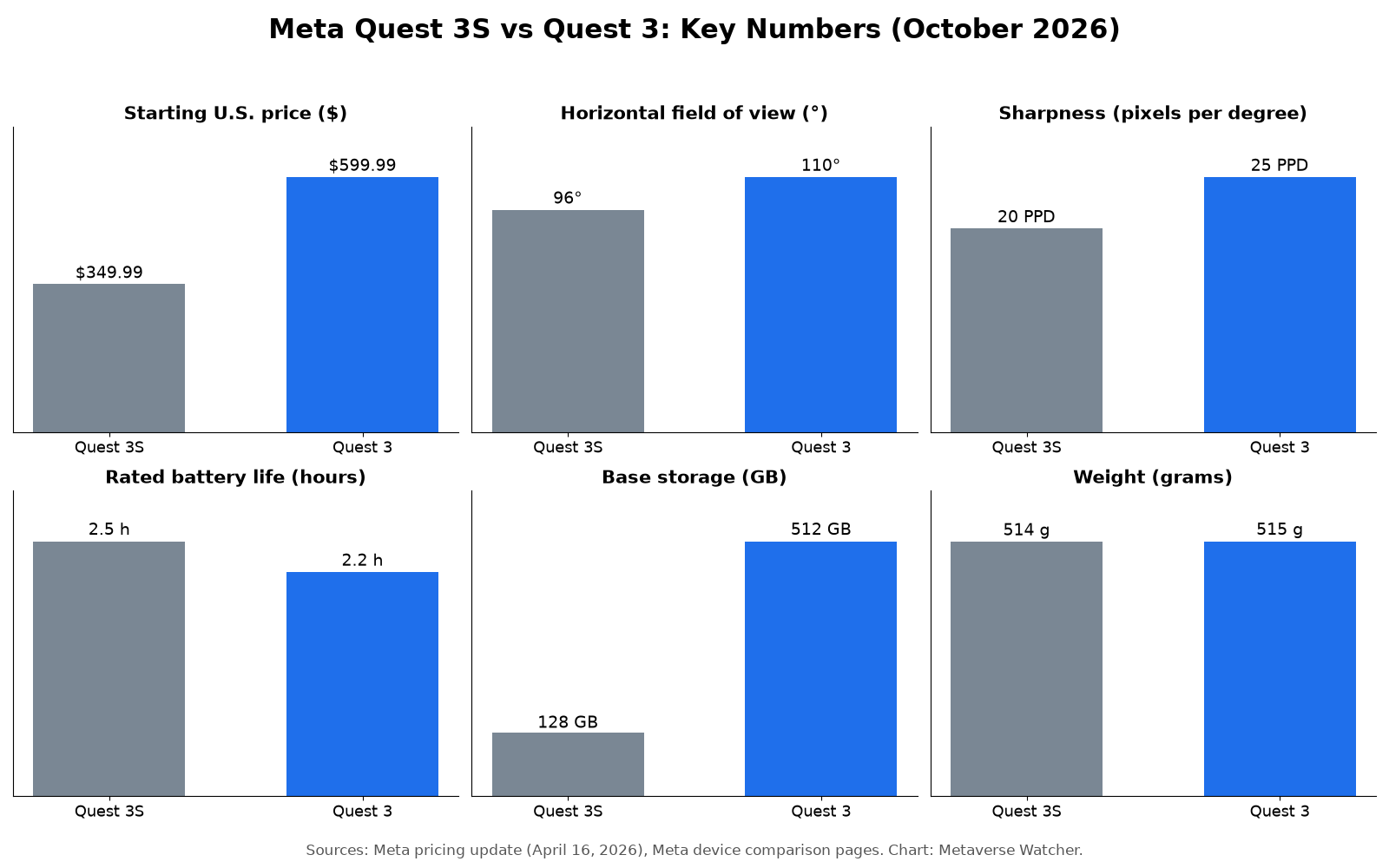
Quest 3 vs Quest 3S Specs at a Glance
| Spec | Meta Quest 3S | Meta Quest 3 |
|---|---|---|
| U.S. price | $349.99 (128GB), $449.99 (256GB) | $599.99 (512GB) |
| Chip and memory | Snapdragon XR2 Gen 2, 8GB | Snapdragon XR2 Gen 2, 8GB |
| Display resolution per eye | 1832 × 1920 LCD | 2064 × 2208 LCD (dual panels) |
| Sharpness | 20 pixels per degree | 25 pixels per degree |
| Lenses | Fresnel | Pancake |
| Field of view | 96° horizontal, 90° vertical | 110° horizontal, 96° vertical |
| Refresh rate | Up to 120Hz | Up to 120Hz |
| Lens spacing (IPD) | Three preset positions | Continuous adjustment |
| Passthrough | Full color, 4MP, 18 PPD | Full color, 4MP, 18 PPD, plus depth sensor |
| Headphone jack | No | Yes, 3.5mm |
| Battery | 4,324 mAh, about 2.5 hours | 5,060 mAh, about 2.2 hours |
| Weight | 514g | 515g |
| Wi-Fi | Wi-Fi 6E | Wi-Fi 6E |
What Is the Same: Games, Chip and Software
This is the most important point in the comparison. Both headsets use the same Snapdragon XR2 Gen 2 chip and 8GB of RAM, run the same Horizon OS, and use the same Touch Plus controllers. In practice, that means the Quest 3S plays essentially the SAME library of Quest games and apps, including Horizon Worlds, fitness apps and Xbox Cloud Gaming. Developers do not build a separate, cut-down version for the cheaper model.
Both also stream PC VR games from a Windows computer through Meta’s Link cable, Air Link, Valve’s Steam Link or Virtual Desktop. Our guide to playing PC VR games on Quest 3 and 3S covers each method.
What the Extra $250 Buys: Lenses and Clarity
The real difference is optical. The Quest 3 uses two LCD panels at 2064 × 2208 per eye behind pancake lenses. Meta says that is 30% more pixels than the Quest 3S, and it rates the Quest 3 at 25 pixels per degree against 20 for the 3S. The Quest 3S uses the same 1832 × 1920 resolution as the old Quest 2, behind Fresnel lenses.
Fresnel lenses have a smaller “sweet spot,” the area of the lens where text and detail look sharp, and they can show glare rings in high-contrast scenes. Pancake lenses stay clearer toward the edges and let the headset sit closer to your face. The Quest 3 also has a wider view: 110 degrees horizontally versus 96. For reading text in virtual monitors, watching video, or streaming detailed PC games, the Quest 3 is noticeably better. For many fast-moving games, the gap matters less.
Fit is a second factor. The Quest 3 adjusts continuously to the distance between your eyes. The Quest 3S has three fixed positions (Wikipedia lists them as 58mm, 63mm and 68mm), which works for most adults but can leave some people slightly out of focus.
Mixed Reality: The Depth Sensor Gap
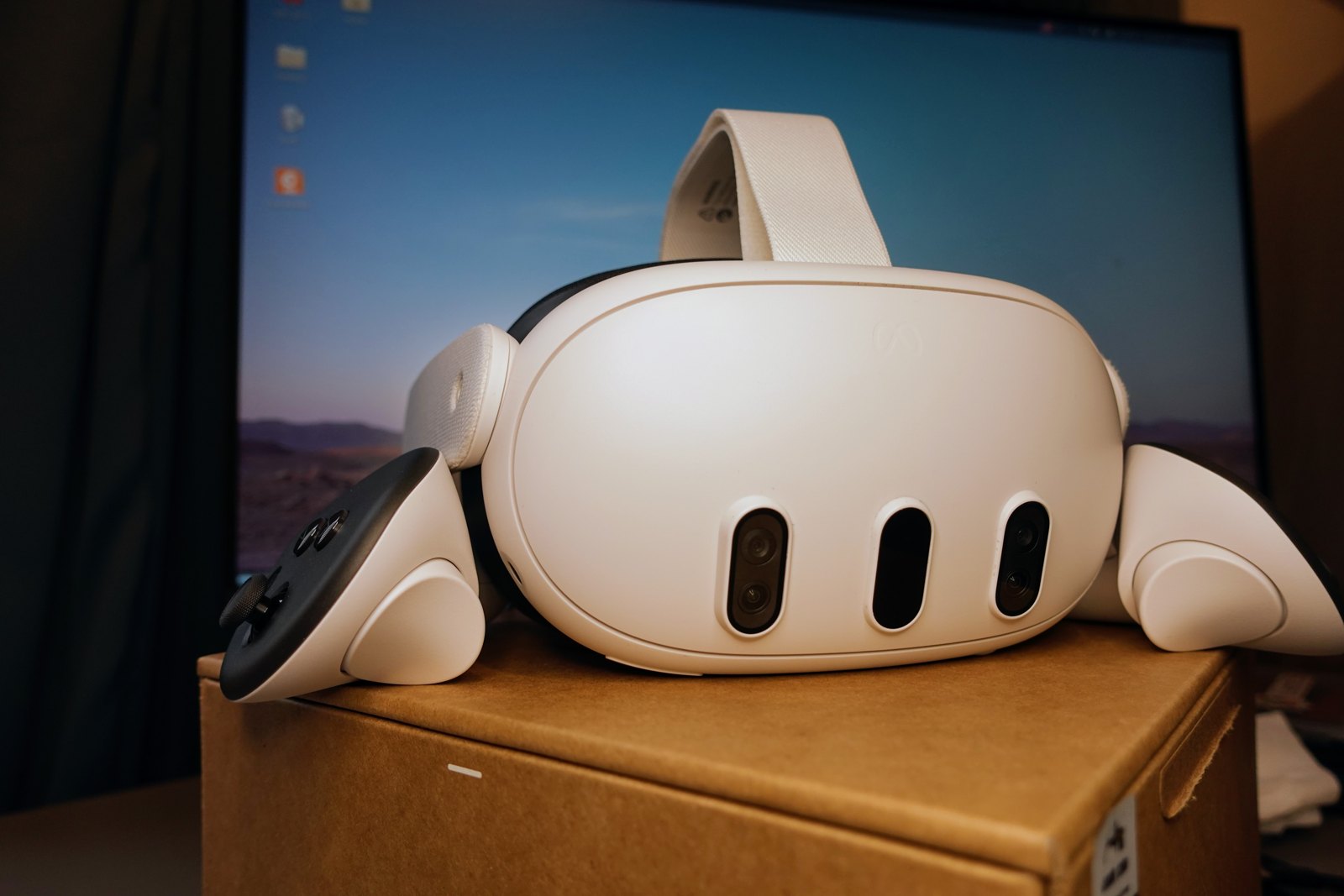
Both headsets show your room in full color with the same 4MP passthrough cameras. Only the Quest 3 adds a dedicated depth sensor, which helps it map walls, furniture and floors when apps place virtual objects in your space. The Quest 3S estimates depth with its cameras instead. Most mixed reality apps work on both, but room scanning is quicker and more precise on the Quest 3, and apps that rely on detailed room meshes tend to work best there.
The Quest 3S does add one thing the Quest 3 lacks: a physical action button that toggles passthrough, handy for checking your surroundings quickly.
Battery, Storage and Comfort
Meta rates the Quest 3S at about 2.5 hours per charge and the Quest 3 at about 2.2 hours, so the cheaper headset actually lasts slightly longer. Weight is effectively a tie at 514g and 515g. The Quest 3S is thicker because Fresnel lenses need more space, which places a bit more of that weight further from your face.
Storage is where the 128GB Quest 3S can pinch. Modern Quest games often take several gigabytes each, and neither headset has a memory card slot. If you plan to keep a large library installed, 128GB fills up fast. The Quest 3 starts at 512GB, FOUR times as much.
What Meta’s Own Sales Data Suggests
Meta expected the cheaper headset to dominate. It did NOT. In a September 2026 interview at Meta Connect, Meta CTO Andrew Bosworth said the Quest 3 sold nearly as well as the Quest 3S, and that comfort and quality of experience mattered as much as price for many buyers. Meta does not publish unit sales by model, but the comment is a useful signal: plenty of buyers decided the better optics were worth paying for.
Should You Wait for Something New?
Meta’s next device is NOT a Quest 4. At Connect 2026 it announced Meta VR Glasses, a lightweight headset with a tethered compute puck, priced at $1,299.99 for spring 2027. That is a premium product at more than twice the price of a Quest 3, not a replacement for either model here. If your budget is under $600 and you want to play now, waiting does not offer an obvious payoff. Buyers with a strong gaming PC and a Steam library should also read our Steam Frame vs Quest 3 comparison and our wider list of the best VR headsets of 2026.
Our Verdict
The Quest 3S at $349.99 is the cheapest complete way into modern standalone VR, and it gives up nothing in game compatibility. The Quest 3 at $599.99 is the better headset in every way that affects what you see: sharper image, wider view, better lenses, a depth sensor and four times the storage. If you can afford the difference, the Quest 3 is the one we would buy for long-term use. If price decides it, the 128GB Quest 3S is a sound choice, while the 256GB Quest 3S is hard to justify at only $150 below the Quest 3.
Sources
- Meta: An Update on Meta Quest Pricing (April 16, 2026)
- Meta Store: Compare Quest 3S vs Quest 3
- Meta for Developers: Compare devices
- Meta for Work: Compare VR headsets
- Wikipedia: Meta Quest 3S
- TechRadar: Meta Quest 3S specs