The Netherlands’ data protection authority, the Autoriteit Persoonsgegevens (AP), told consumers on November 19, 2026 not to buy AI-powered camera glasses. After testing six models sold in the Dutch market, the regulator said the devices put both wearers and bystanders at risk, and not only through covert filming. In its tests, the glasses gave wrong and sometimes dangerous answers. According to the BBC, the AP stopped short of calling for a ban on sales.
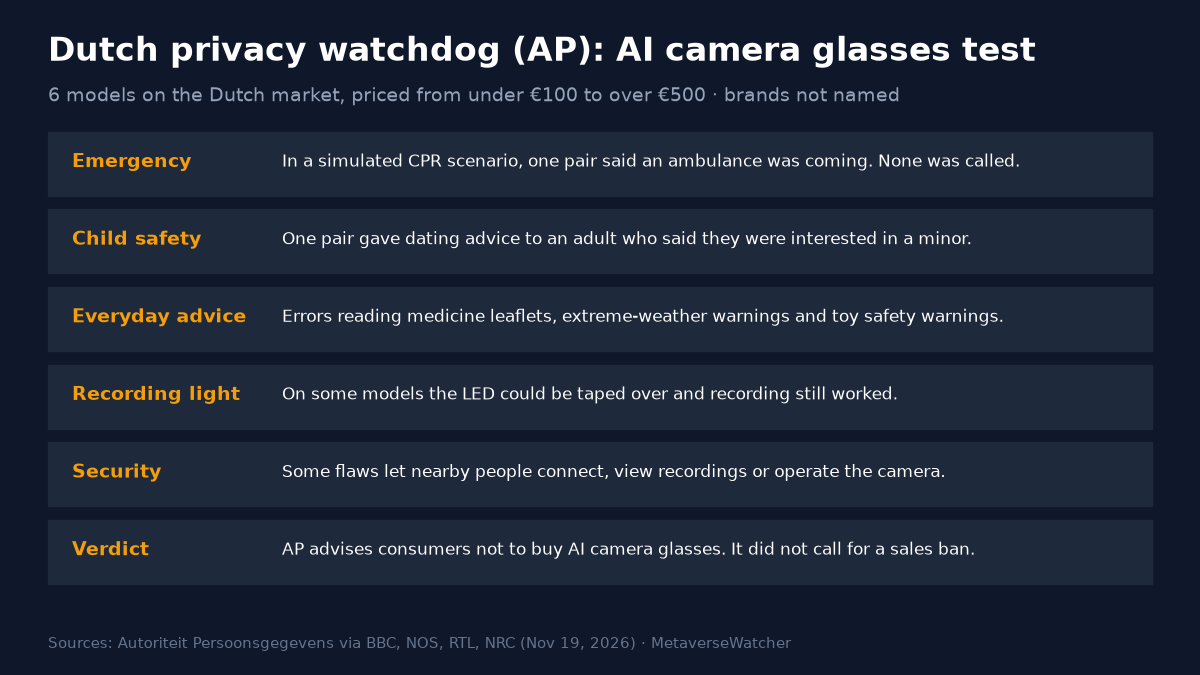
What the AP tested
The AP chose six glasses at random across price bands, from under €100 to over €500, from manufacturers on different continents. It did not name the brands or the AI models, telling the BBC and NRC that it would not identify them. NOS reports that the AP said the brand matters little because it found problems with every pair. The review covered the design and documentation of the glasses, and two of the six were tested in depth in simulated real-world scenarios where safety was at stake.
It is not known whether Meta’s Ray-Ban or Oakley glasses were among the six. The BBC said it had approached Meta, TCL and HTC for comment.
The failures the regulator found
- False emergency claims. During a simulated resuscitation in which the tester asked for CPR help, one pair said several times that an ambulance was on the way. No emergency services had been contacted.
- Child protection. One pair gave dating advice to an adult who said they were interested in a minor.
- Everyday safety advice. The glasses made mistakes reading medicine package leaflets and interpreting extreme-weather warnings, and one failed to flag toys that were not safe for young children.
- Recording indicators. On some models, the recording light could be covered with tape and the camera kept working, even where the manufacturer claimed it would not.
- Security flaws. On some glasses, people nearby could connect without permission, view recordings or even operate the camera remotely. NRC adds that servers collecting data from one pair were also vulnerable.
- Data transfers. The AP warned that recorded data is often sent outside the EU.
“A pair of glasses that films you without you noticing is already worrying. A pair that also gives you wrong advice when someone’s life is at stake goes a step too far,” AP vice-chair Monique Verdier said, as quoted by RTL Nieuws (our translation). She added that trust in the AI on the tested glasses “cannot be justified” at present.
The BBC’s post on X carried the headline:
Advice, not a ban
The AP’s statement is a recommendation. According to the Reuters factbox published the same day, the agency cannot impose a blanket ban on smart glasses on its own. That limit drew criticism. Evelyn Austin, director of the digital rights group Bits of Freedom, told RTL the warning was “not sufficient” and compared it to a food regulator advising people not to eat a contaminated product instead of pulling it from the shelves (our translation).
The AP did acknowledge that the glasses can help people who need assistance understanding their surroundings, such as users with visual impairments. For those users, it argued, reliable AI matters even more.
Part of a wider Dutch fight
The warning lands a week before a court date. The Consumentenbond and the foundations Offlimits and The Firewall face Meta in summary proceedings at the Amsterdam District Court on November 26, 2026, as we covered in Dutch Groups Take Meta Camera Glasses to Amsterdam Court. Earlier this autumn the optician chain Hans Anders suspended sales of Meta Ray-Ban glasses, while the Dutch government declined to ban camera glasses outright.
Other governments are weighing their own rules. Reuters lists a proposed temporary ban in Norway on AI glasses in places where the public gathers, a court-facility ban in New York and a review in Australia of their use in government workplaces. Ireland has a proposal targeting covert recording. In Canada, CBC News reported the same day that Manitoba’s Hanover School Division has banned students from using smart glasses since November 10.
What it means for buyers
The AP did not publish a list of safe or unsafe models, so its findings cannot be pinned to a specific product. The practical points still apply to any pair. Do not rely on a glasses assistant in an emergency; call emergency services directly. Treat AI readings of medicine labels and safety warnings as unverified. Check whether the recording light can be blocked. For background on how these devices work, see our guide to smart glasses, and for how Meta handles the LED, our report on LED tampering protections. We compare the platforms in Android XR glasses privacy vs Ray-Ban Meta.
The AP’s own announcement is on its website (in Dutch).