Ireland has joined the list of countries openly debating limits on camera glasses, and its voice carries extra weight. On November 10, the Oireachtas Joint Committee on Artificial Intelligence published its Third Interim Report with a direct recommendation: “Smart glasses capable of covert recording without consent should be prohibited and this matter should be taken up at the Data Protection Commission.” The recommendation is not law. But Ireland’s Data Protection Commission is the lead EU privacy regulator for Meta, the company that sells the most smart glasses, which makes this proposal more consequential than most venue bans or petitions.
What the Irish Committee Recommended
The smart glasses line is one of 64 recommendations in the report, which focuses on AI, truth and democracy and on AI-generated non-consensual sexual imagery, according to the Houses of the Oireachtas. On glasses, the committee called for regulation to address privacy concerns and for devices capable of covert recording to be prohibited, with the Data Protection Commission taking up the issue, as reported by the Irish Examiner and RTÉ News.
The committee was careful not to condemn the category outright. TDs and Senators noted “the value of smart glasses and … their potential positive use, in particular for those who are visually impaired,” RTÉ reported. That echoes the argument Meta made to RTÉ in October, when Maxine Williams, its vice president for accessibility and engagement, defended the glasses as an accessibility tool. Our report on Meta’s defense of its privacy LED covers that interview.
The Key Word Is “Covert”
The recommendation does not call for a ban on every pair of camera glasses. It targets glasses “capable of covert recording without consent.” How that word is defined will decide who is affected. Committee chair Naoise Ó Cearúil has suggested that the flashing light built into Meta’s glasses would be enough, if left unmodified, to keep them from being classed as covert under any new regime, according to RTÉ and the Irish Independent.
That reading would put the focus on two groups: cheap camera glasses with no visible indicator, and branded glasses whose light has been covered or disabled. It also raises a question the committee did not answer. Both Meta’s capture LED and the light on Google’s new Android XR glasses turn on for photos and videos saved to the gallery, but NOT when the wearer asks the AI assistant to look at the scene. Whether an AI camera query counts as “recording” could become the central argument. We compared how the two companies handle it in Android XR glasses privacy vs Ray-Ban Meta.
Why Ireland’s Regulator Matters
Meta’s European headquarters is in Dublin, so the Data Protection Commission (DPC) leads GDPR oversight of the company across the EU. The DPC has looked at Meta’s glasses before. TheJournal.ie reports that the watchdog raised concerns in 2021 about the original Ray-Ban Stories, saying it had not been shown that field testing established whether the LED was an effective way to tell people they were being recorded. In its 2023 annual report, the DPC said Meta had made changes after that engagement, including a larger light and a blinking pattern while recording.
A parliamentary committee cannot order the DPC to act. But a formal recommendation from the Oireachtas puts the issue on the regulator’s agenda in public, at a time when Europe’s data protection authorities are already looking closely at the category. In October, the European Data Protection Board said glasses makers have GDPR duties of their own to the people being filmed, and asked for recording signals that are on by default and hard to disable. Our explainer on the EDPB’s smart glasses statement has the details.
What Prompted It
The issue has been building in Irish politics for months. In May, Labour Senator Laura Harmon, a committee member, raised reports from Cork of women filmed without their consent. “One woman was filmed in her workplace and another was filmed in a very vulnerable position, receiving medical care,” she told the Seanad, according to TheJournal.ie. Harmon said responsibility lay with the person recording, but called for greater regulation of the technology.
How Ireland Compares
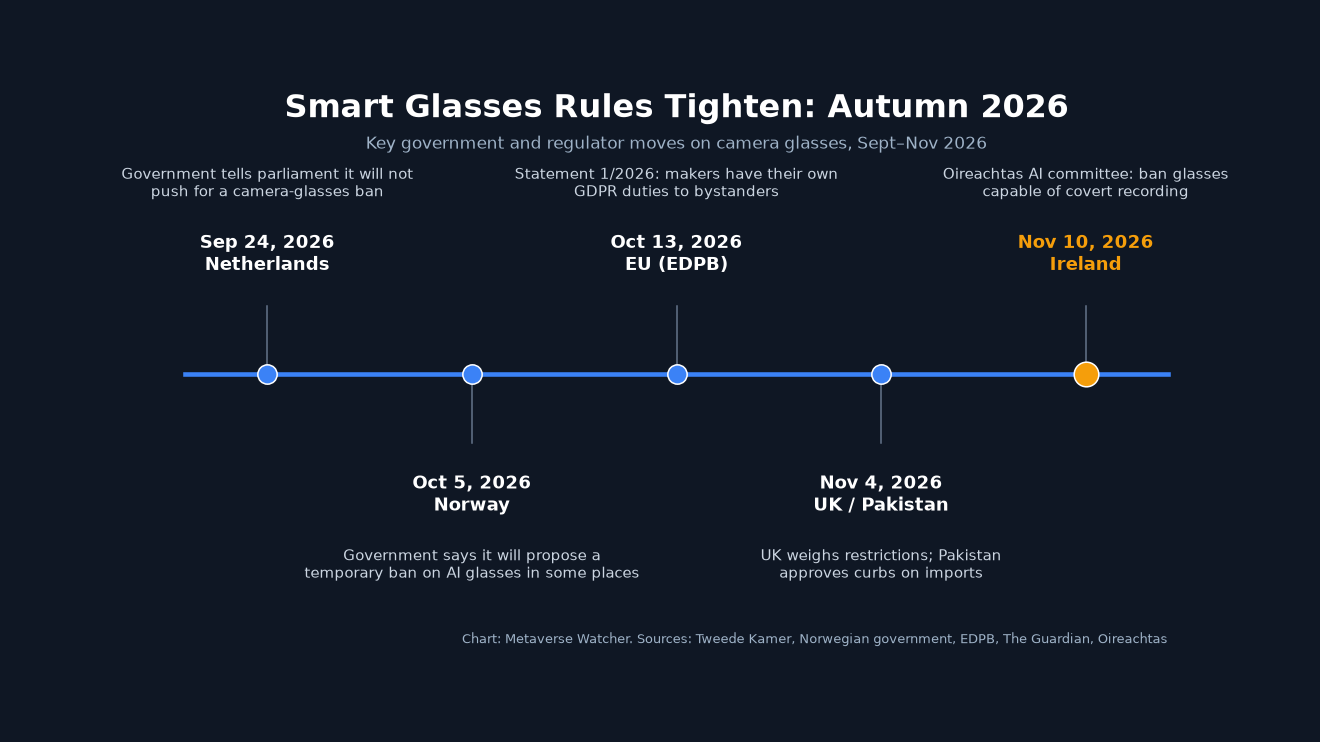
| Country / body | Date (2026) | Move | Status |
|---|---|---|---|
| Netherlands | Sept 24 | Government declines to push for a camera-glasses ban or binding EU design rules | Answer to parliament |
| Norway | Oct 5 | Government says it will propose a temporary ban on AI glasses in selected places | Bill not yet passed |
| EU (EDPB) | Oct 13 | Statement 1/2026 on makers’ GDPR duties and recording signals | Preliminary, non-binding |
| United Kingdom | Nov 4 | Minister says the government is looking at restrictions in certain settings and on sales | Options under review |
| Ireland | Nov 10 | Committee recommends prohibiting glasses capable of covert recording | Recommendation only |
Background on each: the Dutch government’s answers, what Norway’s proposal covers and the UK and Pakistan moves.
What It Means for Buyers and Makers
Nothing changes for Irish owners of Ray-Ban Meta or other camera glasses today. The report is advisory, and any prohibition would need legislation or regulatory action that has not been drafted. For makers, though, the direction is clear. A visible, tamper-resistant recording light is becoming the minimum price of entry in Europe, and the next fight is likely over whether AI camera use should trigger that light too. Glasses without any indicator are the most exposed.
For people who wear glasses at work or in public places, venue and employer rules may move faster than national law. Our guide to smart glasses policies at work covers what organizations are already restricting. Metaverse Watcher will follow whether the Data Protection Commission responds to the committee’s call.
Sources: Houses of the Oireachtas; RTÉ News; Irish Examiner; TheJournal.ie; Irish Independent.