Samsung’s first smart glasses go on sale in the United States and South Korea on December 10, and preorders are already open. For most shoppers, the real decision is simple: buy Samsung’s Intelligent Eyewear, built with Google’s Android XR and Gemini, or buy Ray-Ban Meta (Gen 2), the glasses that have defined this category for the past year. This comparison puts the two side by side using Samsung’s November 12 announcement, Meta’s own launch specifications and independent spec sheets, and explains which pair makes sense for which buyer.

The Short Answer
On paper, Samsung’s glasses are the better hardware: they are lighter, have twice the storage, and claim more battery life in both the frames and the case. Ray-Ban Meta is the safer, more flexible purchase: it costs a little less to start, works with almost any modern iPhone or Android phone, is sold in far more countries, and has a long track record. If you own a recent Galaxy or Pixel phone and want Gemini, Samsung is worth the wait until December 10. If you use an older phone, live outside the US or Korea, or want something proven today, Ray-Ban Meta remains the default choice.
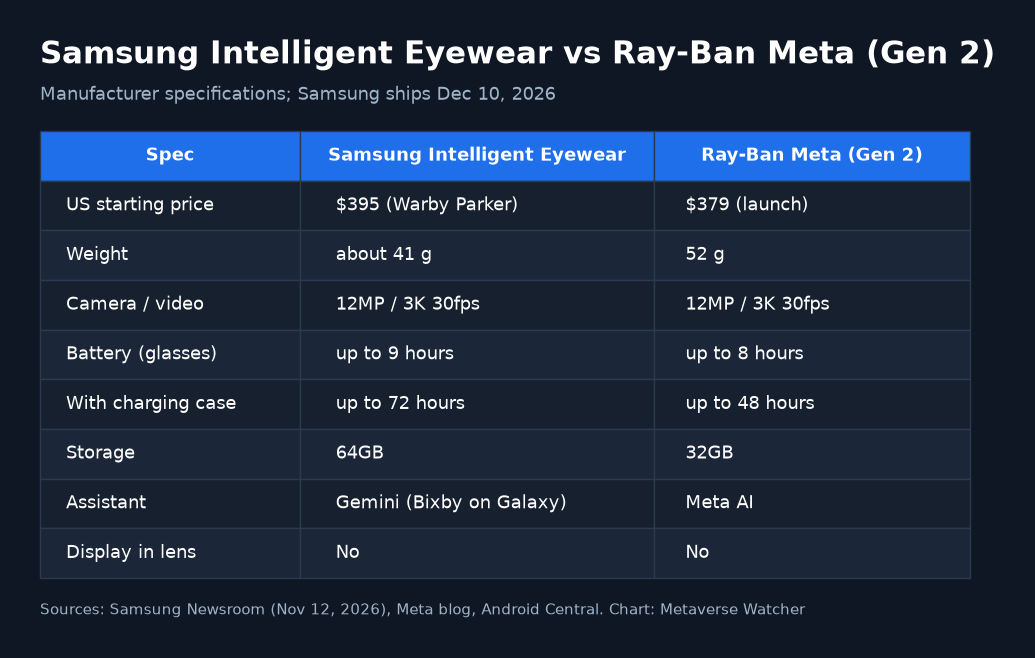
Samsung Smart Glasses vs Ray-Ban Meta: Full Spec Comparison
| Spec | Samsung Intelligent Eyewear | Ray-Ban Meta (Gen 2) |
|---|---|---|
| US starting price | $395 (Warby Parker); $449–$489 (Gentle Monster) | $379 at launch; up to $459 for premium finishes |
| Availability | US and South Korea, December 10, 2026 | US, Canada, UK, much of Europe, Australia, UAE and more |
| Frame designs | 30 (16 Gentle Monster, 14 Warby Parker) | Wayfarer, Skyler, Headliner, with many colors and lenses |
| Weight | About 41 g | About 52 g |
| Processor | Qualcomm Snapdragon AR1 Gen 1 | Not featured in Meta’s launch specs |
| Camera | 12MP with HDR | 12MP ultra-wide |
| Video | Up to 3K at 30fps; HDR up to 2K | Up to 3K at 30fps; 1200p at 60fps |
| Storage | 64GB (2GB memory) | 32GB |
| Audio | 2 open-ear speakers, 4 microphones | 2 open-ear speakers, 5 microphones |
| Battery (glasses) | Up to 9 hours | Up to 8 hours typical use |
| Battery (with case) | Up to 72 hours | Up to 48 additional hours |
| Water resistance | IPX4 | IPX4 |
| Bluetooth | 5.4 (plus Wi-Fi 6E) | 5.3 |
| AI assistant | Gemini; Bixby on Galaxy phones | Meta AI |
| Display | None | None |
| Phone support | Galaxy S, S FE and Z series (One UI 9.0+), Pixel 7 or newer (Android 17), iPhone 13 or newer with 6GB RAM (iOS 26.6+) | iPhone and Android via the Meta AI app |
| Age requirement | 18+ with age verification | See Meta’s terms |
Price: Close, but Ray-Ban Meta Starts Lower
Samsung’s lowest entry point is $395 for a Warby Parker frame, according to Samsung’s newsroom. Gentle Monster frames cost $449 to $489. Meta launched Ray-Ban Meta (Gen 2) at $379, with fancier finishes and Transitions lenses reaching $459, per Meta’s launch post and Digital Camera World’s review. Those are list prices; Ray-Ban Meta is often discounted during sales, while Samsung’s glasses are not yet shipping. With Black Friday on November 27, check our early Black Friday VR and smart glasses deals before paying full price.
Prescription lenses add cost on both platforms. Android Central lists Ray-Ban Meta prescription support from -6.0 to +4.0. Samsung’s partners, Warby Parker and Gentle Monster, are both eyewear retailers, which should make prescription fitting familiar for their customers. Our guide to the best smart glasses for prescription wearers covers how each brand handles lenses.
Comfort and Design: Samsung Is Noticeably Lighter
At about 41 grams, Samsung’s frames are roughly 11 grams lighter than Ray-Ban Meta (Gen 2), which Android Central lists at 52 grams. That is a meaningful difference for glasses worn all day. Samsung also offers 30 designs across its two partners, which gives more choice in shape and fit than Ray-Ban’s three core styles, although Ray-Ban sells those styles in many colors and lens options.
Style is personal. Ray-Ban Meta looks like classic Ray-Ban sunglasses and optical frames; Samsung’s frames look like current Warby Parker and Gentle Monster designs. Neither pair has a display in the lens, so both are camera, audio and AI glasses rather than AR glasses. If you want a screen in your view, see our comparison of Meta Ray-Ban Display vs Even G2.
Camera: Even on Resolution, Different Strengths
Both pairs use a 12-megapixel camera and record video at up to 3K and 30 frames per second. Samsung adds HDR video at up to 2K. Ray-Ban Meta (Gen 2) adds a 1200p mode at 60 frames per second for smoother motion. Clip length is a real difference: as we noted in our Android XR vs Ray-Ban Meta privacy comparison, Google caps video on its glasses at 90 seconds, while 9to5Google reports Ray-Ban Meta clips can run up to five minutes. If you plan to film concerts, rides or long walks, Ray-Ban Meta currently has the edge.
Storage favors Samsung. Its 64GB is double Ray-Ban Meta’s 32GB, which Android Central estimates at about 500 photos and 100 30-second videos. Both pairs sync captures to the phone, so storage matters most on trips where you cannot offload often.
Battery Life: Samsung Claims More
Samsung rates its glasses at up to 9 hours, and up to 72 hours including the charging case. Meta rates Ray-Ban Meta (Gen 2) at up to 8 hours of typical use, or about 5 hours of continuous audio, plus 48 extra hours from the case. Meta also says the glasses reach 50% in 20 minutes. Samsung’s numbers have not yet been tested by reviewers, so treat them as claims until retail units arrive. For tips that apply to Meta’s glasses today, read our Ray-Ban Meta battery life guide.
AI Assistant: Gemini vs Meta AI
This is the biggest practical difference. Samsung’s glasses run Gemini, which works with Google’s apps and services on your phone, and Galaxy owners can also use Bixby. Ray-Ban Meta uses Meta AI, which connects well with Instagram, WhatsApp and Facebook and supports features such as live translation and hands-free messaging. If your digital life runs on Google, Gemini will likely feel more useful. If you share to Instagram and message on WhatsApp, Meta AI fits better.
Privacy policies also differ. Google says images Gemini sees through the glasses are not saved in Gemini History or used to train models, and bystander faces are redacted on the phone before processing. Meta’s rules are looser on AI images. Our side-by-side privacy breakdown covers each policy in detail.
Phone Compatibility: Check Before You Preorder
Samsung’s glasses have a strict compatibility list. They work with Galaxy S, S FE and Z series phones on One UI 9.0 or later, Pixel 7 or newer on Android 17, and iPhone 13 or newer with 6GB of RAM on iOS 26.6 or later. That rules out many mid-range Android phones and the iPhone 13 and iPhone 13 mini, which have 4GB of RAM. Our report on Google Intelligent Eyewear price, specs and compatible phones has the full list, and our guide to pairing Samsung’s glasses with the Galaxy Wearable app explains setup. Ray-Ban Meta, by contrast, works with a broad range of iPhone and Android phones through the Meta AI app; our Ray-Ban Meta setup guide walks through it.
Who Should Buy Which
| If you… | Choose |
|---|---|
| Own a recent Galaxy or Pixel phone and use Google services | Samsung Intelligent Eyewear |
| Want the lightest frame and the most storage | Samsung Intelligent Eyewear |
| Prefer Warby Parker or Gentle Monster styles | Samsung Intelligent Eyewear |
| Use an older or mid-range phone | Ray-Ban Meta (Gen 2) |
| Live outside the US or South Korea | Ray-Ban Meta (Gen 2) |
| Want longer video clips or 60fps recording | Ray-Ban Meta (Gen 2) |
| Share mostly to Instagram and WhatsApp | Ray-Ban Meta (Gen 2) |
| Want the lowest price, especially on sale | Ray-Ban Meta (Gen 2) |
Bottom Line
Samsung has matched Ray-Ban Meta on camera resolution and beaten it on weight, storage and claimed battery life, at a similar price. Its weaknesses are narrow phone support, a two-country launch, a 90-second video cap and no real-world reviews yet. Ray-Ban Meta (Gen 2) is the proven, widely compatible option and is likely to see Black Friday discounts. If you are undecided, the sensible move is to wait for the first Samsung reviews after December 10. For the wider market, including Oakley Meta and other options, see our best smart glasses of 2026 and our Ray-Ban Meta vs Oakley Meta comparison.