Google did not just put a price on its first Android XR glasses this week. It also published the most detailed privacy rulebook any major smart glasses maker has offered so far. In a November 12 post on Google’s blog, Shahram Izadi, Google’s VP and GM of XR, laid out how the Intelligent Eyewear frames from Samsung, Warby Parker and Gentle Monster handle the camera, Gemini, bystanders and third-party apps. The obvious question for anyone choosing between these glasses and Ray-Ban Meta is how the two rulebooks compare. This is our side-by-side, built from Google’s post, Meta’s own privacy notice and the reporting that has tested both companies’ claims.
The Short Version
On paper, Google’s rules are stricter than Meta’s on three points that matter to bystanders and buyers: what happens to images the AI sees, whether faces are hidden from the AI, and what third-party apps are allowed to do with the camera. On one point, the two companies are effectively the same. NEITHER company’s outward recording light turns on when the wearer asks the AI to look at something. And several of Google’s strongest promises are policies, NOT yet independently verified technical controls.
If you have not followed the launch, our earlier report covers the basics: Google Intelligent Eyewear price, specs and compatible phones. Warby Parker frames start at $395, Gentle Monster at $449, and retail sales begin December 10 in the United States and South Korea.
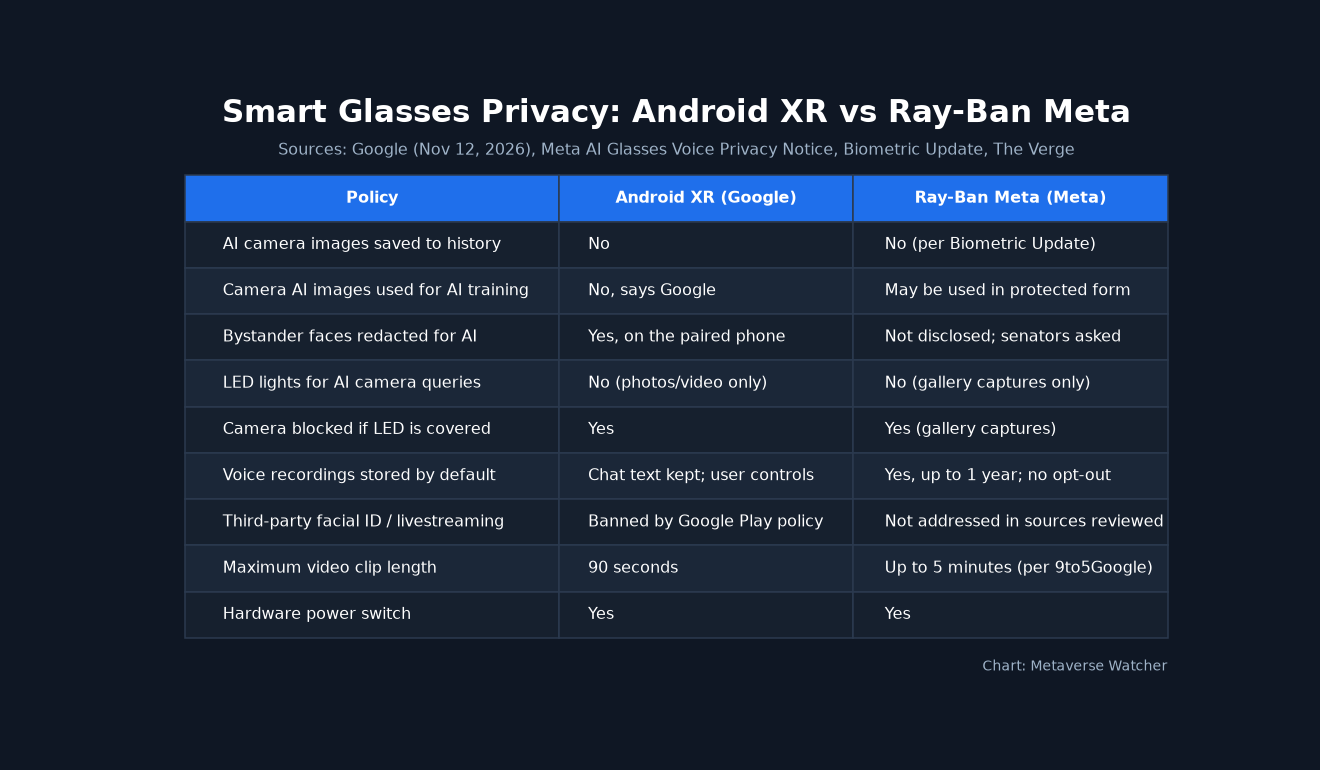
Side-by-Side: Android XR vs Ray-Ban Meta Privacy Rules
| Policy | Android XR Intelligent Eyewear (Google) | Ray-Ban Meta (Meta) |
|---|---|---|
| Camera images sent to the AI saved in chat history | No. Google says Gemini camera visuals are not saved in Gemini History. | No. Meta does not store those AI images in the user’s Meta AI history, according to Biometric Update’s reporting. |
| Camera images used for AI training | No. Google says the visuals are not used to train AI models or target ads. | Meta acknowledges the images can be used, in protected form, to improve products. |
| Bystander faces hidden from the AI | Yes. Faces are redacted on the paired phone before Gemini processes the image. | Not disclosed. Senators asked Meta in October whether faces are blurred for AI features. |
| Outward light during AI camera queries | No. The LED is for photos and videos saved to the gallery. | No. Meta’s capture LED covers content “captured for your gallery.” |
| Camera disabled if the light is covered | Yes, with a recurring self-check of the LED. | Yes, for gallery captures on newer models. |
| Voice data stored by default | Chat text is kept in Gemini History; users control history and whether text trains models. | Yes. Recordings and transcripts stored up to one year; the storage opt-out was removed in April 2025. |
| Third-party facial recognition or livestreaming | Prohibited for Google Play apps. | Not addressed in the sources we reviewed. |
| Maximum video clip | 90 seconds | Up to 5 minutes, per 9to5Google |
| Account age | 18+ Google account required | See Meta’s own terms |
1. What Happens to the Images the AI Sees
This is the clearest difference. Google’s post says camera visuals Gemini uses to answer a question “are not used to train AI models or target ads,” and are not saved in Gemini History. Google went further in a conversation with 9to5Google, which reports that Gemini camera captures are purged immediately after use, and that this is not a setting the user can change. Photos and videos you deliberately take still go to your gallery.
Meta’s position is looser. Its photos and videos stay on your phone unless you share them, and a Meta spokesperson told The Verge in 2025 that gallery captures are not used for training. But images processed by Meta AI are a different category. As we reported in September, Meta acknowledges those images can be used, in protected form, to improve its products. Senators Ron Wyden and Edward Markey quoted Meta’s own disclosures back to the company in October, writing that imagery processed through the glasses’ visual AI “may be retained and used to train AI systems, including with the assistance of human reviewers.” Our coverage of the Wyden and Markey letter has the full list of questions; Meta’s reply is due before Thanksgiving.
2. Faces: Redaction vs Silence
Google says its glasses “automatically redact bystanders’ faces before Gemini processes the visuals.” According to 9to5Google, the redaction runs locally on the paired phone, inside the glasses app, before anything is sent to Gemini. Android Police notes that the wearer’s own face is redacted too, for example if you look into a mirror while asking a question.
Meta has not described an equivalent step for its glasses. Biometric Update reports that Meta strips some identifiers, such as license plates and phone numbers, and says it does not use facial recognition in its consumer AI features. Meta has, however, acknowledged exploring facial recognition for glasses under the NameTag project, which is the subject of a contested Illinois biometric privacy suit. Google, by contrast, publicly bans real-time facial identification on its platform.
3. The Recording Light: Same Gap on Both Platforms
Here the two companies land in the same place. Google’s outward LED lights up “when you take a photo or video for your gallery.” 9to5Google confirms that if you are just using Gemini for context, the light does not activate. Meta’s capture LED is likewise scoped to content captured for the gallery, which is why we called it a privacy gap in September.
That matters most in Europe. The European Data Protection Board’s October statement asks for indicators that make AI-assisted camera processing noticeable to people nearby, not only conventional recordings. Our explainer on the EDPB’s smart glasses guidance covers the four signals it recommends. Google’s argument is that a bystander’s face never reaches Gemini unredacted, and the image is deleted after use. That reduces what the AI can learn about a stranger, but as Biometric Update points out, it still does not tell that person their image is being analyzed.
On tamper resistance the two are close. Google says sensors detect a covered or tampered light and block photos and video, and 9to5Google reports a recurring self-check that blinks the LED white and blue while charging. Meta’s second-generation glasses also refuse gallery capture when the light is blocked.
4. Voice Data
Meta’s rules here are the most restrictive for users. Its AI Glasses Voice Privacy Notice says transcripts and audio recordings are stored by default and kept “for up to one year to help improve Meta’s products,” with trained reviewers involved. Accidental wakes are deleted within 90 days. Since April 2025 there has been no switch to turn storage off; you can only delete recordings in the Meta AI app.
Google keeps the text of Gemini chats in Gemini History by default, and you can review or delete them and choose whether that text is used to improve its models. IBTimes reports that conversation text is kept for 18 months under standard settings. Google also says Gemini focuses on the wearer’s voice using directional microphones, filtering out people nearby. That is a real advantage for bystanders, though it is a design claim we have not seen independently tested.
5. Third-Party Apps: Google’s Biggest Bet, and Its Biggest Open Question
Google’s Play policies prohibit Android XR glasses apps from using the camera for social livestreaming or real-time facial identification, and from changing how the indicator light behaves. Every app must ask before it touches the camera, and access can be revoked per app. Google Shopping and Google Ads also ban products designed to hide recording lights, and wearers must agree not to record people without permission or in sensitive places, or risk having their glasses disabled.
The caveat is enforcement. Biometric Update reviewed Google’s developer documentation and found that authorized apps reach the glasses’ camera through standard Android CameraX interfaces on the paired phone. It found no published operating-system control that technically stops an approved app from running face analysis, and no documentation showing that Gemini’s face redaction applies to third-party apps. Google’s rules also apply to Play Store apps; how they would reach apps distributed elsewhere is not documented. None of that shows facial recognition is possible on the glasses. It means the ban currently rests on policy review, not a verified technical lock.
6. Recording Limits and Accounts
Google caps video recording on Intelligent Eyewear at 90 SECONDS per clip, saying most recordings fell inside that window anyway. 9to5Google notes that Meta allows recordings of up to five minutes. Shorter clips make long covert recording harder, at the cost of creative use. Google also requires an 18+ Google account to set up the glasses, and every pair has a physical power switch so it can be worn as ordinary eyewear.
What This Means If You Are Buying
- If AI training is your main concern, Google’s published rules are the stronger promise: camera visuals are not used for training or ads and are deleted after use. With Ray-Ban Meta, assume anything you send to Meta AI can be used to improve Meta’s products.
- If you worry about the people around you, Google’s face redaction and voice focus are meaningful additions. But neither platform lights the LED when the AI looks at the scene, so the etiquette burden still sits with the wearer.
- If you use glasses at work, check your employer’s rules before either pair goes on your face. Our guide to smart glasses policies at work covers what companies are restricting.
- If you want the most features, Meta still offers more apps, longer clips and a larger installed base. Our Ray-Ban Meta vs Oakley Meta buying guide compares Meta’s lineup in detail.
What to Watch Next
Three dates will test these promises. Meta’s answer to the Wyden and Markey letter is due before Thanksgiving on November 26. Google’s glasses reach stores on December 10, when independent reviewers can check how the LED, redaction and app permissions behave in practice. And Ireland’s parliamentary AI committee recommended on November 10 that smart glasses capable of covert recording without consent be prohibited, according to Biometric Update. That recommendation is not law, but it shows where European debate is heading.
Google has set a higher written standard than Meta. Whether it holds up depends on enforcement that, for now, outsiders cannot fully verify. Metaverse Watcher will update this comparison when Meta responds to the senators and when the first Intelligent Eyewear units ship.
Sources: Google; 9to5Google; Android Police; Biometric Update; Meta AI Glasses Voice Privacy Notice; The Verge.