Two US senators have opened the most direct federal challenge yet to Meta’s camera glasses. In a letter dated Wednesday, October 28, Sen. Ron Wyden (D-Ore.) and Sen. Edward Markey (D-Mass.) asked Mark Zuckerberg to explain how Meta’s AI glasses protect bystanders from nonconsensual filming, and how footage captured by the glasses is used for AI TRAINING. 404 Media first reported the letter on October 29, and Bloomberg Law reported that the senators want both answers and documents on the testing and risk assessments Meta ran before launch.
What the senators wrote
The letter opens bluntly: “Meta’s smart glasses have increasingly been implicated in disturbing invasions of users’ and bystanders’ privacy.” It argues that Meta “identified risks to bystander privacy and vulnerable populations before launching its glasses in 2021” and shipped anyway, according to PetaPixel’s summary.
The sharpest passage targets Meta’s own data practices rather than bad actors. “Meta’s own disclosures confirm that imagery processed through its glasses’ visual AI features may be retained and used to train AI systems, including with the assistance of human reviewers,” the senators wrote, as quoted by 404 Media. They called the reported disclosure of intimate footage to contractors “particularly disturbing,” adding that “exposing unsuspecting individuals’ intimate moments to strangers for AI training is quite another” matter from human review a user knowingly requested.
The letter closes with a line aimed squarely at Meta’s public privacy messaging: “Meta’s professed commitment to privacy and preventing intimate image abuse rings hollow if the company cannot demonstrate meaningful steps to prevent its own products and practices from facilitating those harms,” as reported by Engadget.
The questions Meta has to answer
Based on the reporting from 404 Media, Engadget and PetaPixel, the senators’ questions fall into five groups:
| Area | What the senators asked |
|---|---|
| Safeguards | What Meta does to prevent the nonconsensual “capture, disclosure, or processing of sensitive and intimate imagery” |
| Risk assessment | Whether Meta evaluated the glasses’ potential “to facilitate voyeurism, nonconsensual intimate image capture, or similar privacy invasions,” and whether it ran human rights due diligence and safety testing before release |
| Recording indicator | How Meta handles accidental camera activation and tampering with the recording light |
| AI training and access | What imagery is used to train AI, when employees or contractors can see it, and whether faces and license plates are blurred for AI features, as Meta does on Facebook and Instagram |
| Deletion | Whether people can request deletion of biometric and other data the glasses collect |
Engadget and PetaPixel, citing Gizmodo, report that the senators want responses before Thanksgiving, which falls on NOVEMBER 26.
Why this letter matters more than earlier criticism
Congressional letters carry no legal force on their own, and Meta is not obliged to change anything by the deadline. What makes this one different is its focus. Most criticism of camera glasses has centered on people misusing them, such as the Instagram accounts 404 Media found in an October 2025 investigation posting covert videos filmed inside massage parlors. This letter goes further and asks whether Meta’s own pipeline, from cloud AI processing to human data labeling, exposes BYSTANDERS who never agreed to anything.
That framing puts a spotlight on settings most owners never think about. The camera LED is the only signal a bystander gets, and our Ray-Ban Meta setup guide covers where the AI and media-sharing controls live in the Meta AI app. Our recent analysis of eye tracking and smart glasses privacy shows the same questions will get harder as glasses gain more sensors.
A month of mounting pressure
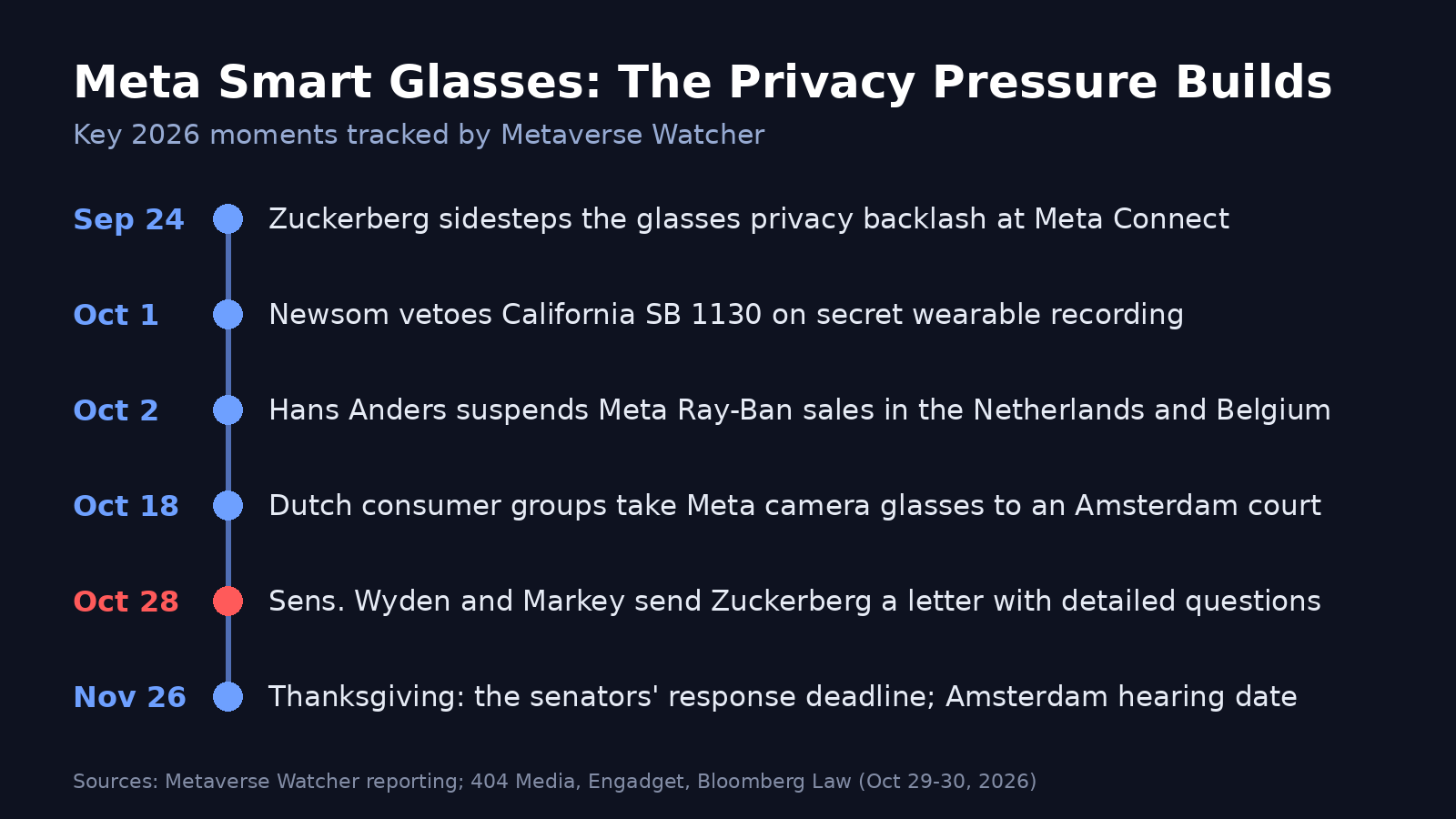
The letter caps a run of setbacks Metaverse Watcher has tracked since Meta Connect:
- September 24: Zuckerberg sidestepped the glasses privacy backlash at Connect, pitching stronger encryption instead.
- October 1: Gov. Gavin Newsom vetoed California’s SB 1130, which would have been the first state law aimed specifically at secret recording with wearables.
- October 2: Optical chain Hans Anders suspended Meta Ray-Ban sales in the Netherlands and Belgium.
- October 18: Dutch consumer and privacy groups took Meta to court in Amsterdam, with summary proceedings set for November 26.
The calendar overlap is worth noting. Meta now faces a US Senate deadline and a Dutch court hearing in the same week, right as it heads into the holiday season that drives a large share of smart glasses sales.
What buyers should take from it
Nothing changes for current owners today, and no product is being pulled in the US. But the letter is a strong signal that bystander privacy, AI training consent and data deletion will shape how camera glasses are regulated. Anyone shopping this season should compare privacy controls alongside specs; our best smart glasses of 2026 list includes camera-free options from Even Realities and others for buyers who want a display without a lens pointed at the world.
Reports through October 29 included no public response from Meta. Metaverse Watcher will update this story if the company replies or the senators publish its answers.