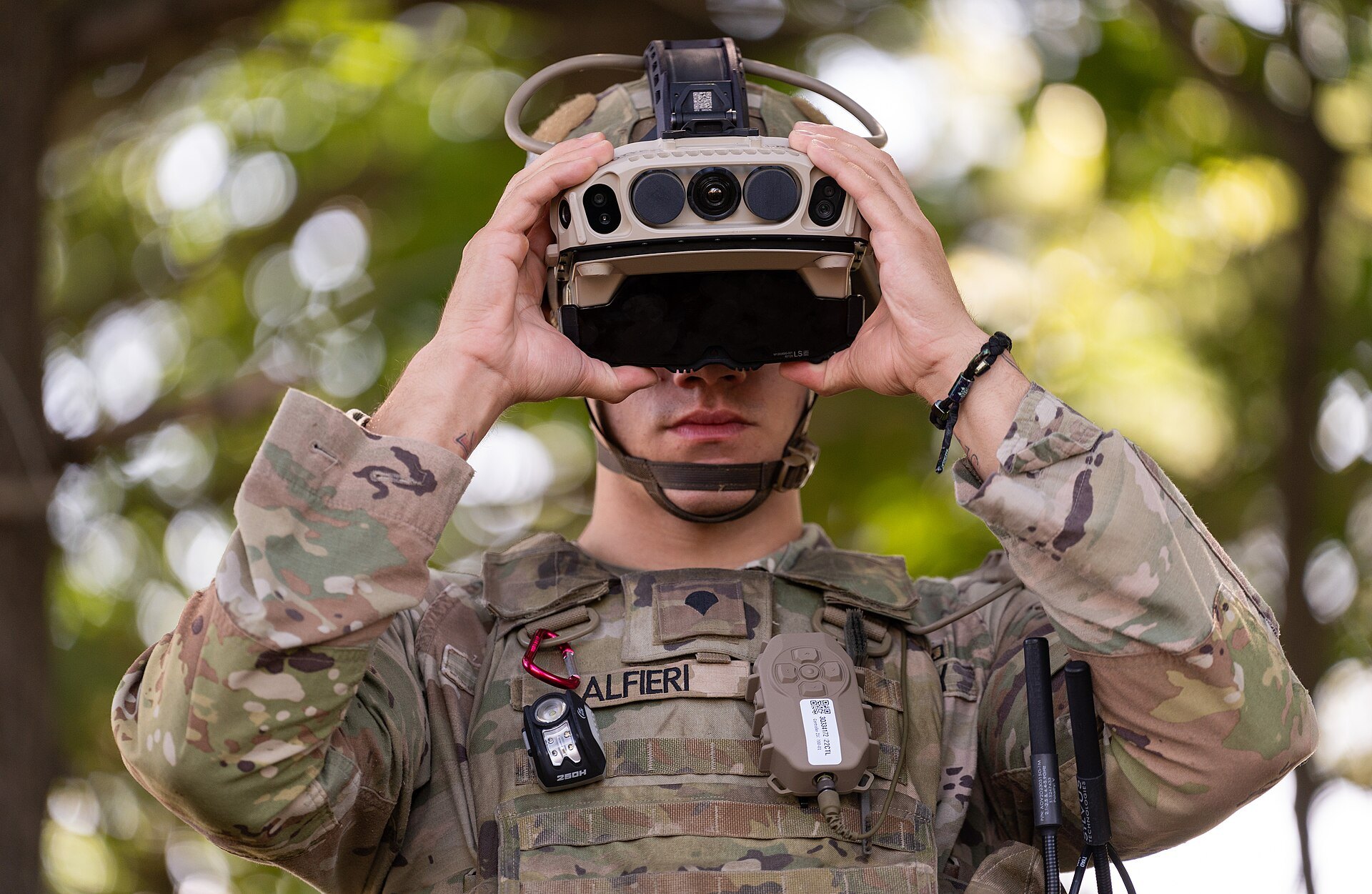
Rivet, the Washington, D.C. startup that WON a slot on the U.S. Army’s Soldier Borne Mission Command (SBMC) program last year, says it has now DELIVERED its FIRST 70 prototypes to the Army and RAISED $55 million in Series A financing since the award. Co-founder and chief executive Dave Marra laid out those FIGURES in an interview published by Defense News on October 13, and he used the same conversation to describe a much BIGGER AMBITION: glasses through which a soldier COMMANDS AI agents that, in turn, task ROBOTS and DRONES.
The hardware is called the Rivet Hard Spec, and its FORM FACTOR is the POINT. Where the Army’s earlier Integrated Visual Augmentation System (IVAS) was a FULL headset that soldiers criticized as CLUNKY, Rivet built a pair of MILITARIZED smart glasses. That puts a DEFENSE contractor squarely on the same design path as the CONSUMER smart-glasses market, rather than the mixed-reality HEADSET path the Army tried FIRST.
What Rivet Actually Disclosed
- Prototypes: 70 units DELIVERED to the Army, according to Marra. The interview does NOT say which units hold them or how they are being used.
- Funding: a $55 million SERIES A, raised SINCE the SBMC selection.
- Original mission: actionable TARGETING and NAVIGATION information for INFANTRY.
- Expanded mission: step-by-step PROCEDURES for technical and mechanical work a soldier does not perform EVERY day, replacing a PHYSICAL manual.
- Civilian markets: aerospace MANUFACTURING plus aircraft and motor pool MAINTENANCE.
Marra framed the maintenance use case as ERROR PREVENTION rather than reskilling. “If you happen to forget or you’re not 100% proficient in this role or you don’t do this particular procedure every single day, you can very easily see how a step could be overlooked, especially when you’re in a high-stress environment,” he told the outlet. The glasses are NOT meant to turn an infantryman into a mechanic, he said, but to put the CORRECT procedure in front of a TRAINED professional.
The Agent Pitch Is a Roadmap, Not a Requirement
The HEADLINE-grabbing part of the interview is Rivet’s LONGER-term goal. “I’m asking an agent to go do something on my behalf,” Marra said. “What we want to get is where an agent and a robot can task each other.” He WANTS soldiers to talk to those systems “in common language, not command language,” giving the example of telling a drone that a target sits over a hill and asking it to ORBIT, reconnoiter and send back VIDEO.
His rationale is that glasses are the most PRACTICAL way to give AI PERCEPTION in the FIELD. “The best way to do that today is having a pair of glasses that has eyes and ears on [the AI],” he said. “So in many cases, I would say that we’re putting eyes and ears on AI.”
That vision should be read CAREFULLY. NOTHING in the reporting describes an Army CONTRACT or REQUIREMENT for glasses that task drones through AI agents; as The Vanguard USA noted, the delivered prototypes are tied to SBMC, and agent control is a COMPANY goal, not a FIELDED feature. It is also NOT a new theme: when Rivet was PICKED in 2025, Marra told Defense One that “natural language interactions are the most critical element to enable,” and summed up his design priorities as “comfort, ruggedization, utility, and compliance.”
Rivet's CEO envisions a world where a soldier commands an AI agent, and the AI agent commands the robots and drones. https://t.co/EerOLVGdtH
— Defense News (@defense_news) October 13, 2026
Two Very Different SBMC Bets
SBMC, previously known as IVAS Next, is the Army’s planned DAY/NIGHT situational awareness and mission command platform for COMPANY-level dismounted troops, designed to stay BACKWARD compatible with the Android Tactical Assault Kit (ATAK). In September 2025, DefenseScoop reported that Rivet had executed a $195 MILLION agreement for the program and Anduril had landed a $159 MILLION deal.
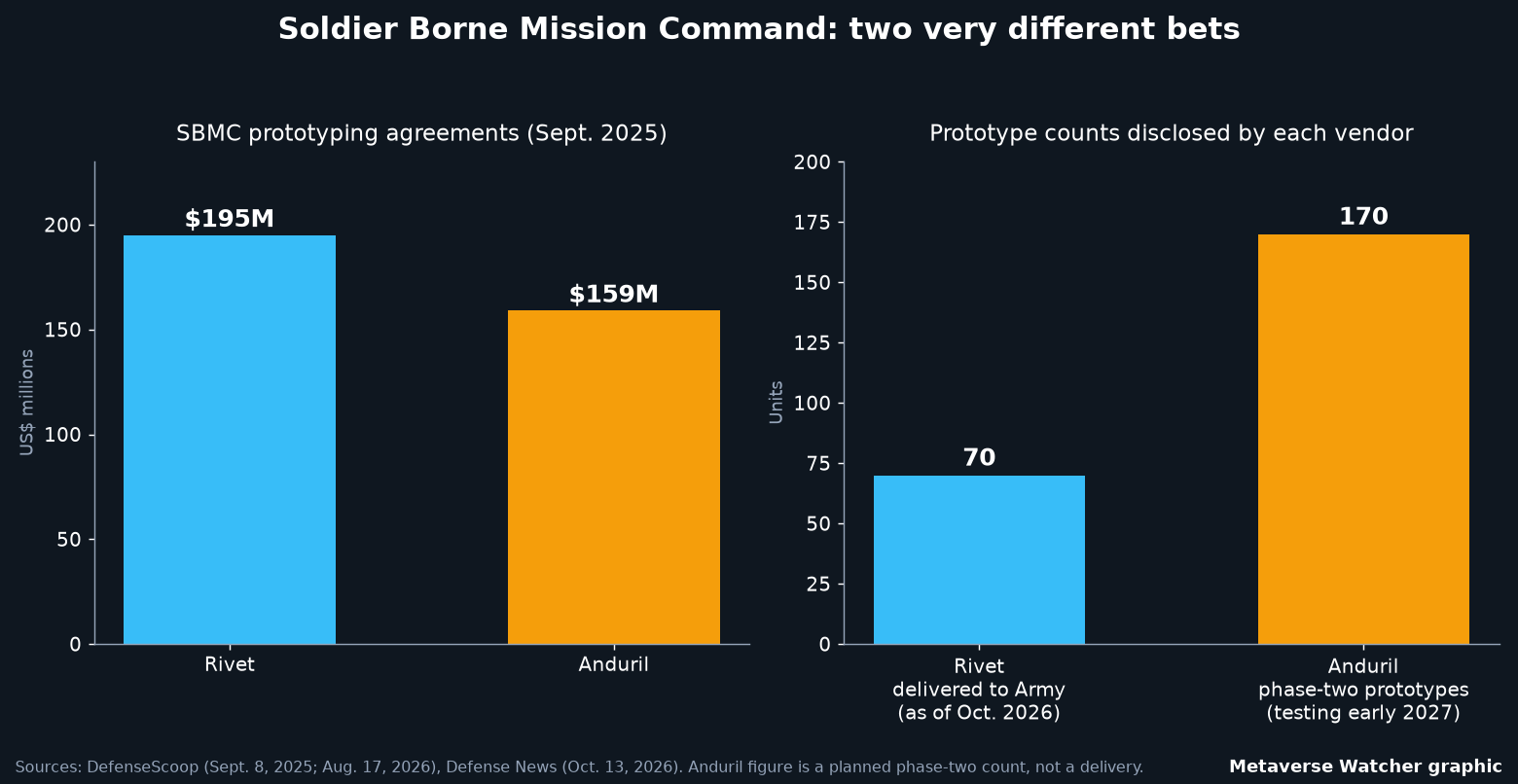
The two vendors have since DIVERGED. In August, Anduril told reporters it was “moving from phase one to phase two,” according to DefenseScoop. Its phase-one kit paired heads-up display GLASSES, built in partnership with Meta and Oakley’s Standard Issue brand, with a FLIP-DOWN sensor bar for NIGHT VISION and THERMAL imaging, an edge compute device, a battery and a controller. Anduril said the full display weighs about 110 GRAMS, that it will deliver 170 PHASE-TWO prototypes with testing slated for late January or early February, and that phase two moves to DIGITAL night vision with 4K DISPLAYS and a field of view about 70% WIDER than current night vision systems. A DOWNSELECT and PRODUCTION award could come in fiscal 2028.
Rivet’s pitch leans harder on PROCUREMENT realities than SPECTACLE. Its Hard Spec page describes a MODULAR range of optical, computing, communications and sensor hardware UNIFIED by Rivet OS, and argues that “all-in-one consumer products fail” and that durable solutions are “modular and iterative.” On X, the company has SAID its HUD integrates into Wilcox’s FUSION CLAW ecosystem through the MANTIS mounting solution.
Why the XR Industry Should Watch
The Army’s HARD lesson from IVAS was that soldiers will NOT wear equipment that is HEAVY or makes them SICK; DefenseScoop’s reporting cites complaints about weight, form factor and NAUSEA. BOTH vendors named here have put a GLASSES-style display at the center of their SBMC hardware, and Anduril’s phase-one HUD was BUILT in partnership with Meta and Oakley’s Standard Issue brand. That CONVERGENCE matters for anyone tracking smart glasses: the same constraints driving Ray-Ban Meta and Android XR eyewear, namely WEIGHT, COMFORT and ALL-DAY wearability, now shape the successor to a program that was once expected to be worth up to $22 BILLION.
Still, Rivet’s announcement is a set of STATUS claims from a CEO interview, NOT an Army statement. The company has not published SPECIFICATIONS for Hard Spec, has not NAMED the units using its 70 prototypes, and has not said when its AGENT-CONTROL features might reach testing. The REAL test is the downselect, and on the timeline Anduril has described, that is still more than a YEAR away.
Sources
- Defense News: Startup wants US soldiers to command AI agents through its smart glasses (Oct. 13, 2026)
- The Vanguard USA: Rivet says it delivered 70 smart-glass prototypes to the Army (Oct. 14, 2026)
- Rivet: Rivet Hard Spec product page
- DefenseScoop: Army awards more than $350M in contracts for SBMC prototypes (Sept. 8, 2025)
- DefenseScoop: Anduril redesigns tech for Army’s SBMC program (Aug. 17, 2026)
- Defense One: Army picks startup Rivet to build AI-enabled soldier glasses (Sept. 6, 2025)
- Rivet Industries on X: Wilcox FUSION CLAW / MANTIS integration (Sept. 9, 2026)
- Featured image: Soldier dons IVAS 1.2 prototype, U.S. Army photo by Jason Amadi, public domain, via Wikimedia Commons
