Caterpillar is pairing with FieldAI to push physical AI, autonomy, and robotics onto construction jobsites and factory floors — and the stack explicitly leans on NVIDIA accelerated computing and NVIDIA Omniverse digital twins. The companies announced the collaboration on September 2, 2026; trade coverage followed through September 4–5.

This is not a consumer headset story. It is the industrial side of spatial computing: live site data feeding high-fidelity twins, robots that can operate in unstructured environments, and OEM machinery data that Caterpillar already owns at scale. For Metaverse Watcher readers, the useful hook is Omniverse-backed digital twins moving from demo reels into a named heavy-equipment partnership.
What the collaboration covers
Per Caterpillar’s September 2 release, the companies will combine Caterpillar’s engineering, operational data, and industry expertise with FieldAI’s robot-agnostic foundation models. Early applications listed in the release:
- Autonomous inspections for safety and operational visibility
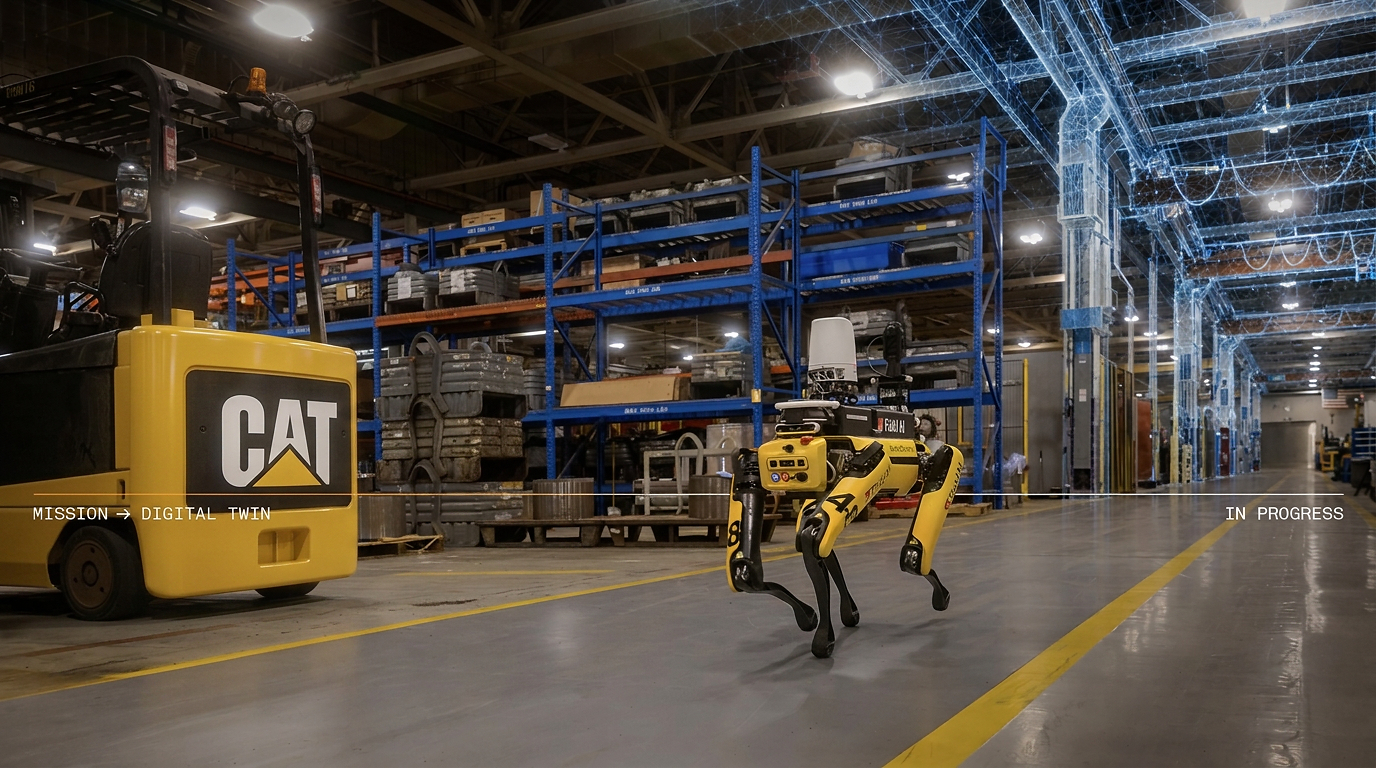
- Jobsite and facility digital twins with real-time insight into equipment, infrastructure, and operations
- Situational awareness to surface risks earlier
- Operational optimization through simulation, automation, and AI-driven insights
Construction Dive frames the deal as Caterpillar advancing automation across its machine catalog, building on the company’s CES 2026 “jobsite of the future” messaging around intelligent excavators, loaders, and dozers.
Why Omniverse is in the sentence
Caterpillar’s release is explicit: the collaboration leverages NVIDIA accelerated computing, NVIDIA Omniverse technologies, and high-fidelity digital twins built from operational data. That is the spatial-computing layer — reconstruct the site, simulate it, then close the loop with robots and machines that can act on what the twin shows.
FieldAI’s own positioning matches the unstructured-site problem that kills most industrial robotics pilots. The company describes Field Foundation Models that mix data-driven AI with physics-based reasoning and uncertainty awareness, and says it has raised more than $400 million, including from NVentures (NVIDIA’s venture arm), Bezos Expeditions, Khosla Ventures, and others. Caterpillar CTO Jaime Mineart put the thesis plainly: industries will be shaped by how well human expertise combines with AI-powered machines.
What is confirmed — and what is not
Confirmed: September 2 collaboration announcement; focus on physical AI, autonomy, and robotics for jobsites and factories; early use cases above; NVIDIA Omniverse / accelerated computing named in Caterpillar’s release; FieldAI selected for complex, dynamic industrial deployments.
Not confirmed: Pricing, ship dates for any new product SKU, number of pilot sites, exclusive OEM rights, or a public Omniverse customer case study with measured ROI. Construction Dive notes the broader construction robotics wave (including other autonomous excavator trials) but does not attach fleet numbers to this Caterpillar–FieldAI deal.
The takeaway for the metaverse beat is capital and platform gravity. While consumer XR fights over glasses launch windows and summer headset calendars, Caterpillar is wiring Omniverse-class twins into the machinery that already digs the dirt. Spatial computing here looks like a jobsite operating system, not a storefront avatar.
Sources: Caterpillar / PR Newswire (Sep 2, 2026); Construction Dive (Sep 4, 2026); Robotics 24/7 (Sep 5, 2026); FieldAI.