A Qualcomm veteran’s startup wants EYEGLASSES to do the job HEARING AIDS often fail at, and it is now looking for San Diego volunteers to PROVE it. AYNAK Inc., incubated at UC San Diego’s Qualcomm Institute, is recruiting local participants to test PROTOTYPE EYEWEAR with AI hearing assistance built into the FRAME, according to a September 30 UC San Diego feature.
The plan is SMALL and deliberate. AYNAK will distribute roughly 35 PROTOTYPE pairs through local optical stores before the holidays, followed by a SECOND distribution in January 2027. The company’s PILOT sign-up page adds the schedule: starting DECEMBER 11, TESTERS wear an early version for about THREE months, attend approximately two in-person visits, and answer three short questions each week.
A vision SENSOR that never takes pictures
The pitch is not simply a hearing aid hidden in a temple arm. Founder and CEO Ramesh Chandrasekhar calls the system MULTIMODAL. “We don’t just have microphones,” he told UC San Diego. “There is a vision sensor, but it’s not to take pictures; the images never leave the glasses. It’s to help you hear by adjusting to different contexts.”
In practice, a small vision SENSOR helps identify the PERSON the wearer is looking at, while MICROPHONES in the FRAME capture sound from different directions. On-DEVICE AI fuses those inputs in real time to make the TARGET VOICE clearer without muting the rest of the room.
The hard part is LATENCY. Wearers hear both the amplified signal from the GLASSES and the natural sound traveling through the air, so the two must arrive almost together or the result is an audible ECHO. That leaves the model only MILLISECONDS per decision, which is why AYNAK processes everything on the GLASSES rather than in the CLOUD. A companion smartphone app lets users tune frequencies to their own hearing profile.
Who can test, and what they get
According to the PILOT page, participants must live in San Diego County (with limited exceptions possible), have a CURRENT eyeglass prescription, own an iPhone or Android phone, and be able to attend two local visits. AYNAK fits the tester’s own PRESCRIPTION lenses into its FRAMES and lends the EYEWEAR for the length of the PILOT. The La Jolla Ledger reports that the participating optical stores have NOT yet been announced, and the PILOT page says the appointment location is still being finalized.
AYNAK is CANDID about maturity. “This is an early pilot, not a finished product,” the page states, warning that some features may not work as expected and that the design may CHANGE during and after the trial. The latest PROTOTYPES come in TWO FRAME styles.
A licensing play, not a GLASSES brand
Chandrasekhar spent 26 YEARS at Qualcomm working on augmented reality and on squeezing electronics into small devices like GLASSES. The project started closer to home: his mother-in-law began losing her hearing around 2015, resisted HEARING AIDS over STIGMA, and the family eventually went through about seven pairs and roughly $15,000 while she still struggled in noisy restaurants. “People have no problem wearing glasses,” he said. “There’s no stigma associated with it.”
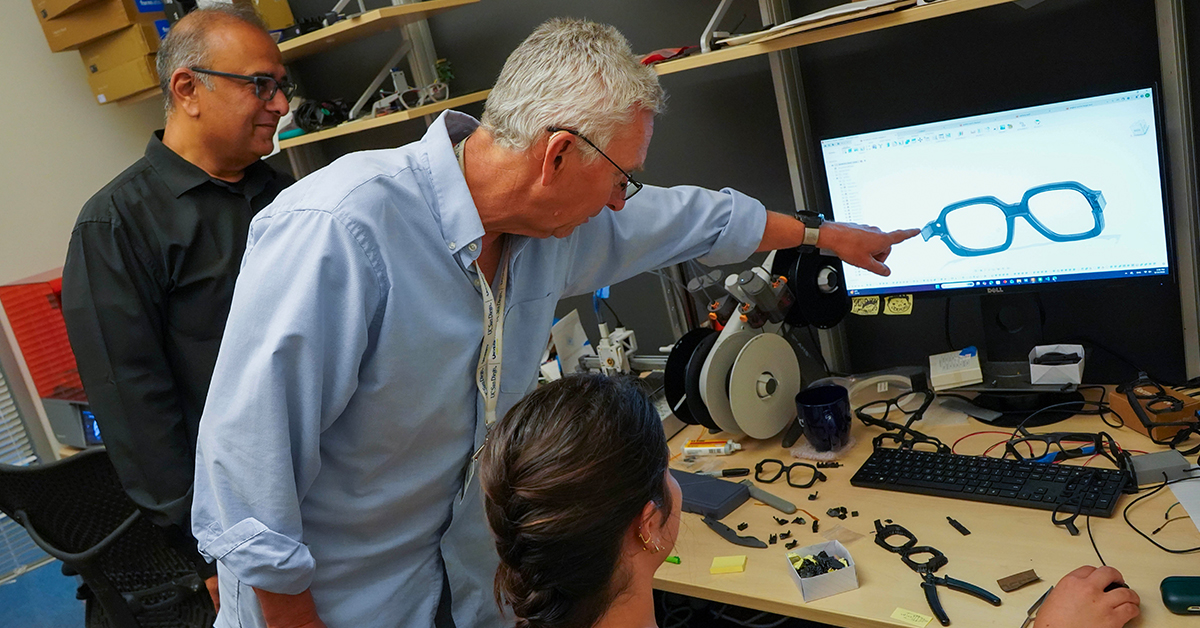
The business model is LICENSING. “Our business is to license the technology, so we need to know how to make the sausage,” Chandrasekhar said, explaining why the team builds PROTOTYPES in-house instead of handing them to a contract manufacturer. Longer term, AYNAK plans to PARTNER with EYEWEAR makers on fashion, explore lower-cost FRAMES for countries where audiology services are scarce, and test new sound-delivery methods with research partners in Japan.
The team is LEAN: six employees at the QI Innovation Space, two remote U.S. staff, and a small group in India. Erik Viirre, director of UC San Diego’s Arthur C. Clarke Center for Human Imagination, advises the company. The QI Innovation Space takes NO equity in its startups.
Why it matters for smart GLASSES
Hearing is quietly becoming one of the most CREDIBLE everyday use cases for smart EYEWEAR. Boston startup Legato put its Legato Frames on sale October 1 starting at $999, and Meta has pushed hearing features onto its GLASSES line. AYNAK’s angle is the CAMERA question that dogs the category: it uses a vision SENSOR to decide whose VOICE to boost while promising that images STAY on the DEVICE.
The market gap is REAL. About 15% of U.S. adults report some trouble hearing, according to the National Institute on Deafness and Other Communication Disorders, yet UC San Diego notes that roughly three-quarters of them have NEVER used HEARING AIDS.
What AYNAK has NOT shown is equally important: no PRICE, no regulatory pathway, no INDEPENDENT performance data, and no named EYEWEAR PARTNER. Roughly 35 pairs in one county is a FEEDBACK loop, not a LAUNCH. The December cohort will be the first real test of whether vision-guided audio works in a crowded holiday dinner, not just on a lab bench.
Sources: UC San Diego Today, AYNAK PILOT page, La Jolla Ledger, TechCrunch.