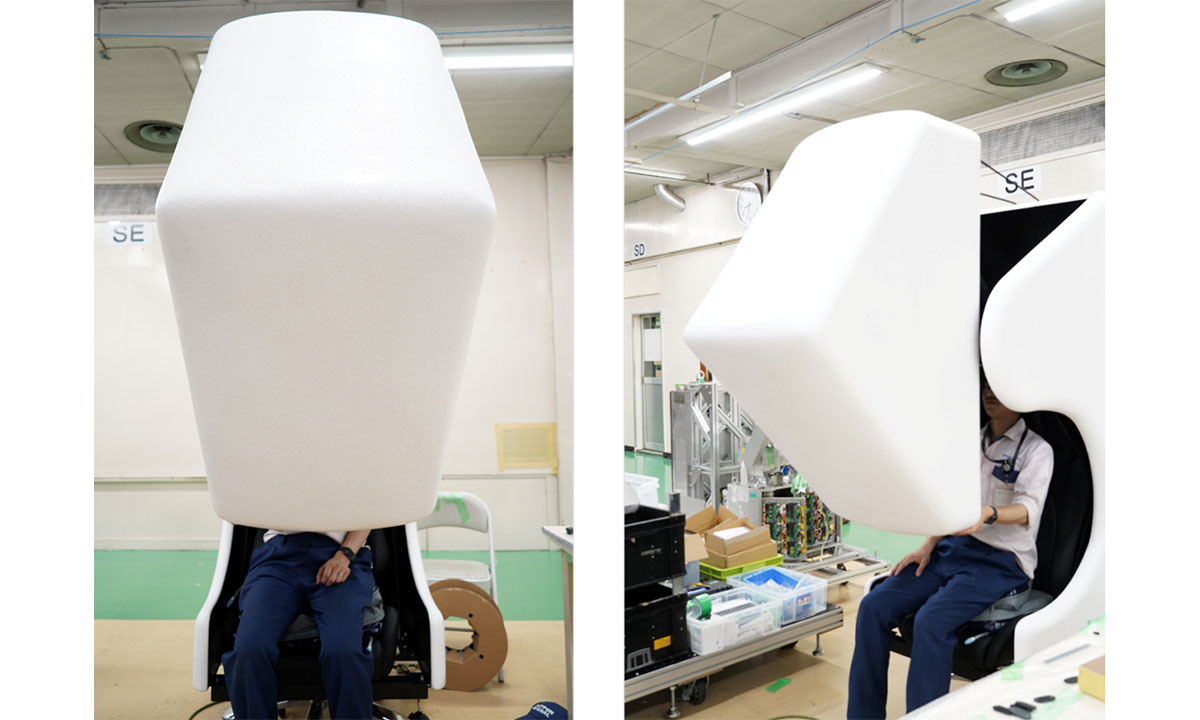
Kyushu University has published a working DEMO of what it calls a MOUNTLESS aerial HMD: a chair that throws a STEREOSCOPIC virtual scene into mid-air so the user never straps a DISPLAY to their face. Associate Professor Shogo Fukushima’s lab describes the system in the SIGGRAPH 2026 Emerging Technologies proceedings, with a university research note dated October 6, 2026. It is a PROTOTYPE, not a shipping PRODUCT.
How the optics work
Conventional headsets put DIFFERENT images close to each eye. Fukushima’s team keeps that STEREO idea but moves the hardware OFF the head. A MICROMIRROR array directs separate views toward the two eyes so the scene appears to FLOAT beyond the chair’s physical footprint. The university calls the technique AERIAL imaging: the picture is not on a panel the user can touch.
The optical module sits on the chair. A built-in GYROSCOPE tracks rotation in REAL time. As the seated user turns, the stereoscopic view UPDATES with them. The press note says NO headset and NO calibration step are required for that look-around loop. The claim is that an IMMERSIVE view can fit inside a relatively SMALL physical footprint.
Why they built it
Fukushima says the project started after a student complained that LONG VR sessions were hard to LIVE in, even to the point of trying to sleep in a headset. Wider fields of view and higher RESOLUTION still tend to ADD weight and pressure on the neck. The lab’s answer was not a LIGHTER headset. It was a display that never MOUNTS at all.
He also flags a FUTURE comfort angle: without a headset constraining the design, larger optical parts and MOVING mechanisms become easier to try, which could help attack the mismatch between visual and PHYSICAL sensation that drives VR sickness. That is framed as POTENTIAL work, not a measured clinical RESULT in the current paper.
What is still missing
The university is SEEKING industry partners. Named use cases include in-car WORKSPACES, museum exhibits, and remote control of construction MACHINERY or disaster-response ROBOTS. Looking further ahead, Fukushima talks about two people sharing the SAME immersive scene—an “Anywhere Door” style ambition, not a SHIP date.
Nothing in the release prices a product, names a commercial OEM, or shows a multi-user field TRIAL. The ACM paper—“Mountless Aerial HMDs: Designing Non-Wearable HMD Experiences Based on Aerial Imaging Optics”—is a three-page Emerging Technologies piece (DOI 10.1145/3799826.3812427), not a full journal study. Coverage on October 8 by Knowridge tracks the SAME Kyushu note.
Primary source: Kyushu University research result, October 6, 2026.