A soft object that SQUASHES is common. One that you can CUT, PEEL, and FRACTURE in real time, while grabbing it with your HANDS, is still RARE. At SIGGRAPH 2026’s Animation and Simulation poster session, KAIST researchers Jewoo Shin and Jinah Park presented OmniBody, a GPU soft-body system that REPLACES connected meshes with voxel-aligned ellipsoidal particles and LOCAL Extended Position-Based Dynamics constraints. In an October 12 interview with 80 Level, Shin says the STRONGEST fit is XR and sandbox games, where people MANIPULATE objects FREELY instead of following SCRIPTED break points.
Local Particles, No Global Solve
OmniBody DROPS the usual connected mesh. Each body is a grid of oriented ELLIPSOIDAL particles. Contact, bending, anisotropic elasticity, volume preservation, and FRACTURE run as separate XPBD constraints. Global motion EMERGES from local neighbor interactions, WITHOUT matrix assembly or a linear system solve. Shin told 80 Level that the design is CONCEPTUALLY closer to finite elements than to simple point masses, but WITHOUT FEM’s EXPENSIVE global step.
That choice MATTERS when topology CHANGES. Mesh pipelines often DUPLICATE vertices and REMESH when something is cut. OmniBody DEACTIVATES the contact constraint between affected particles instead, an operation that PARALLELIZES cleanly. Collisions also simplify: the particles are the collision boundary, so body-on-body, body-on-particle, and self-collision share ONE path.
Numbers That Stay Interactive
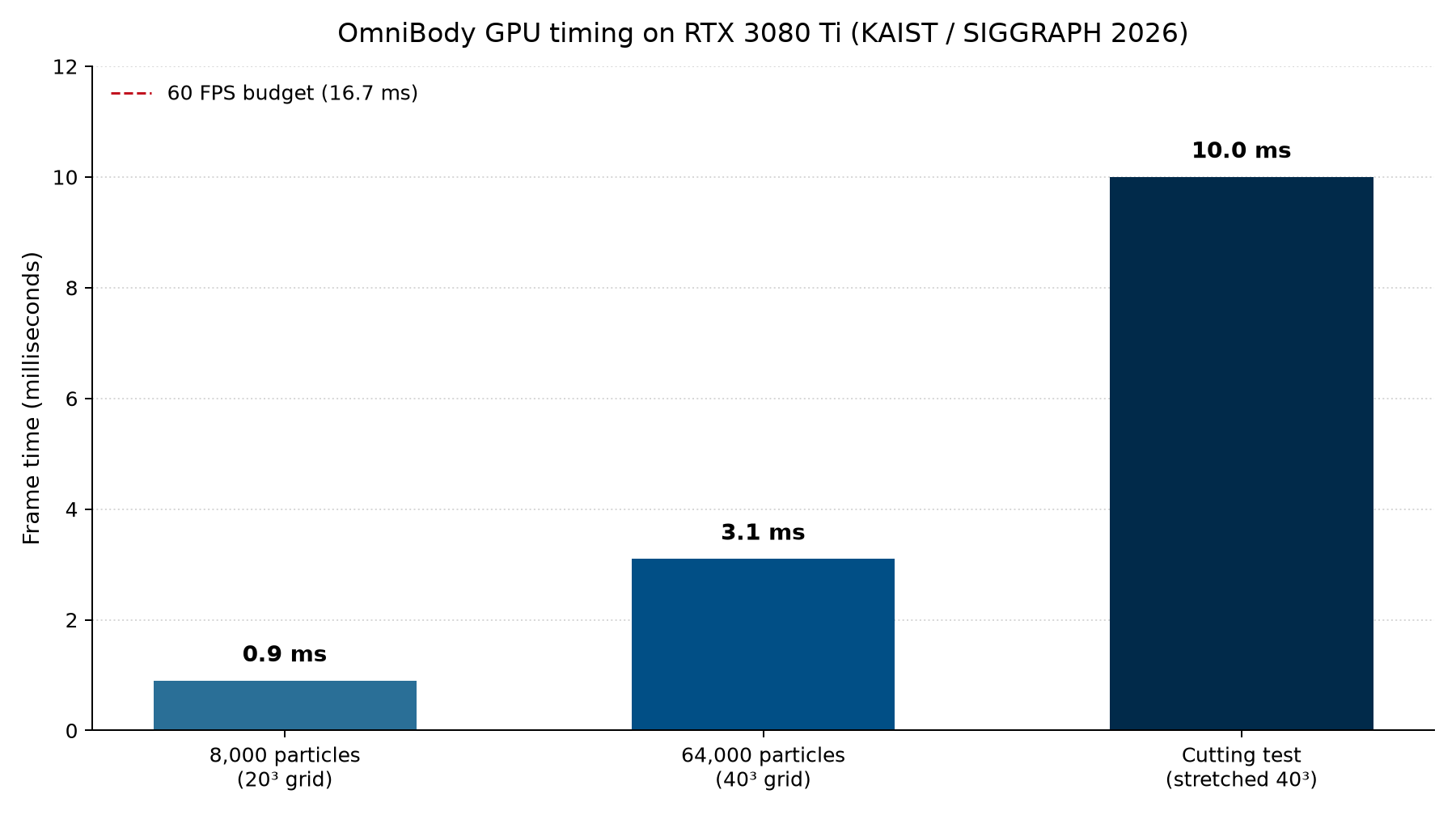
On an RTX 3080 Ti, Shin reports about 0.9 MILLISECONDS per frame for 8,000 particles on a 20³ grid, and about 3.1 MILLISECONDS for 64,000 particles on a 40³ grid. A DEMANDING cutting test on a stretched 40³ cube stayed UNDER 10 milliseconds. ExplorXR’s October 13 XR Daily HIGHLIGHTED the same figures while tying the work to hand-tracked XR sandboxes that have CHASED destructible soft objects for YEARS without the FRAME budget.
The ACM poster listing, “OmniBody: Discretized Local Constraints for Real-Time Destructible and Flexible Soft Bodies Simulation”, places the work in the SIGGRAPH 2026 posters program. We treat the ACM page as the ARCHIVAL citation; 80 Level SUPPLIES the researcher interview.
Why XR, and What Still Breaks
Shin is EXPLICIT that OmniBody should NOT replace every soft-body tool. If you only need mild deformation, established mesh cloth and soft-body solvers will often be FASTER. Where this model GETS interesting is “highly interactive environments such as XR,” he told 80 Level, because users can KNEAD, SLICE, and EXPLORE objects without predefined actions. He POINTS to a virtual kitchen where dough and bread behave like the real thing.
Limits REMAIN. Exposed INTERIOR surfaces after a cut are still hard to render cleanly. The constraints are NOT derived from a strict energy formulation, so some behaviors, such as a lasting pendulum swing, do not MATCH classical physics. Fracture patterns are better at GENERAL fragmentation than at STEERED cracks. Shin also notes that production engines would need STABLE multi-object interactions and TIGHTER GPU layouts before a SHIPPABLE plug-in exists.
For Metaverse Watcher readers, the SIGNAL is practical: a research path that KEEPS cutting and peeling INSIDE a real-time budget, aimed at the hand-tracked XR interaction model Quest, Vision Pro, and Steam Frame already advertise. It is a POSTER, not a storefront release. The next proof will be whether an engine team ADOPTS the particle-constraint approach, or whether mesh remeshing remains the DEFAULT for another generation of VR kitchen demos.
Sources: 80 Level interview with Jewoo Shin (Oct 12, 2026); ACM SIGGRAPH 2026 poster abstract; ExplorXR XR Daily (Oct 13, 2026).