Alibaba has FINALLY put PRICES on its Qwen AI Glasses N1 and N1 Pro. At its Qwen AI hardware launch in Hangzhou on Tuesday, October 13, the company LISTED the N1 standard set from 2,899 yuan and the N1 Pro from 3,399 yuan, and put both on sale IMMEDIATELY on Taobao, Tmall, JD.com and Douyin, according to IT Home and Wallstreetcn. After China’s national subsidy and launch promotions, the ENTRY price DROPS to 2,218 yuan.
On the eve of launch, we noted that Alibaba had still NOT published a price, and we named THREE disclosures to watch. The launch answers ONE of them. The other two, INDEPENDENT eye-tracking tests and a clear statement on where iris and gaze data are STORED, are STILL open.
The Price Ladder
Each model comes in TWO sets: a standard set and a “super battery” set with extra swappable temple batteries. Figures below are from IT Home and Sina Tech, both dated October 13.
- N1 standard set: 2,899 yuan listed; 2,218 yuan at first sale.
- N1 super battery set: 3,297 yuan listed; 2,446 yuan at first sale.
- N1 Pro standard set: 3,399 yuan listed; 2,600 yuan at first sale.
- N1 Pro super battery set: 3,797 yuan listed; 2,827 yuan at first sale (IT Home lists 2,829).
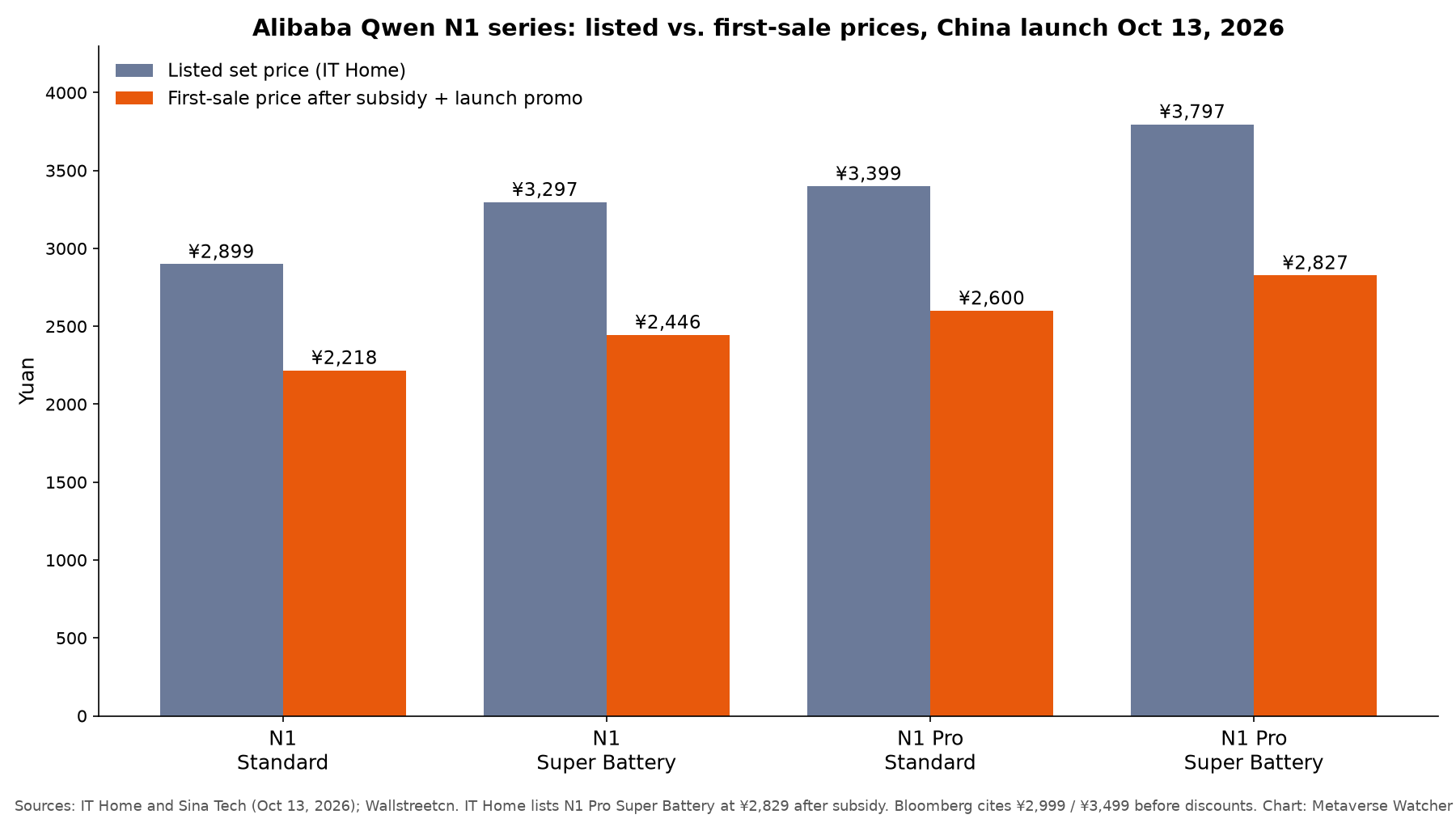
The headline number depends on WHO you read. Bloomberg reports a starting price of 2,999 yuan, about $450, BEFORE discounts, and 3,499 yuan for the Pro. IT Home and TechNode list the standard sets 100 yuan LOWER, at 2,899 and 3,399. Buyers should check the LIVE store price, not the press figure.
The subsidy ALONE does NOT explain the gap. Wallstreetcn notes that smart glasses joined China’s national SUBSIDY scheme this year at 15% of the price, CAPPED at 500 yuan per item. On a 2,899-yuan N1, that would bring the price to about 2,464 yuan. The remaining discount to 2,218 comes from LIMITED-TIME launch offers, which Sina says include lens-fitting discounts, trade-in credit, six interest-free installments and a 60-day price guarantee. Those are LAUNCH terms, not PERMANENT prices.
What the Pro Adds
Both models share a 50-megapixel sensor with 4K recording, live photos and stabilization, a three-chip compute platform, and dual SWAPPABLE temple batteries. Alibaba rates the N1 at NINE hours of mixed use and the N1 Pro at EIGHT. NEITHER model has a DISPLAY.
The Pro adds EYE TRACKING, iris verification for payment, and health monitoring of heart rate, blood oxygen and skin temperature. Wallstreetcn reports that the iris system was co-developed with Ant Group’s GPASS unit, and that Qwen claims a false-acceptance rate BELOW one in a million. That is a VENDOR claim, not an INDEPENDENT test result.
The payment flow is now DOCUMENTED. According to Wallstreetcn and Digital Today, the user starts a payment in Alipay, LOOKS at the merchant’s QR code, CHECKS the payment details and NODS to approve. The glasses VERIFY the iris and complete the transaction. That confirms what early users said before launch: the glasses replace the CONFIRMATION step, but the payment STILL begins on the PHONE.

A Bose Earbud as the Cheaper Entry
Alibaba also started sales of Qwen ear-clip earbuds made with BOSE. Bloomberg gives a price of 1,299 yuan; Wallstreetcn reports a first-sale price of 1,099 yuan. The earbuds offer real-time TRANSLATION across 89 languages and live note-taking. Alibaba has NOT published SHIPMENT targets for ANY of the three products, according to Wallstreetcn.
Why It Matters
Bloomberg frames the PRICING as a sign that Alibaba is competing on FEATURES, not PRICE. At list, the N1 sits ABOVE Xiaomi’s 1,999-yuan AI glasses and BELOW Rokid Glasses at 3,299 yuan, per Wallstreetcn. With subsidies, though, the base N1 lands CLOSER to Alibaba’s own Qwen G1, which sold from 1,997 yuan after subsidy in March. The subsidy is doing REAL work in this market, and that support is NOT guaranteed to last.
The bigger story is the PRO. Alibaba is BETTING that eye tracking and BIOMETRIC payment will make camera glasses a DAILY tool for COMMERCE, just as Meta ships a CAMERA-FREE model to ease PRIVACY concerns. The price question is now SETTLED. The questions that STILL matter are whether gaze tracking HOLDS UP with prescription lenses and in bright sunlight, and whether Alibaba will say where iris templates and gaze data are PROCESSED and stored. None of the launch reports we reviewed answer EITHER.
Sources: IT Home (Oct 13); Sina Tech (Oct 13); Wallstreetcn (Oct 13); Bloomberg via The Star (Oct 14); TechNode (Oct 14); Digital Today (Oct 14).