Tether, the company best known for the USDT stablecoin, has RELEASED an on-device SPEECH model and put SMART GLASSES in the HEADLINE. Its October 14 press release says QVAC TranscribePsy is “designed for continuous, real-time audio” and can HANDLE audio from glasses “in near real-time.” The research team’s own launch post gives a DIFFERENT ANSWER. Asked “Can it transcribe as I speak?”, its FAQ says: “Not yet. This release transcribes each recording or utterance once it is COMPLETE. Streaming is in progress.”
What actually shipped
TranscribePsy is a 254-million-parameter speech-to-text model built by PRUNING NVIDIA’s 627-million-parameter Parakeet-TDT-0.6B-v3 and then TRAINING the smaller model to COPY the larger one’s outputs, on about 564,000 HOURS of speech. Tether PUBLISHED FOUR builds in a Hugging Face collection: a 25-language PyTorch checkpoint for laptops, an 8-language variant, an 8-bit GGUF build for PHONE processors, and a Core ML build for Apple’s Neural Engine. The on-device engine is on GitHub.
The HEADLINE speed figure, 10 minutes of audio in 1.65 seconds on an iPhone 17 Pro Max, comes from the 8-LANGUAGE Core ML build, not the 25-language model, “once loaded,” according to the launch post. That is 363 TIMES faster than real time, but it describes a FINISHED recording processed in ONE batch, NOT live captions. Across six phones, the GGUF build answered a single utterance in 1,021 ms on AVERAGE, against 2,631 ms for the NEXT-FASTEST model Tether tested and 5,854 ms for Whisper-small. PEAK memory stayed between 530 and 542 MiB.
The benchmarks are strong, and they are Tether’s own
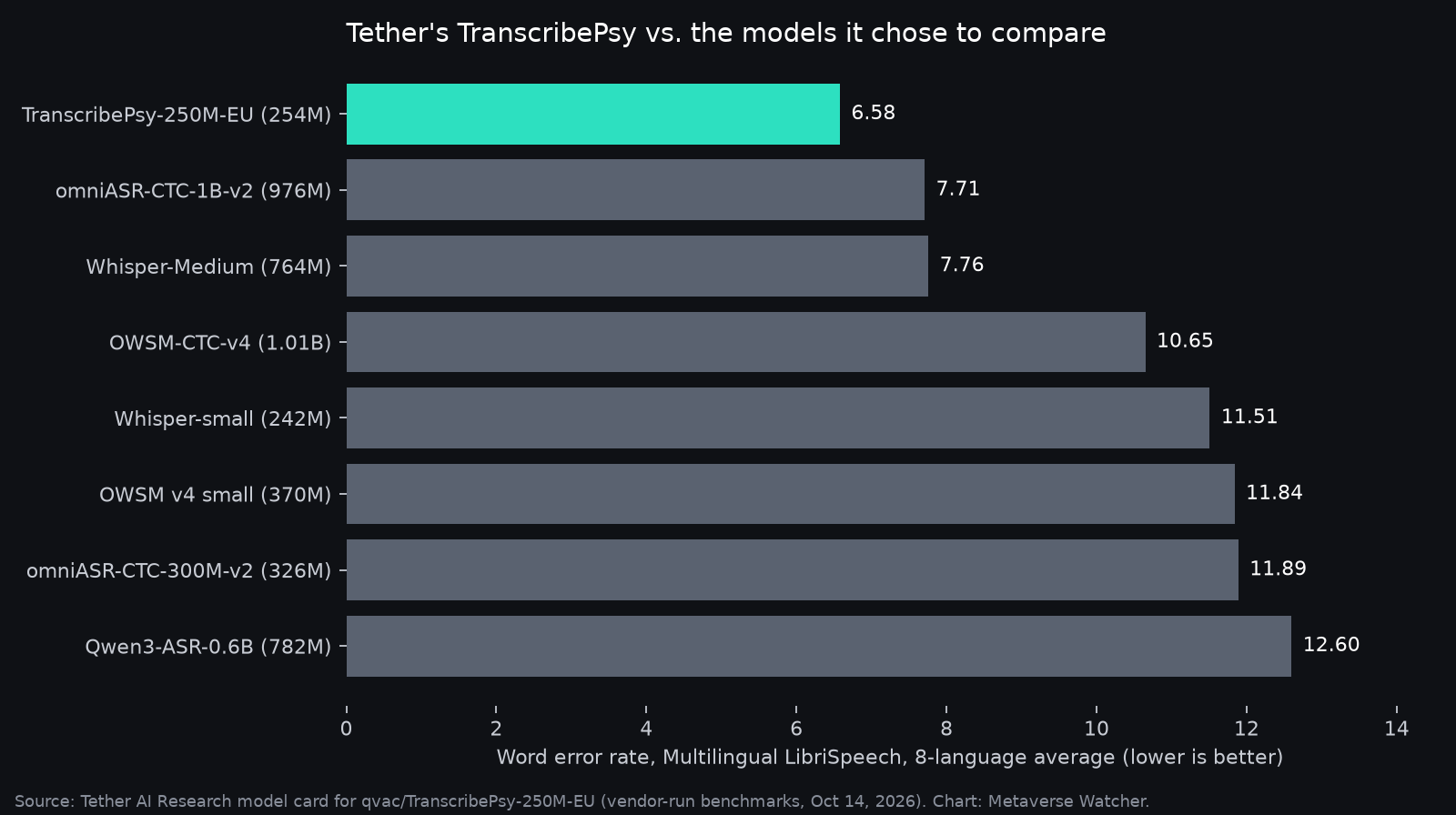
On Multilingual LibriSpeech, averaged over eight languages, the model card reports a word error rate of 6.58, roughly HALF the ERRORS of Whisper-small (11.51) and AHEAD of models THREE to FOUR times its size. The same card shows it is NOT first everywhere: Qwen3-ASR-0.6B LEADS on the Open ASR Leaderboard set (7.40 against 8.02), and omniASR-CTC-1B-v2 LEADS on Common Voice (20.07 against 21.56). EVERY figure was run by Tether with its own pipeline, and the training CODE and DATA are not part of the release, a GAP remio also flagged.
Where the glasses pitch runs thin
The press release LEADS with GLASSES and humanoid ROBOTS. The launch post describes a model that “turns speech into text on a PHONE or a LAPTOP,” and its LIST of uses is dictation, meeting transcripts, captions for RECORDED talks, private interviews, and offline voice commands. NONE of the four builds TARGETS glasses HARDWARE, and Tether names NO glasses maker as a partner or tester. The REALISTIC path is the one the release itself describes: glasses send audio over Bluetooth or Wi-Fi to a phone, and the PHONE does the WORK.
For an utterance-based assistant, that can STILL be FAST. The launch post says text is ready about a QUARTER of a second after the speaker stops on an iPhone’s Neural Engine. But CONTINUOUS conversation CAPTIONING, the feature that matters most for hard-of-hearing wearers and TRANSLATION glasses, NEEDS STREAMING, and Tether lists that as FUTURE work alongside “smaller and faster models” and more languages. It gives NO date.
The license wording is also UNCLEAR. The weights carry Apache 2.0, a PERMISSIVE license that ALLOWS COMMERCIAL use, yet BOTH the press release and the FAQ ADD that they are “released for research and educational purposes.” Tether does NOT explain whether that phrase is a RESTRICTION or a description, which is EXACTLY what a glasses maker would need to know before SHIPPING it.
Why it still matters for wearables
The PRIVACY argument lands at a sensitive moment for the category. Meta said this week it had RESOLVED a bug that left some Ray-Ban Meta glasses recording without the wake word, European REGULATORS have issued a statement on smart glasses, and HTC is marketing the VIVE Eagle as the private alternative. A FREE, SMALL, ACCURATE model that keeps voice audio on the user’s OWN phone gives smaller glasses makers an option they did not have to BUILD themselves. Tether CEO Paolo Ardoino framed it PLAINLY: “AI is going to become part of our phones, glasses, and machines, but that doesn’t mean our data needs to leave them.”
Interest so far is mostly on SOCIAL media. QVAC’s launch post on X had passed 7.1 MILLION impressions by Saturday, while Hugging Face’s public counters showed about 250 DOWNLOADS across the four model repositories. Until a streaming build SHIPS, or a glasses maker PUTS its NAME to an integration, TranscribePsy is a STRONG phone transcription model with a glasses STORY attached, NOT yet a glasses PRODUCT.