The small SteamVR overlay app vrOS has pushed THREE playtest BUILDS in FOUR days, and every one of them REWORKS the same feature: lining up LIGHTHOUSE body trackers with Valve’s STEAM FRAME. Version 2.1.0 made camera-based “optical alignment” its HEADLINE. Version 2.2.0, just TWO days later, says alignment “no longer uses the headset cameras” at all. Version 2.3.0, ONE day after that, patches a DRIFT problem its developer MEASURED at about 10 cm. EACH set of notes STILL files the feature under KNOWN ISSUES.
Why Steam Frame owners care
The Steam Frame tracks ITSELF with its own CAMERAS, while Vive and Tundra trackers are tracked by EXTERNAL base stations. That leaves TWO coordinate spaces that have to AGREE before a VRChat avatar’s hips and feet land where the wearer’s body ACTUALLY is. Frame owners on X have been working through that GAP for WEEKS: one user wrote on October 13 that a space-calibration tool “doesn’t seem to pick up my trackers at all,” and a full-body tracking guide for the Frame posted October 4 has drawn MORE than 370 likes.
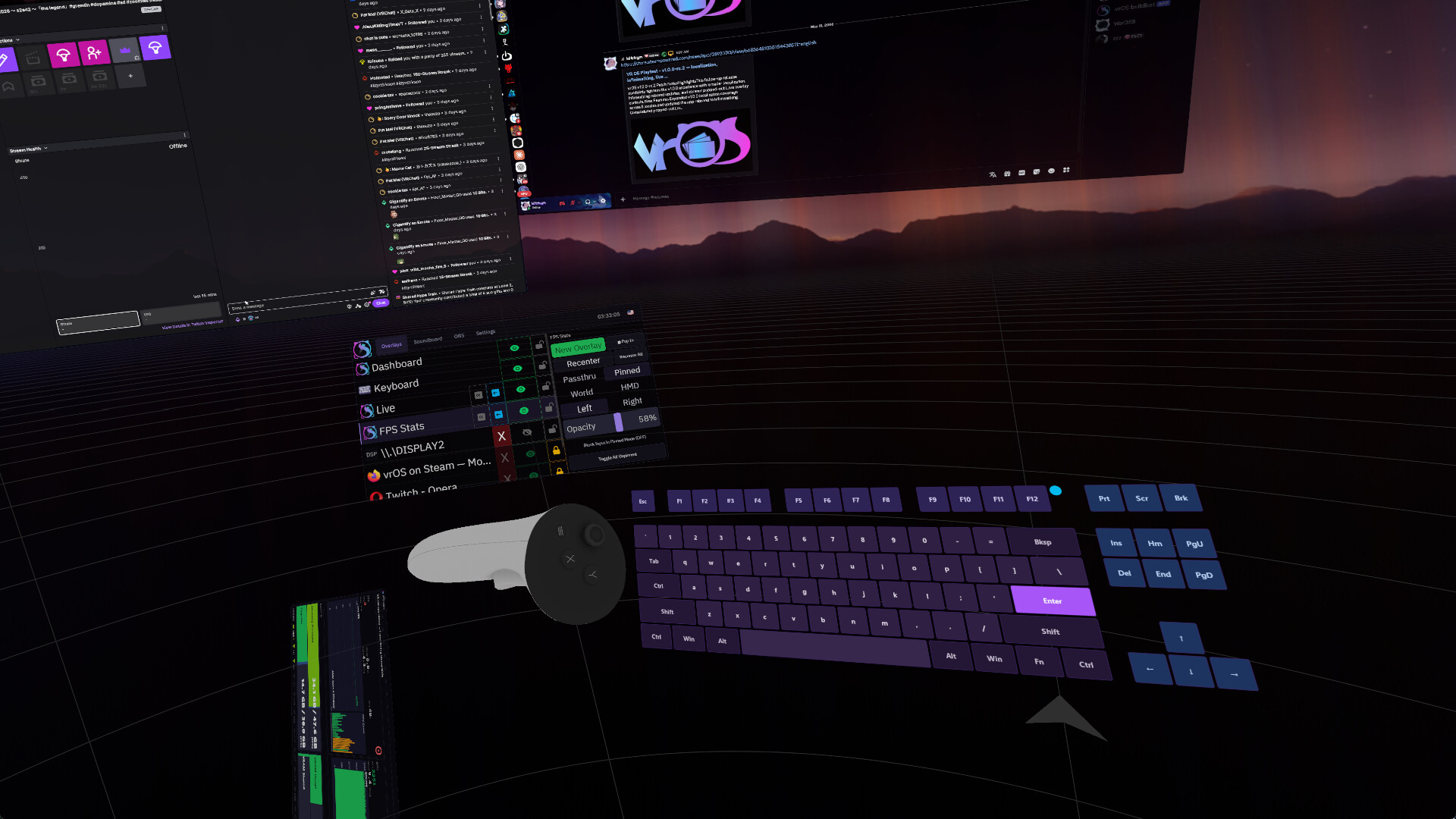
vrOS, sold by catnet systems for $7.98 and released on Steam on May 12, 2026, is one of SEVERAL community projects aiming at that problem. Its store page PITCHES desktop panels, a VR keyboard, playspace fixes, tracker calibration, and VRChat OSC tools in ONE overlay. It had ZERO user reviews when we checked Steam’s review API on Saturday.
Three builds, three approaches
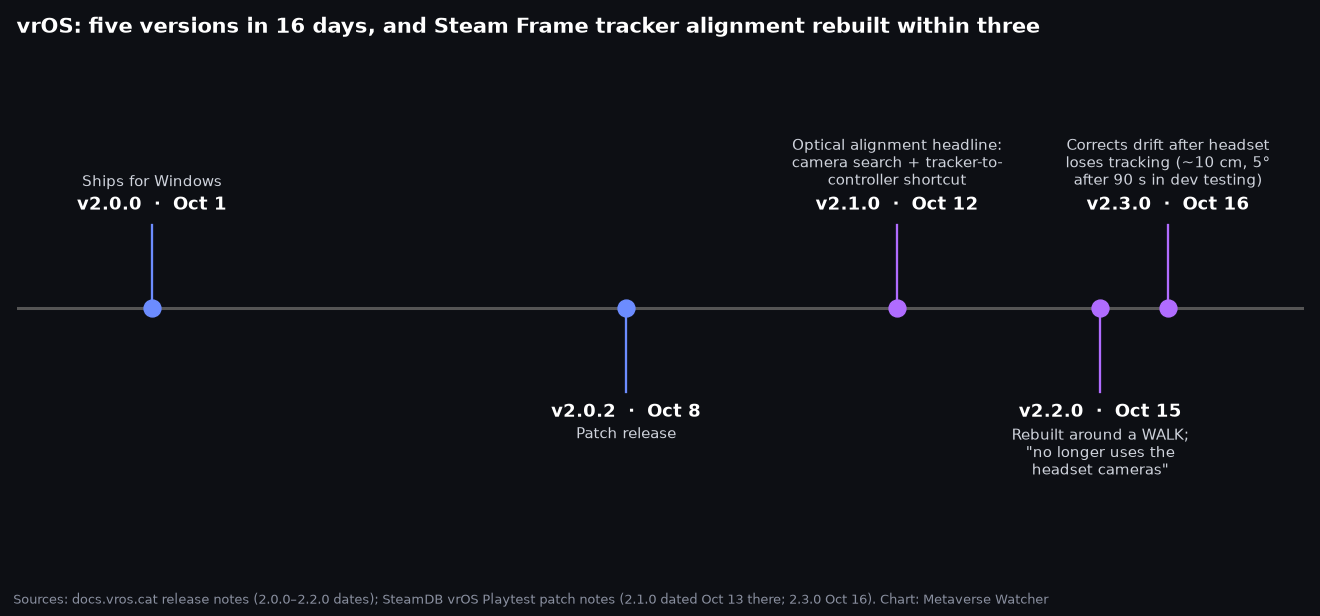
v2.1.0 (dated October 12 in the vrOS release notes and October 13 on SteamDB’s playtest record) called OPTICAL alignment “the main work in this release.” The FASTEST path was to hold a tracker against a Frame CONTROLLER and press Start; a HANDS-FREE option used the headset cameras to search for base stations, with a room map telling the wearer which way to turn. The build also FIXED a bug that could leave a tracker “about 12 cm off in parts of the room” when SteamVR switched base stations, and a flicker bug in which vrOS reset SteamVR’s standing origin “hundreds of times in an evening.”
v2.2.0 (October 15) REBUILT the process around a short WALK. The user HOLDS a Lighthouse tracker firmly against a Frame controller, turns the pair for a few seconds, then walks past EACH base station until the reading shows ±2 cm or better and the page reads ALIGNED · ROOM LOCKED. The notes are BLUNT about the change: “Alignment no longer uses the headset cameras: the walk replaces the camera search and its guidance.” They give NO REASON for DROPPING the camera method and NO ACCURACY figure for it.
v2.3.0 (October 16) addresses what happens when the headset LOSES the room. In the developer’s testing, the Frame’s view could come back SHIFTED by “about 10 cm and 5° after a 90-second loss” while trackers KEPT the old alignment. vrOS on the headset now MEASURES that shift, REPORTS it to the PC, and corrects the trackers ONCE when the room is found. Base stations the walk NEVER passed are now labeled “Estimated,” and trackers on them are FLAGGED.
Alongside the alignment work, the builds add FRAME-SPECIFIC extras: aux-button SHORTCUTS for up to FIVE presses, LIVE microphone tuning, headset GPU, CPU, thermal, and battery readouts, and battery charge or drain shown in WATTS. v2.1.0 also CUT an idle process check from four times a second to once every 5 seconds.
The docs and the store page disagree
The vrOS install page STILL says “vrOS 2.0.0 ships for Windows; Linux and native Steam Frame builds are in development and are not on Steam yet,” and its COMPATIBILITY table lists the Frame’s overlay path and window capture as “Not settled.” The Steam STORE page tells a DIFFERENT story: its Linux minimum requirements list SteamOS ARM64, a Snapdragon 8 processor, the Turnip driver, and “Verified on Steam Frame.” The playtest patch notes THEMSELVES describe “vrOS on the headset” and a dashboard logo that turns white “when vrOS runs on the Steam Frame by itself.”
Version LABELS are also MUDDY. The docs list 2.2.0 as “Released 15 October 2026,” while SteamDB records it as an update to the SEPARATE playtest app, 3893370, which SteamDB lists as LIMITED access that testers must REQUEST. The SAME docs page says playtest notes only arrive there “once the version they lead to is published.” As of Saturday afternoon, 2.3.0 did NOT appear in the docs at ALL.
What is still missing
The ±2 cm target is the DEVELOPER’S own on-screen threshold, NOT an INDEPENDENT measurement, and the 10 cm drift figure comes from a SINGLE INTERNAL test the notes describe in one sentence. ALL three builds keep the SAME caveat: tracker alignment “is still in development,” and the latest two say the team is still working on “how reliably the room lock holds through a long session.” There is NO stated date for a STABLE release that carries the walk-based method, and NO explanation of what the camera search got WRONG.
For Frame owners with existing Lighthouse gear, the PACE is the story. A $7.98 tool REWRITING its CORE calibration method in the MIDDLE of a playtest shows that the problem is SOLVABLE, but NOT yet SETTLED, and buyers should TREAT any single build as a SNAPSHOT rather than a FINISHED answer.