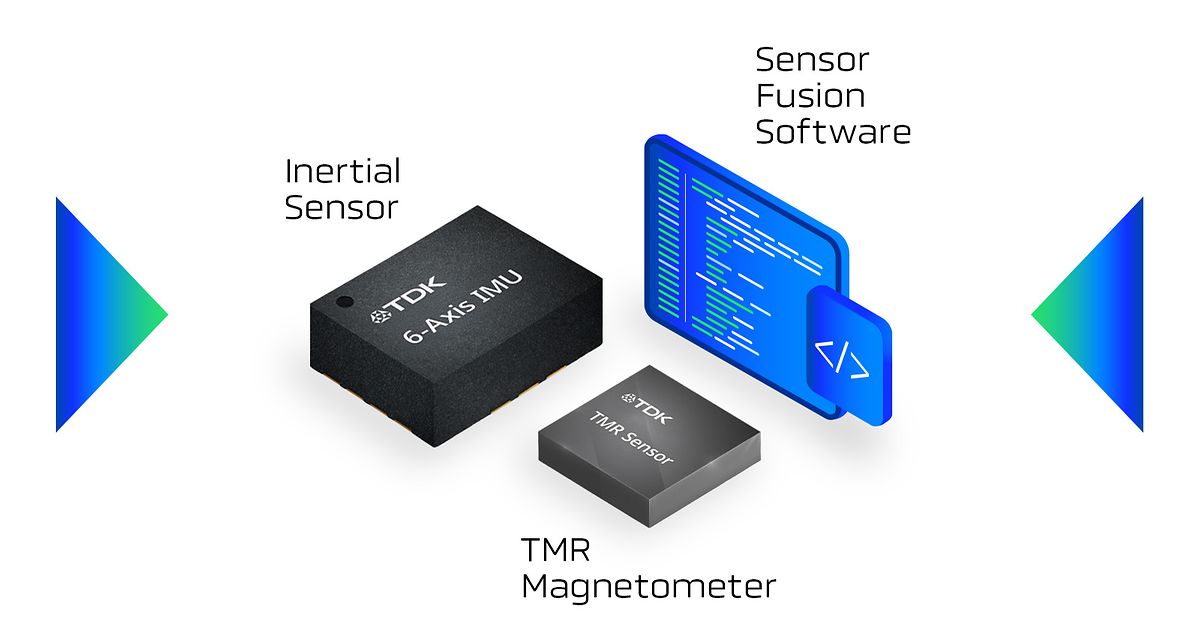
TDK has put a COMPASS problem on the smart-glasses agenda. On October 13, the company said its InvenSense PositionSense kit is NOW available through WORLDWIDE distribution: a TWO-chip, NINE-axis sensor set that pairs a 6-axis IMU with a 3-axis TMR magnetometer and runs sensor fusion ON the chip. TDK lists “wearables including smart glasses and AR/VR” FIRST among its TARGET applications. What the announcement does NOT include is a single CURRENT-draw figure, a price, or the NAME of the glasses maker TDK says it has already worked with.
What TDK Is Actually Shipping
According to TDK’s release, PositionSense combines THREE pieces: a 6-axis SmartMotion IMU that TDK calls its “lowest-power” unit, with a VIBRATION-resistant gyroscope; a 3-axis magnetometer built on tunnel magneto resistance (TMR); and on-chip FUSION software for 9-axis calibration. The STATED job is ABSOLUTE orientation, meaning a heading that knows which way is NORTH, not just how the head MOVED since boot.
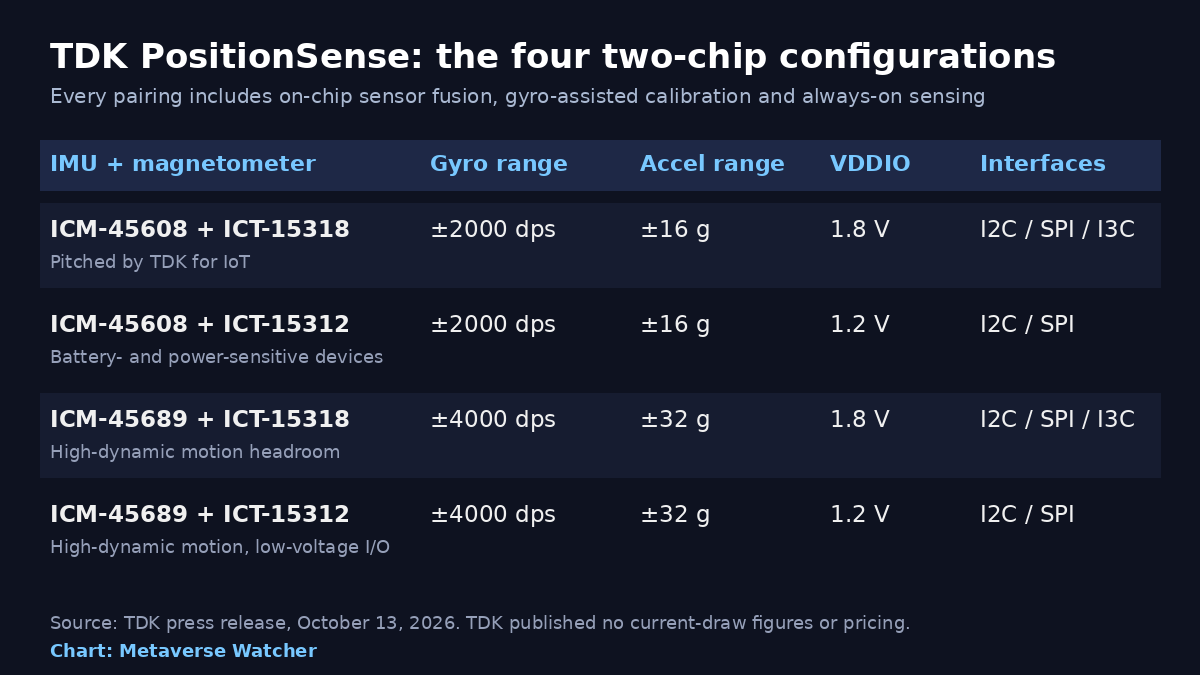
It comes in FOUR hardware pairings. Two use the ICM-45608 IMU with a ±16 g accelerometer and ±2000 dps gyro; two use the ICM-45689, which DOUBLES BOTH ranges to ±32 g and ±4000 dps for “high-dynamic MOTION.” Each IMU is matched with either the ICT-15318 magnetometer configuration (1.8V VDDIO, with I3C support) or the ICT-15312 (1.2V VDDIO, I2C and SPI only), which TDK POSITIONS for BATTERY-powered and power-sensitive designs.
Why Two Chips Matter for Glasses
The TWO-chip layout is the part MOST relevant to eyewear. Song Li, director of product marketing at TDK InvenSense, told Fierce Sensors that keeping the magnetometer SEPARATE lets device makers place it at the EDGE of a board, away from MAGNETIC interference, while the IMU sits at the CENTER. In a glasses temple CROWDED with speakers, a battery and radios, that placement freedom is a REAL design constraint, not a MARKETING detail.
Li also FRAMED the use case in terms smart-glasses buyers will recognize: a runner keeping POSITION sensing on the glasses instead of glancing at a PHONE, and NAVIGATION in dense downtowns or indoors where SATELLITE positioning DEGRADES. “Wearables can keep the magnetometer on for a long time and with an accurate real-time heading,” he said. That is the same problem walking-directions features face, such as the Naver Map turn-by-turn guidance for Ray-Ban Meta we covered on October 12: audio directions are ONLY as good as the HEADING behind them.
InvenSense CEO Joseph Bousaba put the pitch more BROADLY: “When your device uses PositionSense, users are always on track and never lost – even in a city, field, factory, or location without a satellite connection.” That is a CLAIM, and TDK offers NO accuracy figure in DEGREES to back it.
What Is Missing
- POWER numbers. TDK repeats “lowest-power” for BOTH the IMU and the magnetometer but publishes NO microamp or milliwatt figures in the release, the METRIC that DECIDES whether an always-on compass FITS a glasses battery.
- Heading ACCURACY. There is NO stated error in degrees, and no figure for how FAST the “automatic magnetic shock recovery” settles.
- CUSTOMERS. Fierce reports TDK has worked with “select customers, including a smart glasses manufacturer,” but NO brand is named.
- PRICE. NONE is given; TDK POINTS buyers to authorized DISTRIBUTORS.
The Bigger TDK Pattern
PositionSense is NOT a STANDALONE bet. Fierce notes the kit was DEMONSTRATED in May at Sensors Converge 2026, and that TDK is pitching itself as a SINGLE supplier for smart-device components. The SAME week, the company said it would show its meta-optic mirror retinal-projection DISPLAY prototype at CEATEC and at electronica in November, a project we detailed in our October 2 report. Add TDK’s earlier move to buy OQmented’s assets for an AR light engine, and the company now has PIECES for the display, the light engine and the MOTION stack of a pair of glasses.
The VERDICT: PositionSense is a CREDIBLE, SHIPPING COMPONENT aimed SQUARELY at a WEAK spot in today’s AI glasses, which is knowing which way the wearer is FACING WITHOUT leaning on a phone. Until TDK publishes power and accuracy DATA, or a glasses BRAND CONFIRMS it inside a product, treat it as an ENABLING part, NOT proof that better on-glasses navigation is coming SOON.
Sources: TDK press release (October 13, 2026); Fierce Sensors (October 13, 2026); Electronics360 (October 13, 2026). Featured image: TDK.