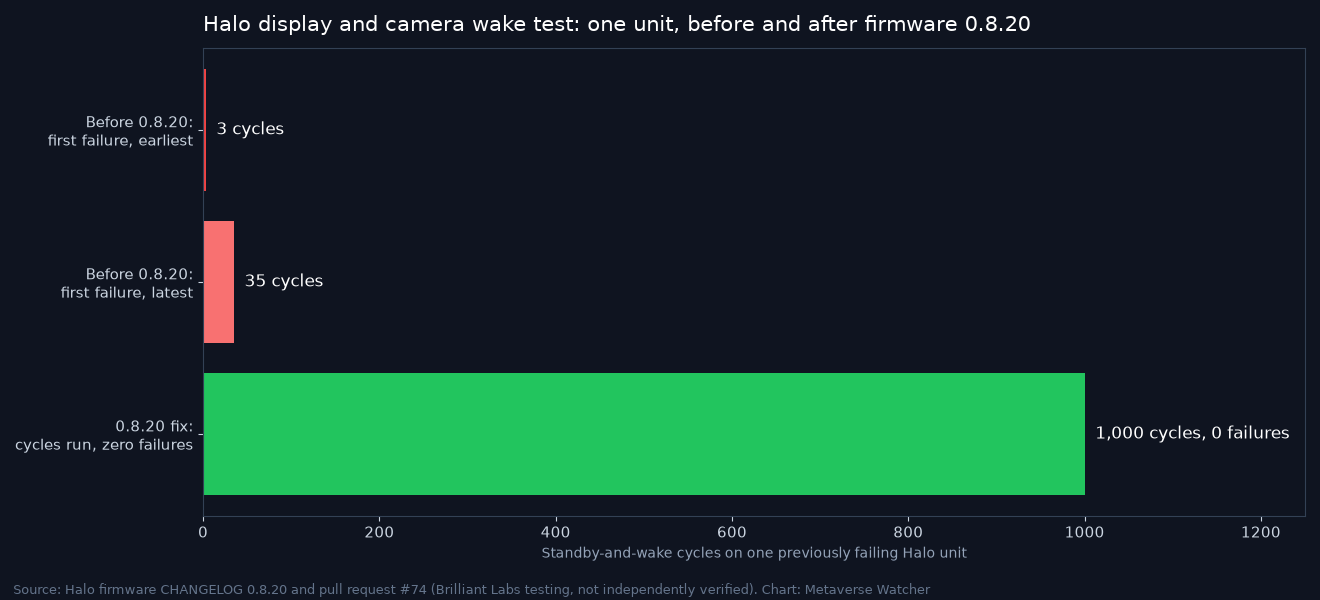
Brilliant Labs has FIXED the BUG that could leave its $399 Halo glasses half-dead after a nap. Halo firmware 0.8.20, published on GitHub on October 16, 2026, says the DISPLAY and CAMERA “could stop responding after a wake from standby until the next reboot.” The company traced it to an electrical GLITCH on a shared chip bus and says a unit that used to fail within 3 to 35 wake cycles then ran 1,000 cycles with ZERO FAILURES. The catch: that PROOF comes from Brilliant Labs’ OWN BENCH, on ONE unit, and the notes do not say how many SHIPPED glasses were AFFECTED.
What actually broke
The detail sits in pull request #74, merged October 14. On some units, waking the glasses left the DISPLAY call failing with ERROR -11 and the CAMERA call with -19, while the motion sensor on a DIFFERENT bus kept working. In Brilliant Labs’ Noa assistant app, the PR says, this “shows up as the camera failing after the glasses go to sleep.” For an AI wearable whose pitch is seeing what you see, a camera that SILENTLY QUITS after STANDBY is not a cosmetic flaw.
The ROOT cause is unglamorous HARDWARE behavior. Powering up the DISPLAY’s bias supply, a TPS65132 chip, can glitch the I2C bus it SHARES with the display and the camera. The bus controller then sees a start signal with no stop, treats the bus as BUSY, and holds every later transfer. On an AFFECTED PRODUCTION unit, the PR says, the supply WEDGED the bus EVERY time it came up, and the display’s own power-up usually cleared it. The 4 to 11% of display power-ups where it did NOT are what OWNERS hit in the FIELD.
One more data point explains why this survived development. The same glitch appeared on the Halo DEV KIT in 179 of 200 power-ups, but there the stop signal ALWAYS arrived, so the DEV KIT “does not wedge in normal use.” In other words, the HARDWARE developers worked on did not show the failure that RETAIL units did.
The fix, and the numbers behind it
Brilliant Labs patched BOTH layers. Its fork of the Zephyr real-time OS now recovers the I2C controller when a transfer TIMES out, and the bias-supply driver resets the bus as soon as its output switches on, so the display’s first write no longer waits for that TIMEOUT. According to the changelog, in 1,000 standby-and-wake cycles on the unit that had failed within 3 to 35, NONE failed and every display wake took 0.40 seconds.
A SECOND camera fix closes a related trap. If the camera sensor failed to resume, the next wake call wrongly reported the camera as ALREADY active, and every capture timed out until a REBOOT. The camera now stays in POWER save until a resume GENUINELY SUCCEEDS, and a sensor whose setup FAILS is powered off so the retry starts CLEAN.
Louder phone audio and less echo
The release also touches the audio path that a voice-first device LIVES on:
- LE Audio gets a 6 dB BOOST. Music or video a phone plays through Halo previously had NO pre-gain, so a phone slider a quarter of the way up sat 12 dB below full VOLUME. MEASURED on a Pixel 7 Pro, low and mid volumes are now about 6 dB LOUDER, while full VOLUME is UNCHANGED. Developers can change both levels and save them on the device (#73).
- ECHO cancellation digs DEEPER. In the 1.6 to 3.4 kHz band, the playback ceiling drops from about -20 dB to about -26 dB. On two desk units, that removed about 5 dB MORE ECHO in that band; replays of earlier captures show 0.1 to 2.5 dB more echo removed overall, with the WEARER’s SPEECH and interrupt timing UNCHANGED (#75).
Echo matters because Noa is meant to be INTERRUPTED mid-reply. If the glasses hear their own bone-conduction speakers as the WEARER, the assistant either talks over itself or ignores a real BARGE-IN.
A shipping product, still on a 0.8 firmware
Halo is on SALE now. Brilliant Labs’ store page lists it at $399 with “Shipping now!”, a weight of just over 40 grams, a color display, a low-power optical sensor for AI inference, dual microphones, dual bone-conduction speakers, and a display optic adjustable from +2 to -6 diopters. The firmware REPOSITORY describes Zephyr RTOS on an Alif Balletto chip, a Lua runtime for on-device apps, and Bluetooth over-the-air UPDATES.
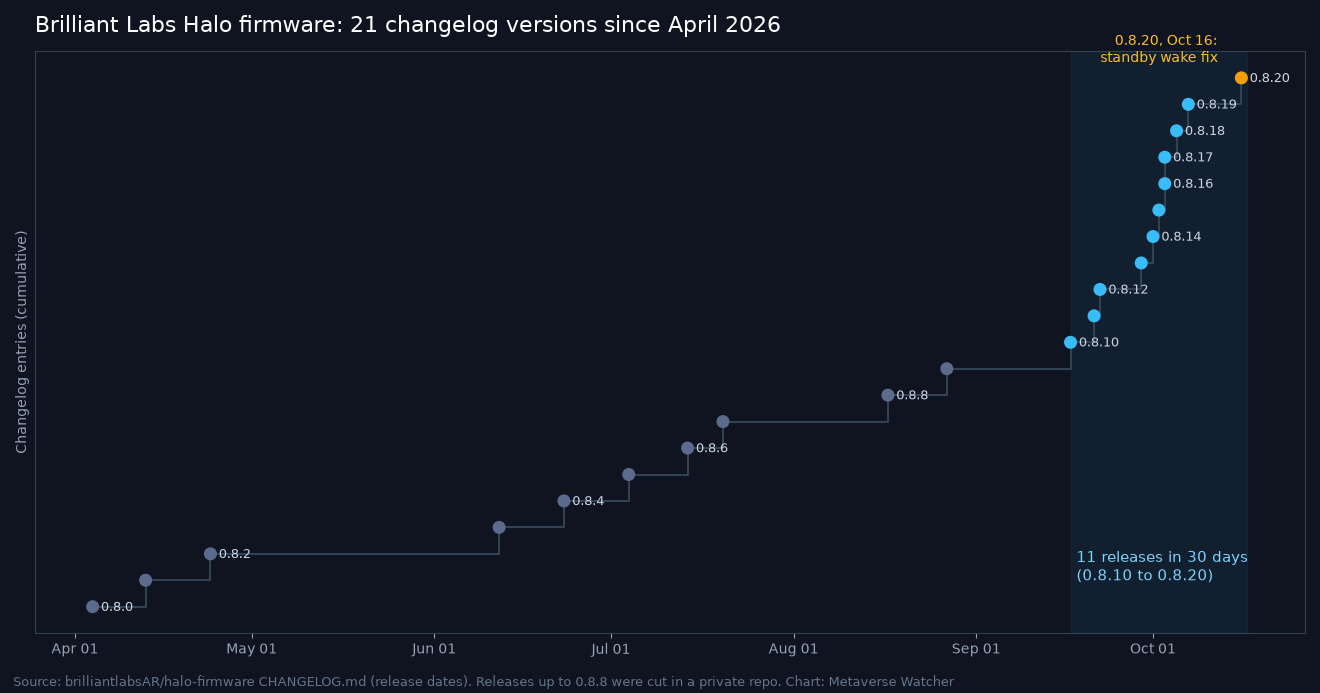
The PACE is the story under the story. The changelog says releases through 0.8.8 were cut in a PRIVATE REPOSITORY. Since the PUBLIC repo opened on August 19, it has listed 13 firmware release pages, including ELEVEN between September 17 and October 16. That is the CADENCE of a team still STABILIZING hardware in CUSTOMERS’ hands, done in the OPEN. Each release carries SIGNED release and debug images plus SHA256 CHECKSUMS, which OWNERS can VERIFY themselves.
The company’s pitch for Halo has leaned on PRIVACY and OPENNESS:
Noa can see, hear, and remember
— Brilliant Labs (@brilliantlabsAR) September 18, 2026
— all processed locally on your phone.
Private. Open source. Halo.
What the notes leave out
THREE gaps are worth flagging. FIRST, SCALE: the changelog says “some units” and gives no COUNT or SHARE of SHIPPED glasses. SECOND, DELIVERY: the GitHub release does not say WHEN, or whether, the Noa app will push 0.8.20 to owners over the air. THIRD, VERIFICATION: every figure here, from 1,000 CLEAN cycles to 6 dB louder audio, is Brilliant Labs measuring its OWN hardware.
The Metaverse Watcher read
Brilliant Labs did not stop at a one-line STABILITY note. It published the failing ERROR codes, the chip involved, the failure RATE, and the TEST that cleared it. That TRANSPARENCY is the open-source promise working as advertised. The flip side is just as PLAIN: a $399 AI wearable sold as “shipping now” had a camera that could DIE after standby, and the dev kits did not REVEAL it. Owners whose Halo camera stops working after SLEEP should look for 0.8.20; everyone else should WATCH whether the update reaches the Noa app, and whether the CADENCE slows as the hardware settles.
Sources: Brilliant Labs, Halo firmware 0.8.20 release (Oct 16, 2026); Halo firmware CHANGELOG.md; GitHub pull requests #74, #73 and #75; Brilliant Labs Halo product page; @brilliantlabsAR on X.