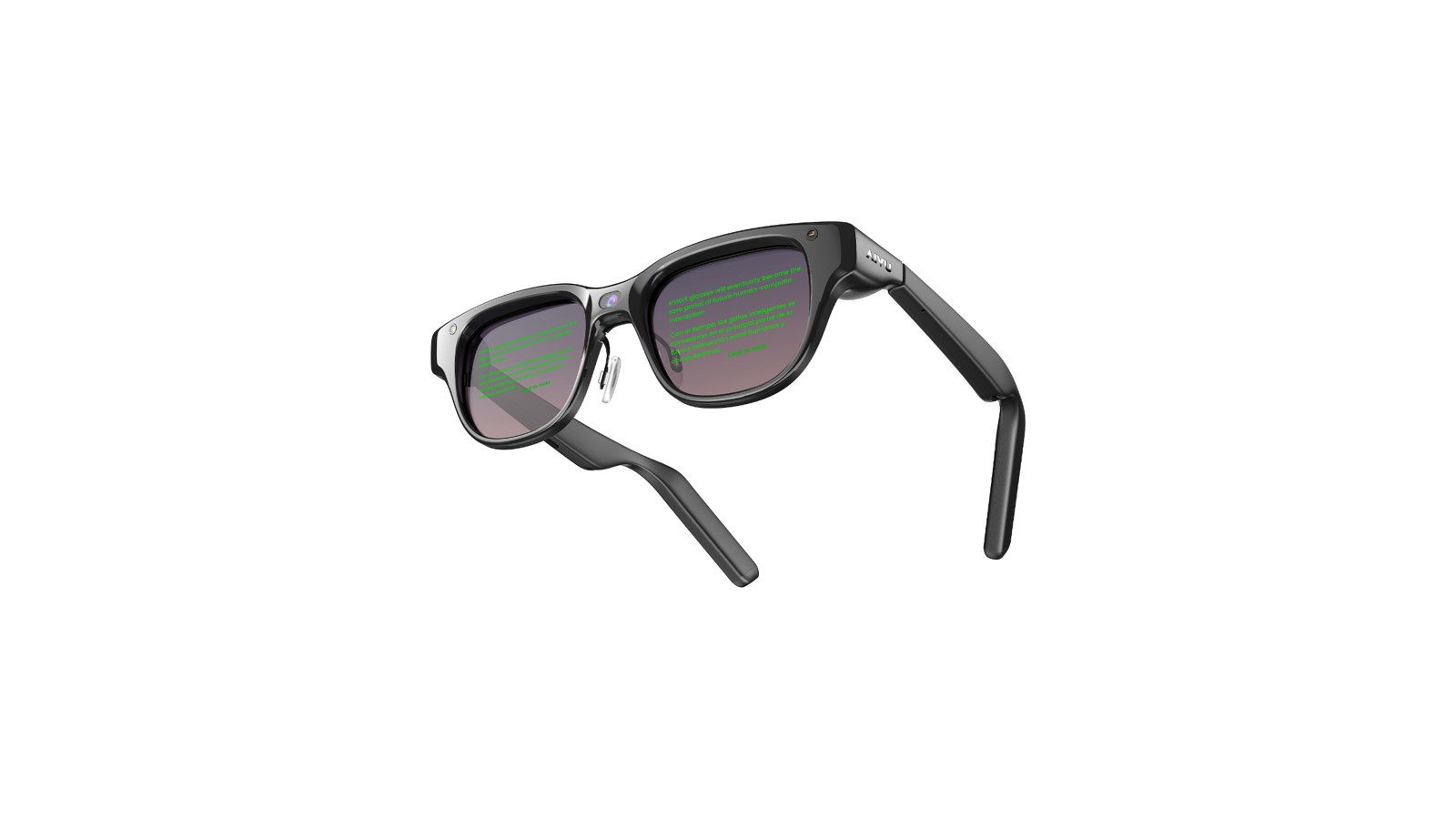
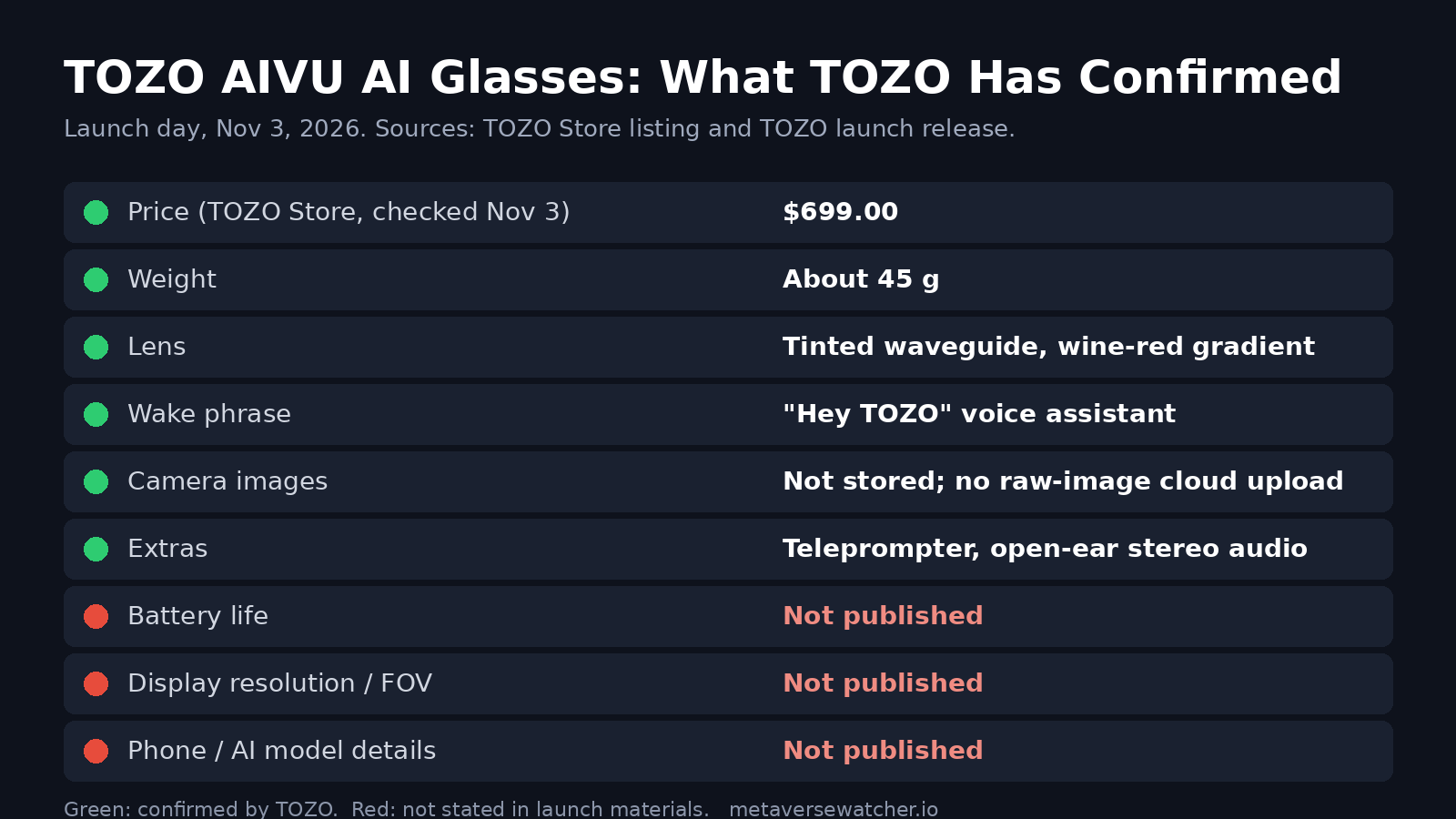
TOZO, the audio brand best known for budget earbuds, put its AIVU AI glasses on sale on November 3, 2026. The TOZO Store listing shows a price of $699.00 (checked November 3). The pitch is a pair of tinted sunglasses with a waveguide display built into the lens, a “Hey TOZO” voice assistant, camera-based object recognition, and a privacy promise TOZO sums up as “See Everything. Store Nothing.”
The launch matters less for the hardware than for what it signals: display-equipped AI glasses are moving from Meta, Google and startups into the hands of mainstream accessory brands, and they are arriving with privacy positioning front and center. It also arrives with some basic buying facts still missing.
What TOZO Announced
According to TOZO’s launch release on ACCESS Newswire, AIVU would go on sale November 3 through the TOZO Store, Amazon and “other selected platforms.” The company describes the product as having the “world’s first tinted waveguide lens in AI glasses,” meaning the display optics and the sunglass tint are combined in one lens rather than stacking a clip-on shade over a clear waveguide.
- Lens: tinted waveguide with a wine-red gradient, which TOZO says also cuts glare outdoors.
- Weight: about 45 g, which TOZO markets as all-day wearable.
- Assistant: hands-free voice control with the “Hey TOZO” wake phrase.
- Vision features: object, building, artwork and landmark recognition, plus sign translation, per the TOZO Store product page.
- Teleprompter: a script shown only to the wearer, aimed at presenters and creators.
- Audio: open-ear stereo speakers; the store page mentions 16.2 mm drivers.
- Purchase terms: the store lists a 30-day money-back guarantee and a “12+6 months” warranty.
The Privacy Claim, Read Carefully
TOZO calls its approach an “Ephemeral Vision Architecture.” In the launch release, the company says the camera captures images only when needed for a recognition task, that raw visual data is not stored or shared, and that there are no cloud uploads of raw images, no user profiling and no historical image records.
The store page goes further, stating that “all visual processing happens on-device.” Those two statements are not quite the same. “No cloud uploads of raw images” leaves room for derived data, such as a description of the scene or the user’s question, to be sent to a cloud AI service. TOZO has not said which AI model answers questions or where that processing runs. Until it publishes a privacy policy specific to AIVU, buyers should treat the on-device claim as the company’s description rather than an independently verified fact.
Even so, the positioning is pointed. Camera glasses have drawn growing scrutiny, including the U.S. senators’ letter we covered in Meta Smart Glasses Privacy: Senators Demand Answers. A design that keeps no image history is a direct answer to the bystander-recording concern that has followed Ray-Ban Meta since launch.
What Is Still Missing
On launch day, neither the release nor the product page lists:
- Battery life, the single most important number for display glasses.
- Display resolution, brightness or field of view for the waveguide.
- Which AI model powers answers, and whether a subscription is needed.
- Prescription lens options, which matter for anyone who wears corrective glasses.
The $699 store price also sits well above the roughly $399 Kickstarter pledge level reported by SmartAIWearables during the crowdfunding campaign. TOZO’s own release did not state a price, so the store listing is the only official figure we could verify.
Where AIVU Fits
| Question | TOZO AIVU (as of Nov 3) |
|---|---|
| In-lens display | Yes, tinted waveguide |
| Camera | Yes, for recognition; TOZO says images are not stored |
| Price | $699.00 on the TOZO Store |
| Where to buy | TOZO Store; Amazon and other retailers named in the release |
| Battery and display specs | Not published |
At $699, AIVU lands in the same price conversation as display glasses from much larger companies. Our Meta Ray-Ban Display vs Even G2 comparison covers the two best-known options with in-lens screens, and both come with published specs and an established app ecosystem. Buyers who mainly want a camera and an assistant without a display can look at our Ray-Ban Meta setup guide for what that category already does well.
The competition is also about to get more crowded. Samsung’s first Android XR glasses are reported for a mid-December launch in the U.S. and Korea, as we noted in Samsung Smart Glasses Reportedly Slip to Mid-December, and startups are experimenting with new input methods, such as the silent-speech glasses that opened preorders this week.
Our Take
AIVU’s most interesting idea is the combined tinted waveguide, which could make display glasses look more like ordinary sunglasses. Its strongest selling point is the no-image-storage privacy design. But launching at $699 without battery life, display specs or a named AI provider asks buyers to take a lot on trust. We would wait for independent hands-on reviews that measure battery life and test whether the recognition features work reliably before buying.
Sources: TOZO Store AIVU listing (price checked November 3, 2026); TOZO launch release via ACCESS Newswire; SmartAIWearables (Kickstarter pledge level). Product image: TOZO press material.