By Metaverse Watcher Staff. Published November 11, 2026.
Even Realities has launched the Even G2 Enterprise SDK, a toolkit that lets businesses run their own apps on the company’s camera-free display glasses. Announced on November 10, the SDK lives inside a company’s mobile app, talks to the glasses directly over Bluetooth, and keeps Even’s own servers out of the runtime connection. It is the clearest sign yet that the most popular non-Meta display glasses are being positioned as a work tool, not only a consumer gadget. Access is limited for now: the SDK is in ALPHA, by application, and needs Enterprise firmware that is not yet public.
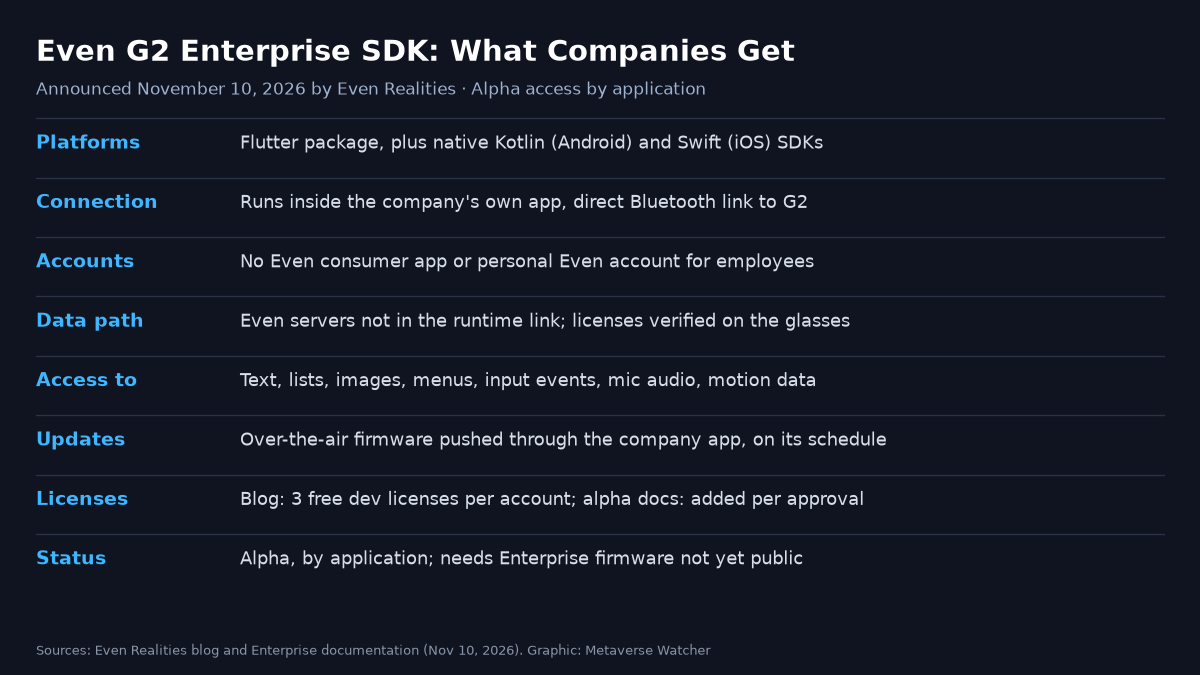
What Even Realities Announced
In its launch post, Even Realities said it is “launching the Even G2 Enterprise SDK and opening enterprise partnerships.” The SDK supports Flutter as well as native iOS and Android development, and the company’s developer documentation describes it as a Flutter package with native Kotlin and Swift SDKs for direct integration.
The architecture is the important part. The SDK runs inside the customer’s own mobile app, and employees use the glasses entirely through that app. They do not install the Even Realities consumer app or create a personal Even account. The company’s app talks to its own backend, and Even says “our servers are not part of the runtime connection between your app and the glasses.” Device licenses are verified locally on the glasses themselves, and the customer’s app decides who has access, when the microphone is used and how data is handled.
Will Wang, Even Realities’ founder and CEO, framed it as a workflow play in a statement quoted by 9to5Google: “With the Enterprise SDK, we’re giving companies the flexibility to build around the way their teams already work, rather than asking them to change their workflows to fit the technology.”
What Developers Can Build With
| Capability | What the SDK provides |
|---|---|
| Display content | Text, lists, images and menus, using the same component model as the Even Hub developer platform |
| Input | Input events from the glasses |
| Sensors | Microphone audio and motion data |
| Connectivity | Device connection and automatic reconnection over Bluetooth |
| Maintenance | Over-the-air firmware updates delivered through the customer’s app, installed on the customer’s schedule |
| Licensing | One license per pair of glasses, managed in the Enterprise section of the developer portal |
Because the components match Even Hub, developers who already build consumer G2 apps start with a familiar toolkit. We covered how small that consumer catalog still is in our report on Quietglass’s free G2 apps; the enterprise route gives companies a way around waiting for the right app to appear in a store.
The Fine Print: Alpha Access and Licenses
The launch post and the documentation describe two different stages, and buyers should read both. The blog says each registered developer account includes THREE free device licenses for development and testing. The documentation, last updated November 10, says the SDK is currently in alpha with access by application, that licenses work only on glasses running Enterprise firmware “which is not publicly available yet,” and that during the alpha “accounts do not get the 3 free licenses.” Instead, Even adds licenses to each account it approves and sends Enterprise firmware to the glasses registered to that account.
Applying is done by signing in at the Even Hub portal, opening the Enterprise section and emailing the company about the team and how many glasses it plans to use. Even has not published per-license pricing beyond the free allowance. The XR Beat reports that Even’s launch materials describe paid device licenses that do not expire and carry no recurring subscription fee, with larger deployments handled directly by the company.
On source code, the blog says Even “plans to publish” the SDK under the Apache 2.0 license with protocol documentation, guides and sample apps. The XR Beat says Even told it the code was published on November 10. We have not independently confirmed a public repository, so treat open-source availability as stated by the company rather than verified.
Why It Matters: Camera-Free Glasses at Work
Even G2 has no camera and no speakers. It is a 36-gram binocular reading display built for notes, teleprompting, translation and notifications, priced from $599, as we detailed in our Meta Ray-Ban Display vs Even G2 comparison. That design choice, often seen as a limitation for consumers, is a selling point for employers. Camera-equipped glasses are a hard sell in offices, hospitals, factories and client meetings, and the privacy questions around them have not gone away, as our smart glasses privacy analysis and coverage of senators’ questions to Meta lay out.
The data model matters as much as the hardware. A company that routes microphone audio through its own app and backend, with Even’s servers outside the loop, has a far simpler compliance story than one relying on a consumer account tied to an employee’s personal profile. The XR Beat reports that Even confirmed customers can put access behind their existing sign-in system and send audio to transcription and AI services of their choice.
There is also a market logic. 9to5Google cites G2 at 11% of the AR glasses market as of September, and Even is one of the few display-glasses makers with meaningful consumer traction outside Meta, as covered in our Omdia shipment share report. Enterprise deals can deliver volume and predictable revenue that a consumer app store cannot yet provide.
What Businesses Should Weigh
- Build cost: the SDK is a toolkit, not a finished product. Companies still need to build, integrate and maintain the app, and prove that a display in the glasses improves a specific task.
- License terms: beyond the free allowance, pricing is by negotiation. The XR Beat notes Even did not confirm whether licenses transfer to replacement glasses or set out long-term compatibility commitments.
- Timeline: with Enterprise firmware not yet public and access by application, most organizations are looking at pilots, not rollouts, in the near term.
- Prescriptions: G2 supports a wide prescription range, which helps fleet deployments where staff need corrective lenses.
The Bigger Picture
The enterprise push lands as the display-glasses field gets crowded. Samsung and Google’s Android XR eyewear, Snap Specs and Meta Ray-Ban Display all target overlapping buyers, and our upcoming smart glasses tracker lists what is still on the way. Even’s answer is to lean into what it already does differently: no camera, light weight, and now an integration model where the customer owns the app and the data. For a wider view of the current options, see our guide to the best smart glasses of 2026.
Sources: Even Realities, “Introducing the Even G2 Enterprise SDK” (Nov 10, 2026); Even Realities Enterprise documentation (updated Nov 10, 2026); 9to5Google (Nov 11, 2026); The XR Beat (Nov 10, 2026); iDevice (Nov 10, 2026).