In-app purchases are now the biggest source of money on the Meta Quest Store. Meta says that for January through September 2026, revenue from in-app purchases (IAP) passed premium app sales for the first time. Premium apps are games and apps that cost money to buy. The disclosure comes from a new post on the Meta Horizon OS Developers blog by Chris Pruett, Meta’s Director of Games. It is the clearest picture Meta has given of where Quest spending goes in the long gap between the Quest 3S (2024) and Meta VR Glasses, due in spring 2027.
What Meta disclosed
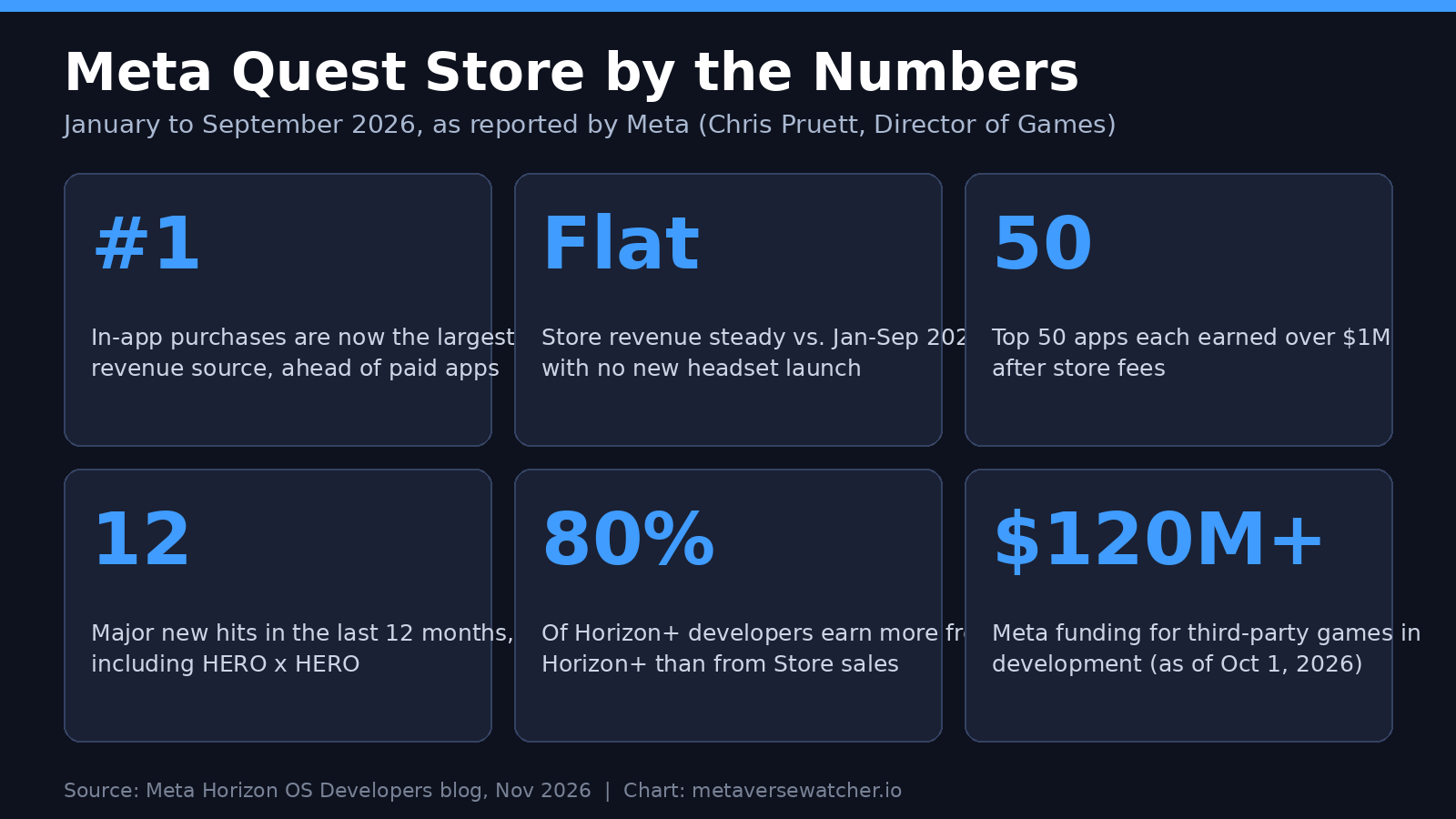
- Revenue was steady: Store revenue for January to September 2026 was “steady compared with the same period last year,” even with no new headset launch. Meta gives no dollar figure beyond saying developers “took home hundreds of millions of dollars.”
- IAP is now number one: for the first time, in-app purchases passed premium app sales as the largest source of Store revenue.
- More apps are earning: each of the top 50 apps made over $1M after store fees in the nine months. Hundreds more earned “hundreds of thousands of dollars.”
- New hits: 12 “major new hits” launched in the past 12 months, including HERO x HERO, which Meta calls one of its top earners.
- Horizon+ is paying: among developers in the Meta Horizon+ program, 80% now earn more from Horizon+ than from Store sales. Their median revenue mix is over 70% Horizon+.
- Funding: as of October 1, 2026, Meta had over $120M committed to third-party games in active development.
Who is in the top 50
Meta did not publish a ranked list, but it named titles from its top 50 by revenue and grouped them by audience. We have put those groups in one table:
| Cohort (Meta’s description) | Titles Meta named | How they mostly make money |
|---|---|---|
| Multiplayer competitive social games | HERO x HERO, UG, Gorilla Tag, I am Cat, Roblox, Animal Company, Scary Baboon, Yeeps, Beyond Sandbox | “Overwhelmingly” in-app purchases |
| Fitness, sports, utility and casual | FitXR, GOLF+, PokerStars: Vegas Infinite, Virtual Desktop, WIN Reality Baseball, TRIPP, Real VR Fishing, Walkabout Mini Golf, Dungeons of Eternity | Mostly premium sales; fitness often uses subscriptions; PokerStars is IAP only |
| “Cross-over” hits | BONELAB, Blade & Sorcery: Nomad, Green Hell, Five Nights at Freddy’s: Help Wanted, plus tactical shooters such as Breachers, Pavlov Shack, Ghosts of Tabor, Tactical Assault VR | Not broken out |
The split shows two different Quest audiences. One is young, social and free-to-play: Gorilla Tag, Animal Company and UG make their money from cosmetics and currency rather than a purchase price. The other is older and buys apps outright: golf, fishing, fitness and productivity. Meta’s own first-party blockbusters are largely absent from what it named. UploadVR, which also covered the disclosure, notes that of Meta’s big premium releases, only Resident Evil 4 appeared in the top-seller chart it checked, at number 44.
Why it matters for Quest owners
For buyers, the shift has three practical effects.
1. More free games, more stores inside games. When IAP outearns paid apps, studios follow the money. Several premium titles have already switched to free-to-play on Quest. Parents should expect more in-game spending prompts and review purchase settings; our Quest parental controls guide covers how to require approval for purchases.
2. Horizon+ is becoming the main way to get premium games. With 80% of participating developers earning more from the subscription than from sales, more paid games will land in the catalog at or near launch. Payday: Aces High is a recent example. That improves the value of the subscription, which is reportedly being rebranded as Meta VR+ and, according to UploadVR, could add 3D films as a benefit. Our Is Meta Horizon+ worth it? analysis runs the numbers.
3. Quest 3 is the target. Pruett tells developers that “Quest 3 is your baseline” for existing audiences, following Meta’s November 2 notice that Quest 2 and Quest Pro are reaching end of feature development. Existing apps keep working, but anyone still on a Quest 2 should plan an upgrade path; see our guide to moving games and saves to Quest 3.
What Meta expects from VR Glasses
The most notable forecast is about the next device. Meta expects Meta VR Glasses buyers to treat “games and apps” as “secondary to entertainment consumption.” Those who do buy games will want “seated, hands-first experiences that are ‘mid-core’ in design: challenging to master but not to play.” Meta also says it does not expect most VR Glasses owners to have Touch controllers, and it tells developers to design for hand tracking from day one.
That fits recent moves by Meta toward video, including 3D films on Quest and the IMAX Enhanced app for VR Glasses. It also suggests that Quest 3 and 3S remain the main platform for traditional controller games for some time. Pruett expects the Quest 3 and 3S audience to stay “active and vibrant.”
Our take
“Steady” is a careful word. Meta did not say revenue grew, and it confirmed last month that Quest hardware sales are down. Still, flat revenue without a new headset is a reasonable result. The more important number is the mix: the Quest Store now earns most of its money like a free-to-play mobile platform. Holiday sales will show whether that holds, and Meta says the winter holidays are “always the most active and most profitable period of the year.” VR Glasses will test it next. Studios built on paid premium games face a harder market. Buyers get more free games and a stronger subscription, with more prompts to spend money inside games.
For what to play now, see our best Quest 3 games of 2026 and best free Quest games lists.
Sources
- Meta Horizon OS Developers: What to Expect from the Meta VR Ecosystem this Holiday Season and Beyond (Chris Pruett)
- UploadVR: Meta: Quest In-App Purchases Now Bring More Revenue Than Paid Apps (Nov 12, 2026)
- Road to VR reporting on the Horizon+ rebrand (Nov 10) and Meta’s lower Quest sales (Oct 2026)