A UCSD student club has PUBLISHED an OPEN-SOURCE tool that turns Meta’s Neural Band, the EMG wristband that ships with Meta Ray-Ban Display, into a RAW RESEARCH-GRADE electromyography RECORDER on a Mac. The project, called RawMeta, went PUBLIC on GitHub on OCTOBER 12 under the Triton Neurotech organization, and it does something Meta has NEVER offered developers: it streams the band’s UNFILTERED electrode samples, NOT the GESTURES Meta decodes from them.
The headline numbers are SPECIFIC. RawMeta reads EIGHT channels at 2048 Hz, delivered as 16 samples per Bluetooth batch at 128 batches a second, at 16-bit resolution worth roughly 0.2008 MICROVOLTS per count. The README prints the FULL conversion formula and puts band-to-stream latency at about 60 ms. MIXED first reported the release on October 13.
What RawMeta Actually Does
RawMeta is a Python package with a SINGLE rawmeta command. It can STREAM the eight channels to Lab Streaming Layer (LSL) as a stream named MetaNeuralBand_EMG, RECORD them losslessly to disk, and CONVERT recordings to NumPy, CSV, or EDF+ files that open in EDFbrowser, MNE, and EEGLAB. The team says the EDF+ export stores the band’s 16-bit counts with scaling in the header, so the file is BIT-EXACT with what the band sent.
The toolkit goes WELL BEYOND capture. It includes a LIVE viewer with per-electrode contact checks, guided recording sessions with spoken cues, signal reports, and a GESTURE CLASSIFIER that compares LDA against a random forest. A commit on October 12 added “RawMeta Live,” a REAL-TIME viewer modeled on the OpenBCI GUI. The README says validation holds out WHOLE repetitions or whole recordings, and it WARNS that re-wearing the band shifts the electrodes, so CROSS-SESSION accuracy should be EXPECTED to drop.
For context on SIGNAL QUALITY, the README says a RESTING forearm reads roughly 2 to 10 µV RMS after a 20 to 450 Hz filter, while “a strong fist hits hundreds of µV to a few mV on the flexor-side channels.”
Ownership Is Cryptographic, and Meta Still Holds the Front Door
This is NOT a SIMPLE Bluetooth pairing. According to the README, “the band only streams to a host that proves it is the band’s owner.” Becoming that owner requires a ONE-TIME enrollment: rawmeta enroll opens Meta’s OWN sign-in page, then runs a claim in which Meta SIGNS receipts that the band confirms, and a FRESH P-256 OWNER KEY is generated on the Mac. After that, the project says, “no internet or Meta account is needed,” and every session is a LOCAL signed handshake.
The link itself is ENCRYPTED through a layer the project calls AirShield: P-256 key exchange, HKDF-SHA256, AES-256-CBC with a chained initialization vector, and an eight-byte HMAC on each message, carried over a Bluetooth LE L2CAP channel. Ownership MOVES with the key file. Copying it to a SECOND Mac, or re-enrolling there, TRANSFERS ownership, and “the old Mac stops working.”
The Data-Loss Table Is the Real Story
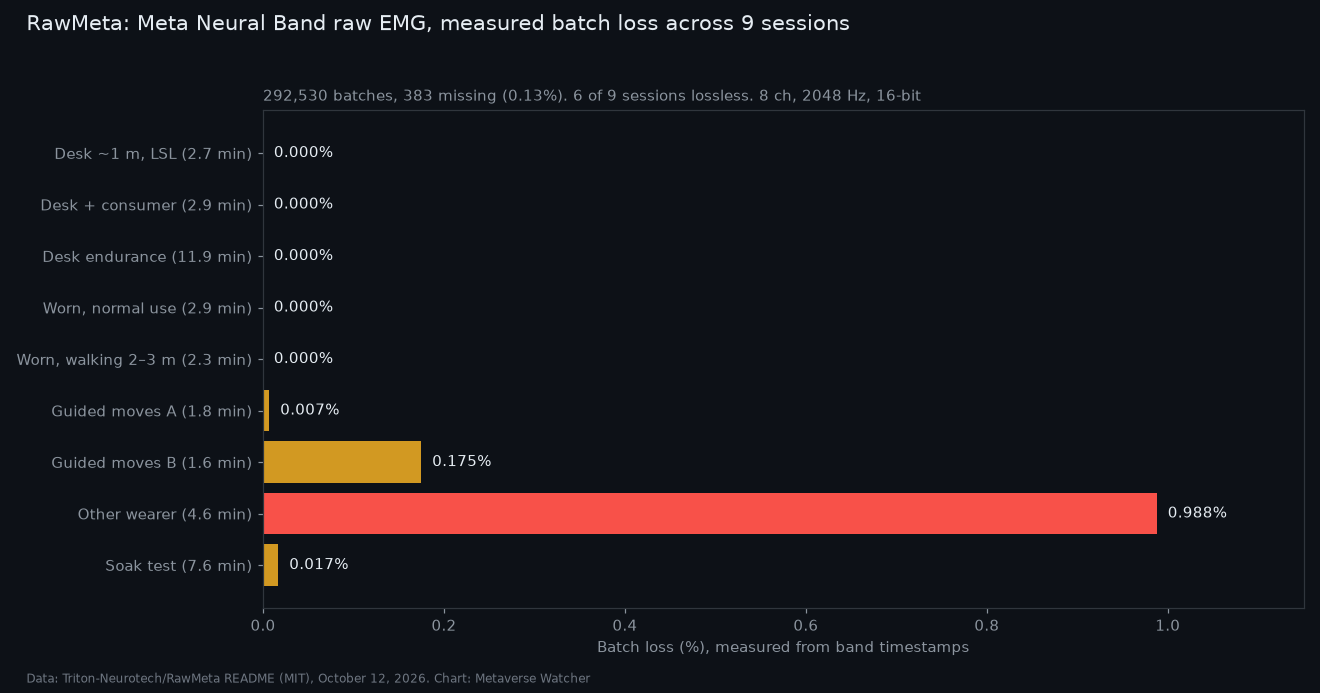
What SETS RawMeta APART is how OPENLY it reports its OWN FAILURES. Across NINE sessions, the team counted 292,530 batches with 383 missing, or 0.13% overall, and SIX of the nine sessions showed ZERO loss. The WORST case was a 4.6-minute session on ANOTHER person’s arm, with the band position unknown, which LOST 0.988%.
The METHOD matters. The README explains that the band’s sequence numbers do NOT skip when it DISCARDS batches, because it only numbers the batches it ACTUALLY sends. RawMeta therefore measures loss from the band’s microsecond TIMESTAMPS, which the team says yields numbers that “can be higher (and are more honest) than tools that count sequence gaps.” FREEZING the RawMeta process for a FULL second every 10 seconds caused NO loss, which the team says rules out the Mac as the bottleneck and points to the RADIO path. Their ADVICE: keep the band CLOSE, within 1 to 2 meters with line of sight, and DISCONNECT other Bluetooth devices.
Limits and Warnings
- macOS ONLY. RawMeta uses CoreBluetooth via pyobjc; the README points LINUX users to the community project kinesis-linux.
- ONE firmware tested. The team tested firmware 79a235830f7f+. Code for a newer parameter set used by later firmware EXISTS but is “untested on hardware here.”
- Do NOT pair with the Meta AI app. The README says that is how firmware updates arrive, and “an update can break all of this.” It also tells users NOT to MODIFY or DOWNGRADE firmware, or redistribute Meta firmware or models.
- Approximate electrode map. The electrode-to-muscle mapping DEPENDS on how the band is rotated on the arm.
Why It Matters
Meta has positioned the Neural Band as the INPUT layer for its display glasses, and its developer surface exposes DECODED actions, NOT muscle SIGNALS. RawMeta shows the HARDWARE underneath is a CAPABLE EIGHT-CHANNEL surface EMG SENSOR, which matters to neurotech STUDENTS, ACCESSIBILITY researchers, and anyone prototyping gesture input beyond Meta’s built-in vocabulary.
Keep the SCALE in perspective. RawMeta is MIT-licensed CLUB code, NOT a Meta PRODUCT, and both the Triton Neurotech repository and the copy its own clone instructions point to showed ZERO stars at the time of writing. The README CREDITS the protocol knowledge to two earlier MIT-licensed community projects, callbacked/kinesis and ThomasBurgess2000/kinesis-linux. It also follows a separate community effort that drove Rokid glasses with the Neural Band, which we covered on October 7. Meta has NOT commented on RawMeta, and a SINGLE FIRMWARE update could CLOSE the door. For now, the band is OPEN to anyone WILLING to ENROLL it.
Sources
- Triton-Neurotech/RawMeta on GitHub (README and commit history, October 12, 2026)
- MIXED: A student club turned Meta’s Neural Band into an 8-channel, 2048Hz EMG recorder (October 13, 2026)
- callbacked/kinesis and ThomasBurgess2000/kinesis-linux