Spatial computing just crossed a regulatory line that consumer demos never reach. On September 1, 2026, Stryker said the first surgical case with SportSuite Vision on Apple Vision Pro was completed at Duke Health: a hip arthroscopy run through an FDA De Novo–authorized application, not a research pilot strapped to a headset.
The authorization date matters as much as the OR milestone. Stryker received FDA De Novo clearance for SportSuite Vision on July 17, 2026, as the first application authorized for intraoperative use with Apple Vision Pro. The Duke Health case is the first reported clinical use under that clearance, performed by orthopedic surgeon Chad Mather III, M.D., M.B.A.
What the clearance actually covers
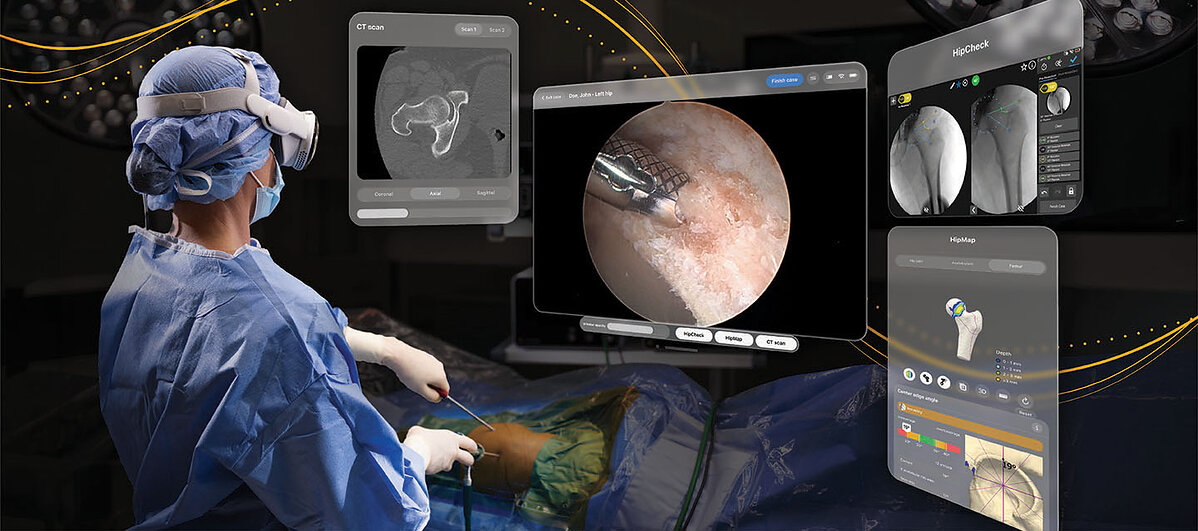
This is not a blanket blessing for Vision Pro in every OR. Per Stryker’s indication language, SportSuite Vision is authorized for intraoperative display of arthroscopic video and medical imaging during femoroacetabular impingement and labral repair hip arthroscopy, including the same information shown by Stryker’s HipCheck and HipMap FAI Analysis software. Surgical tasks run through a video see-through AR head-mounted display. Virtual overlays are meant to be used with traditional monitors for other OR staff, not as a solo replacement for the room’s displays.
That constraint is the story. Apple’s headset becomes a regulated display surface for a narrow sports-medicine workflow. It does not become a general-purpose surgical computer. The FDA classification creates a Class II product code for arthroscopic or orthopedic endoscopic intraoperative AR video see-through systems, which is how future competitors will have to argue equivalence.
Why surgeons care about field of view, not novelty
Arthroscopy already forces surgeons to split attention across multiple monitors. SportSuite Vision’s pitch is ergonomic: arthroscopic feed, HipCheck, HipMap, and CT imaging can sit in one customizable spatial layout inside the sterile field. Mather’s quote in the release is practical rather than futurist: spatial computing let him place clinical information where the workflow needed it without leaving the sterile field.
Matt Moreau, vice president and general manager of Stryker’s Sports Medicine business, framed the same point as workflow connectivity: multiple clinical streams in one spatial environment, closer to a connected digital OR. Treat that as product messaging. The durable facts are the De Novo date, the Duke Health first case, and the narrow hip-arthroscopy indication.
What this does not prove yet
One authorized case does not prove shorter operative times, fewer complications, or hospital-wide adoption. Vision Pro still entered the room as consumer hardware running regulated software. Traditional monitors remain required for staff who are not wearing the headset. Expansion beyond FAI and labral repair would need additional clearances, not a press photo.
For the XR beat, the signal is quieter and more important than another glasses rumor. Spatial computing is accruing regulated, procedure-specific footholds while the consumer market argues about Quest cadence and Steam Frame pricing. Surgery is one of the places where “useful in the field of view” beats “metaverse” as a success metric.
Sources: Stryker press release (Sept. 1, 2026), PR Newswire, FDA De Novo DEN250040.
1 thought on “Stryker’s SportSuite Vision Puts Apple Vision Pro in a Real Hip Surgery”