Meta’s Quest Browser has now shipped a WebGPU feature for WebXR in EACH of its last THREE releases. Version 152.1, dated October 2 in Meta’s developer release notes, adds composition LAYERS for WebGPU-rendered WebXR sessions. The catch is in the SAME sentence: it is an “Experimental Feature,” and developers must MANUALLY switch on webxr experiments in chrome://flags to try it. That FLAG is the whole story for ANYONE hoping to SHIP a WebGPU headset app to ORDINARY Quest owners this year.
Three releases, one direction
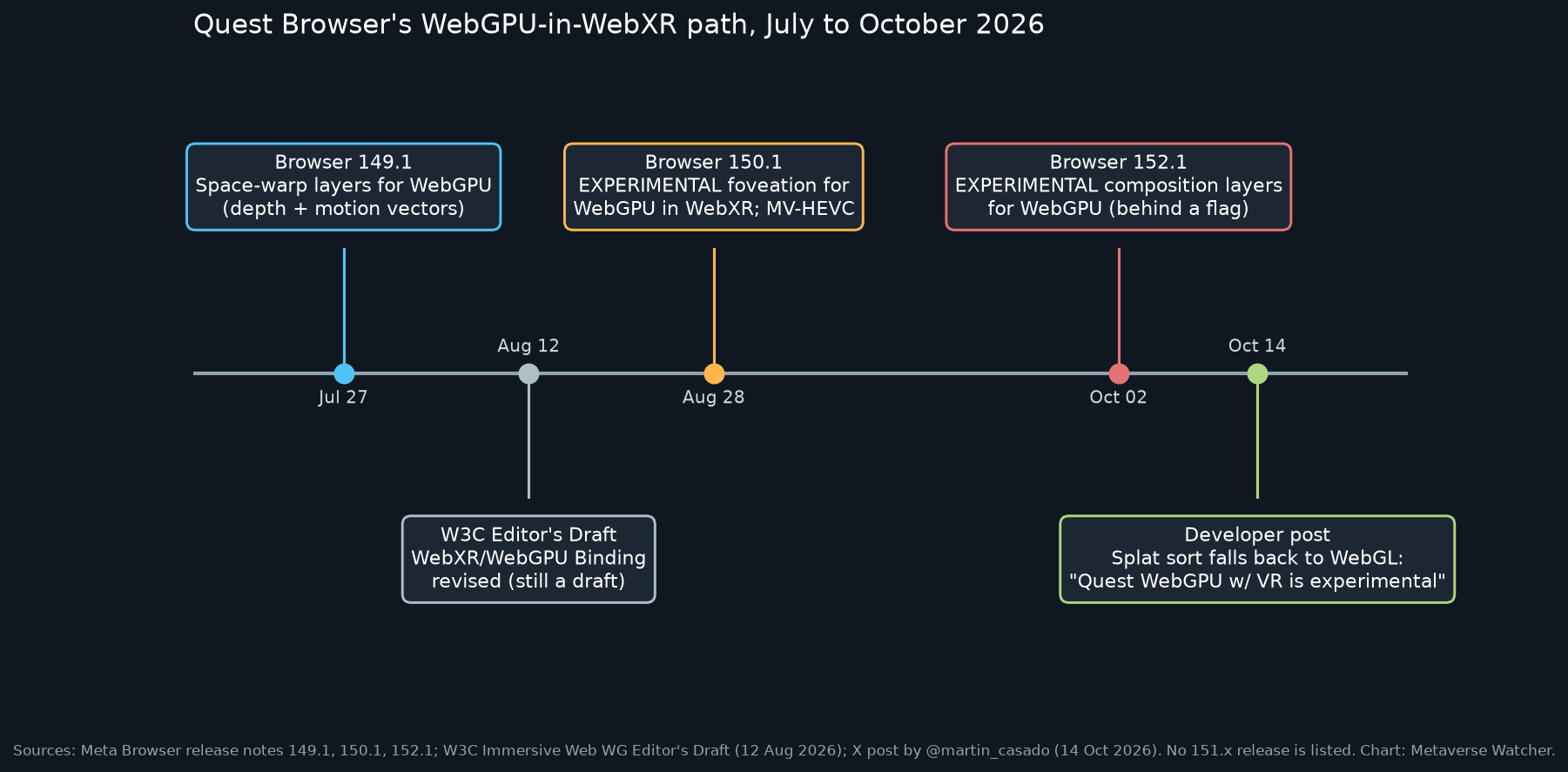
Meta’s Browser release index lists FIVE builds in 2026, on April 21, June 3, July 27, August 28 and October 2. There is NO 151.x entry. The last THREE EACH moved WebGPU a step DEEPER into immersive sessions:
- 149.1, July 27: “space-warp layers for WebGPU.” Meta’s note explains that Space Warp lets a WebXR app render at a LOWER frame rate while the compositor uses its DEPTH and MOTION-vector data to generate the MISSING frames. This entry carries NO experimental label.
- 150.1, August 28: “Experimental support for foveation to WebGPU in WebXR,” alongside MV-HEVC video playback.
- 152.1, October 2: EXPERIMENTAL composition layers for WebGPU in WebXR, behind the flag, plus unspecified performance, reliability and security fixes.
Read TOGETHER, the sequence COVERS the THREE things a standalone headset needs before a renderer is PRACTICAL: a way to SKIP frames without judder, a way to spend FEWER pixels at the edge of the lens, and a way to HAND text and VIDEO to the compositor instead of baking them into the 3D scene. Composition layers matter MOST for the last job. A quad or cylinder layer is sampled ONCE by the system compositor, which is why menus, captions and video panels usually look SHARPER on a layer than painted into the main eye buffer.
The Japanese WebXR tracker BANGEO noticed the middle step when it landed:
Quest Browser 150.1、WebXRのWebGPU描画でfoveationを実験的にサポート
— BANGEO- WebXR総合情報共有サイト (@bangeo_jp) September 24, 2026
The standard is still a draft
Meta is BUILDING against a MOVING target. The WebXR/WebGPU Binding Module, Level 1 is an Editor’s Draft of the W3C Immersive Web Working Group, last revised on August 12, 2026, with Google’s Brandon Jones as EDITOR. The document says it is “intended to become a W3C Recommendation,” and ALSO that “publication as an Editors’ Draft does not imply endorsement by W3C and its Members.”
The draft ALREADY describes what Meta has been SHIPPING piecemeal. Its XRGPUBinding interface creates projection layers and FOUR other layer types, quad, cylinder, equirect and cube, and its sub-images can carry a motion-vector texture, the INPUT that space-warp needs. In other words, the browser features are not Meta INVENTIONS; they are EARLY, flag-gated implementations of an API that can still CHANGE. BANGEO’s WebXR status table, last checked October 14, lists Quest Browser 152.1 as the ONLY engine with even experimental support in its WebGPU-binding row.

What developers are doing in the meantime
The PRACTICAL COST of “experimental” showed up on X this week. The developer behind the @martin_casado account POSTED a Quest demo built ENTIRELY from Gaussian splats, and EXPLAINED why ONE piece of it runs on the OLDER API:
Ambient drone with water effects and aurora now working in VR. Entire scene is Gaussian splats. Audio is generative. Unfortunately the Quest WebGPU w/ VR is experimental so the splat sort is done using WebGL (slower). Not bad FPS tho’
— martin_casado (@martin_casado) October 14, 2026
That is the TRADE-OFF in ONE line. Splat SORTING is the kind of parallel workload WebGPU compute was DESIGNED for, yet a PUBLIC demo cannot ASK visitors to open a flags page first. Until the WebGPU path for WebXR is ON by default, WebGL stays the SAFE target for anything meant to reach a GENERAL audience, and WebGPU stays a lab tool on Quest.
What Meta has not said
The release notes are SHORT, and the GAPS are MATERIAL. Meta gives NO DATE for removing the flag, does NOT say which layer types 152.1 supports, and does NOT say whether WebGPU foveation from 150.1 has left experimental status. The 152.1 note links to composition-layer documentation but adds NO performance figures. Its “performance is now improved” line names NO workload. Meta’s main developer feed separately lists SDK builds such as the Meta XR Simulator under version 207, a number BANGEO warns is NOT a Browser version.
The Metaverse Watcher take
Meta has now put WebGPU layers, foveation and space-warp into ONE shipping browser, even if TWO of the three sit behind experimental labels, and that is REAL progress for the OPEN web on standalone hardware. But a feature that NEEDS chrome://flags is a PROTOTYPE, not a platform. The MILESTONE to WATCH is a Browser release note that drops the word “experimental” from WebGPU in WebXR. Until then, the MOST ambitious web XR work on Quest will keep doing what that splat demo did: RENDER in WebGPU where it CAN, and fall BACK to WebGL where users ACTUALLY are.
Sources: Meta Browser 152.1 release notes; Browser 150.1; Browser 149.1; Meta Browser release index; W3C WebXR/WebGPU Binding Editor’s Draft; BANGEO WebXR status; @martin_casado on X; @bangeo_jp on X.