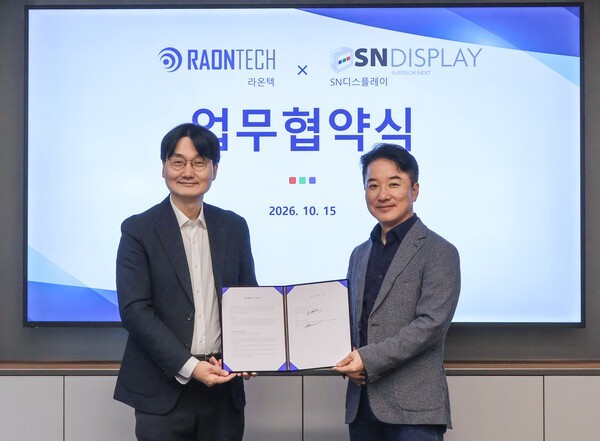
TWO Korean suppliers want to FIX one of the HARDEST problems in AR glasses: getting FULL COLOR out of a microLED panel whose pixels are SMALLER than a few micrometers. RAONTECH, a microdisplay and display-driver maker, said on October 16 in Korea that it SIGNED a memorandum of UNDERSTANDING with SN Display, a perovskite MATERIALS startup, on October 15. The goal, as THE ELEC and ETNews report it, is next-generation AR and VR microdisplays that use perovskite COLOR CONVERSION in place of QUANTUM DOTS.
Read the announcement CLOSELY and it is a FEASIBILITY study, not a product program. Neither company has disclosed a prototype, a DATE, a customer, a dollar figure or a single MEASURED result. What it DOES show is where KOREAN component makers think the NEXT bottleneck in smart-glasses displays sits.
What the Two Companies Actually Agreed
According to ETNews, the two firms are ALREADY running preliminary research that applies SN Display’s perovskite material to RAONTECH’s microLED and micro-OLED SAMPLES, to check whether it IMPROVES performance and WHERE it could be used. THE ELEC frames the same work as a study of whether perovskite color conversion can be INTEGRATED into both display types to reach ULTRA-FINE pixels and full-color IMAGES.
The division of labor is SIMPLE. RAONTECH brings microdisplays and DRIVING electronics. SN Display brings PEROVSKITE nanocrystals and color-conversion know-how. RAONTECH’s own statement, as quoted by ETNews, makes the next step CONDITIONAL: depending on sample evaluation and technical results, the companies MAY JOINTLY develop microdisplay prototypes or widen the deal into AR and VR display solutions. “May” is doing a LOT of work in that sentence.
Why Color Is the Hard Part
MicroLED is the display AR glasses makers WANT for OUTDOOR brightness, but putting red, green and blue emitters on ONE tiny panel is DIFFICULT. THE ELEC notes that many designs work around it with an X-cube, an optical prism that COMBINES three separate single-color panels. That ADDS parts, SIZE and alignment work to a frame that has to SIT on a FACE. We have seen the SAME constraint in recent coverage, from Kopin’s Pentagon-funded color microLED work to Rokid’s still-unconfirmed full-color glasses.
The alternative is to build only BLUE microLEDs and CONVERT some of that light into RED and GREEN with a thin layer of material on top. Quantum dots are the USUAL choice. THE ELEC says quantum-dot conversion STRUGGLES below about 4 micrometers per pixel, and that its LOW conversion efficiency COSTS brightness. MicroLED-Info puts the typical quantum-dot layer at 3 to 10 micrometers THICK, which means the color layer can be TALLER than the pixel it sits on is WIDE.
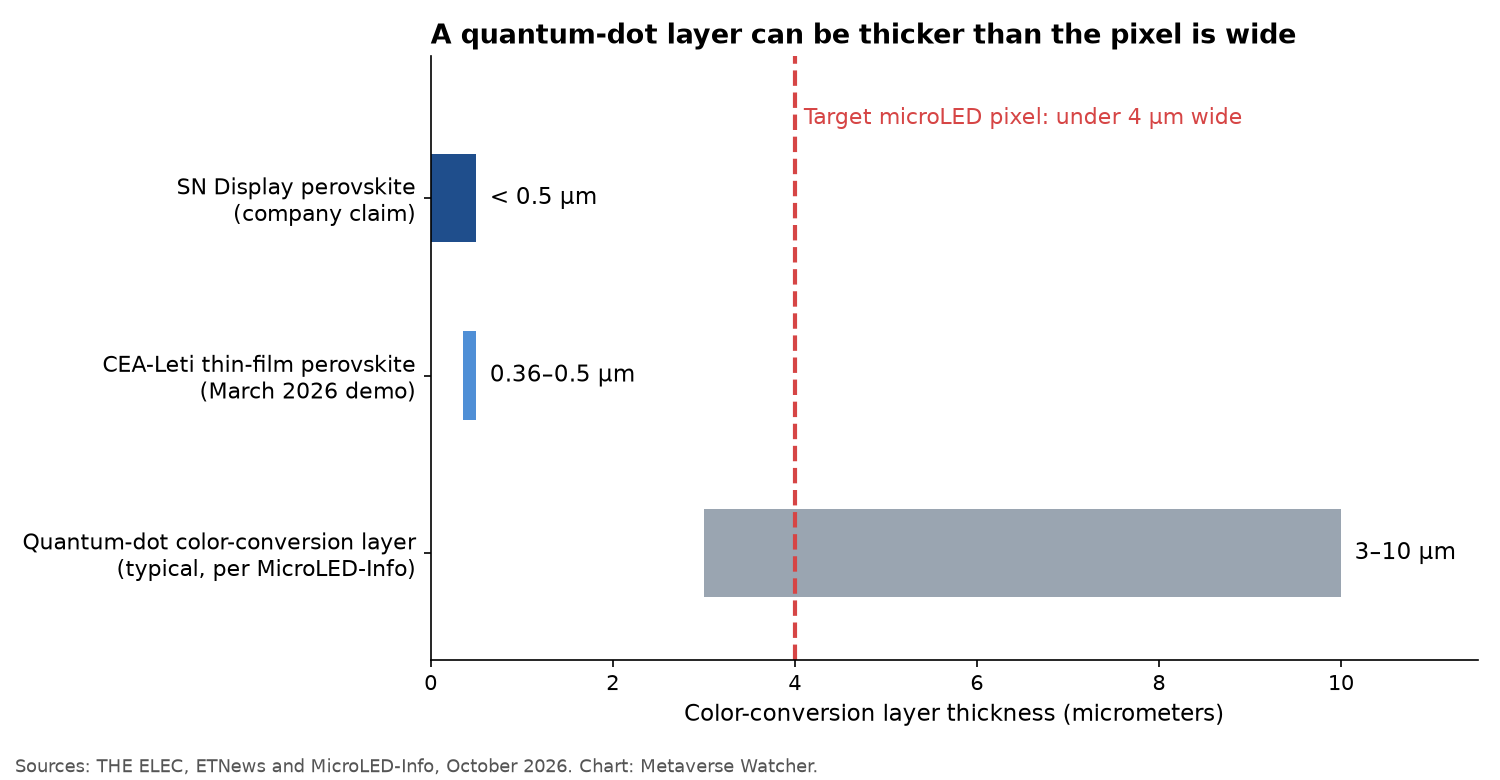
SN Display’s pitch is that its perovskite holds HIGH conversion efficiency at LESS than 0.5 micrometers thick and can be PATTERNED with ordinary SEMICONDUCTOR processes. The partners say they will TEST it on microLED pixels SMALLER than 4 micrometers. For scale, a 4-micrometer pixel pitch works out to roughly 6,350 PIXELS per inch. That is our ARITHMETIC, not a company target, but it shows how FAR beyond TODAY’S glasses panels the stated goal sits.
Who SN Display Is
MicroLED-Info describes SN Display as a 2020 startup founded by Professor Tae-Woo Lee of Seoul National University. It SELLS perovskite nanocrystals, resins and down-conversion films, and develops nanocrystal arrays for AR and VR displays ABOVE 3,000 pixels per inch. Earlier this year, Lee’s team and the company reported a perovskite nanocrystal platform with NEAR-UNITY efficiency and IMPROVED stability, compatible with inkjet printing and photolithography above 3,500 pixels per inch.
One reporting DETAIL is worth FLAGGING. THE ELEC’s English photo caption NAMES SN Display’s chief executive as “Kim Tae-woo.” ETNews’ Korean caption, which credits the photo to RAONTECH, gives the name as 이태우, or Lee Tae-woo, matching MicroLED-Info’s account. We use LEE here.
RAONTECH, for its part, was part of a team with KAIST, Inha University and QSI that MicroLED-Info says built a 1,700-pixel-per-inch MONOLITHIC red microLED microdisplay in January. That is a pitch of roughly 15 micrometers, again by our arithmetic. The NEW deal aims at pixels nearly FOUR times finer.
A Crowded Lane, Not a Solo Bet
Perovskite color conversion is NOT NEW to this pairing. MicroLED-Info points to CEA-Leti, the French research institute, which in March 2026 demonstrated thin perovskite films that ABSORB 90% of blue light at 360 to 500 nanometers thick. It ALSO names Yicai Core Light in China as developing perovskite quantum-dot microLED microdisplays. Patterning approaches borrowed from chipmaking are SPREADING on the OLED side too, as in ETH Zurich’s photolithography work on tiny OLED pixels.
What Is Missing
- No measured results. The announcement gives NO brightness, efficiency or color-gamut numbers from RAONTECH’s samples.
- No lifetime data. NEITHER company cites how LONG the perovskite layer HOLDS up under a bright microLED. That matters, because STABILITY is the property SN Display’s own research this year was built to improve.
- No timeline or money. There is NO prototype date, NO investment figure and NO named device maker.
- No commitment. Joint prototypes are CONTINGENT on results, by RAONTECH’s OWN wording.
What to Watch
The FIRST real signal will be DATA: a sub-4-micrometer microLED sample with perovskite conversion, shown with brightness and lifetime figures at a trade show or in a paper. The SECOND will be a BUYER. Until a glasses maker PUTS its name next to this work, the MOU is best read as an OPTION on a future display, not a ROADMAP for one.
Sources
- THE ELEC: RAONTECH, SN Display to Develop Next-Generation AR, VR Displays
- ETNews (Korean): RAONTECH and SN Display cooperate on perovskite-based next-generation microdisplays
- MicroLED-Info: Raontech and SN Display collaborate on perovskite-based microLED microdisplays
- OLED-Info: Raontech and SN Display to develop perovskite QD color conversion for OLED microdisplays