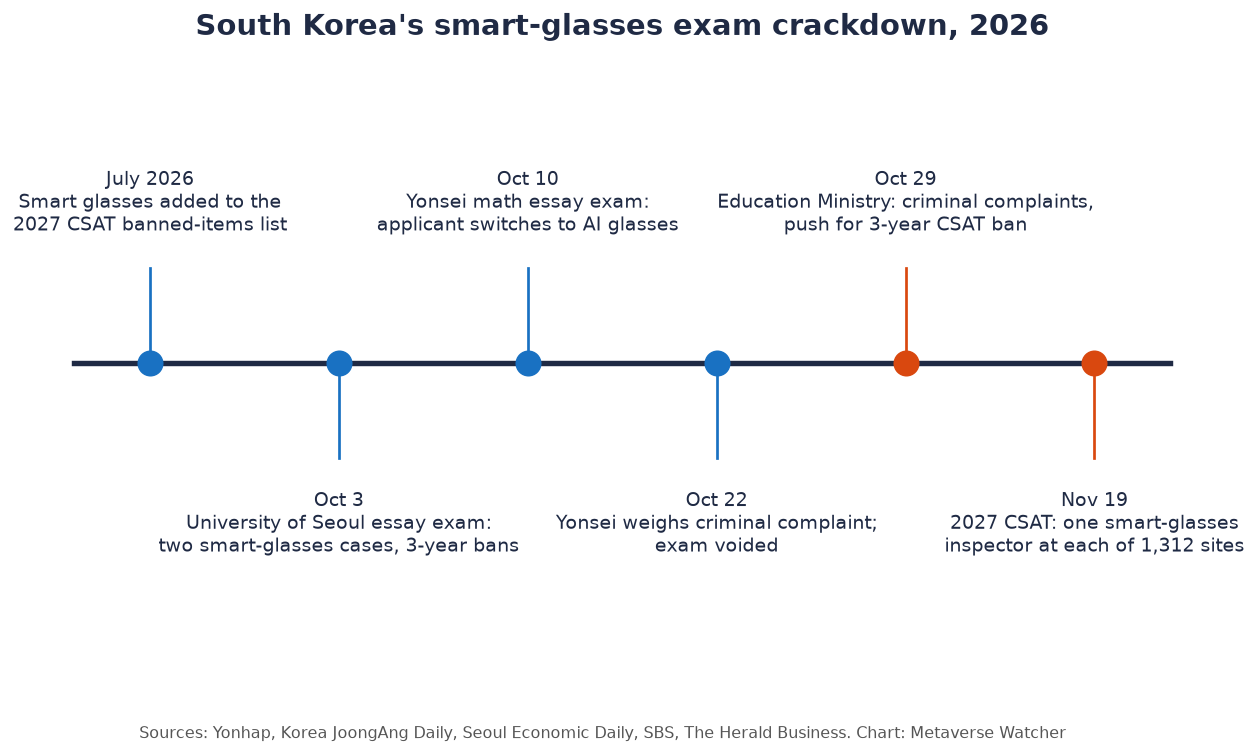
South Korea’s Ministry of Education said on Thursday, October 29, that it will seek criminal charges against anyone caught using AI smart glasses to cheat on the College Scholastic Ability Test (CSAT, known locally as the Suneung), the national university entrance exam. The ministry also wants to lengthen the exam ban for cheaters from one year to THREE YEARS, and it will station a dedicated smart-glasses inspector at every one of the 1,312 test sites when the 2027 CSAT is held on November 19, according to Yonhap and Korea JoongAng Daily.
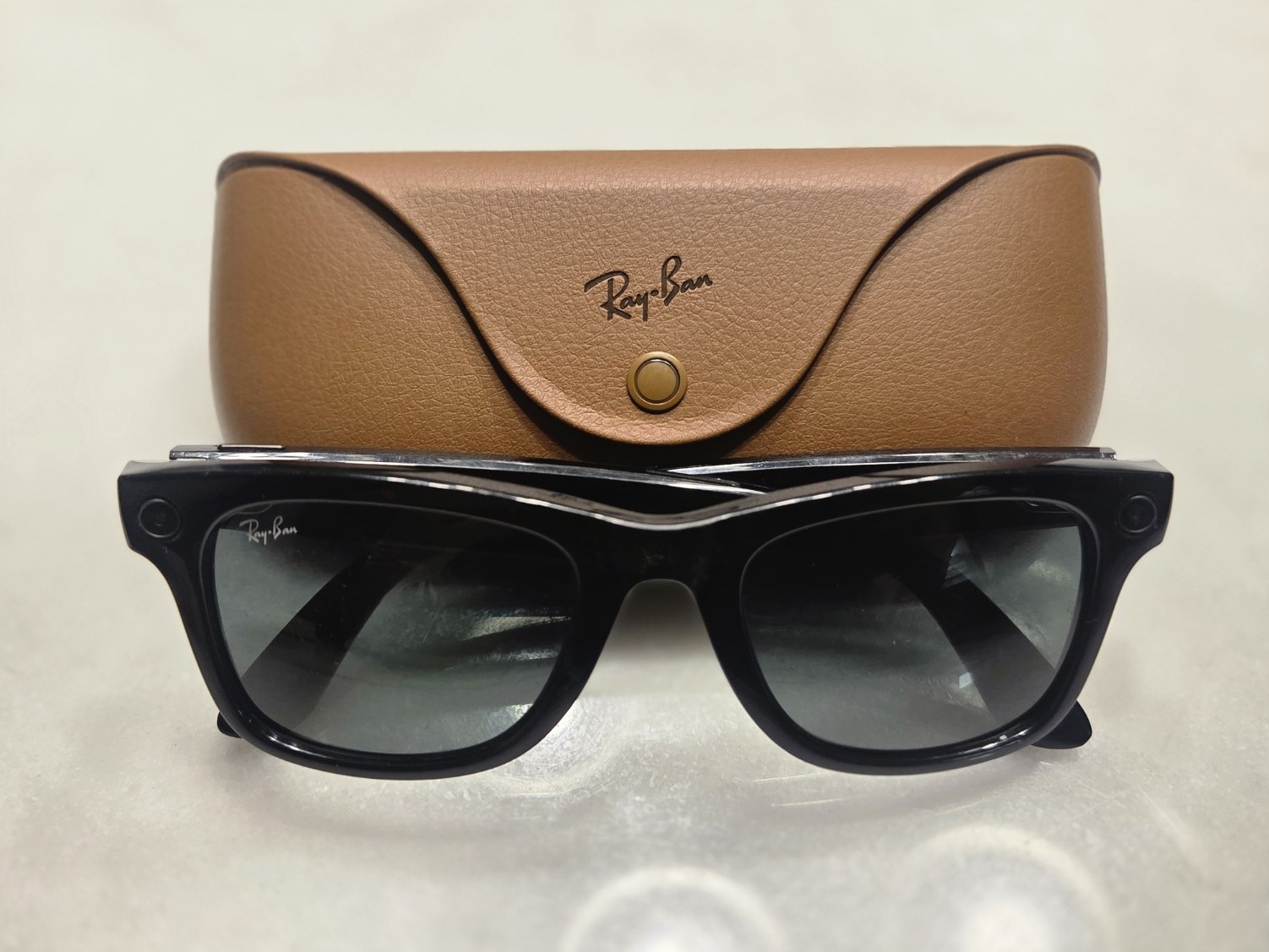
It is the most aggressive national response yet to a problem schools elsewhere have only started to name: camera-equipped glasses that can photograph a question, pass it to an AI model and, on display models, show an answer on the lens.
What the Education Ministry Announced
The ministry’s response plan, reported by ChosunBiz, treats smart-glasses cheating as deliberate interference with a national exam. The key measures:
- Criminal complaints. The ministry will file complaints and request investigations so offenders can face charges of obstruction of official duties by fraudulent means and interference with business. It pointed to a 2005 cheating ring that used mobile phones to share answers; those involved received eight-month prison sentences, suspended for two years.
- A longer ban. It will push to amend the Higher Education Act so that cheaters lose CSAT eligibility for three years instead of one.
- One inspector per site. Starting with this year’s exam, one designated staff member at each of the 1,312 test sites will judge whether a suspicious device is a pair of smart glasses. If a device can’t be identified on the spot, a rapid-response network of regional education offices, the ministry and the Korea Institute for Curriculum and Evaluation (KICE) will step in.
- Support for proctors. Liability insurance for proctors will be expanded, and changes to proctor pay are planned starting with the 2028 CSAT.
- Detection hardware. The ministry will review radio-frequency detectors developed by specialized institutions and could distribute them as early as next year.
- Universities. It recommends that universities apply the same sanctions to their own entrance exams.
Why Now: Three Cases at Two Seoul Universities
The announcement follows a run of incidents during early-admission essay exams this month. On October 3, a test-taker at the University of Seoul natural-sciences essay exam wore ordinary glasses during the ID check and then switched to smart glasses; the applicant was removed and barred for three years, Yonhap reported. SBS later reported, citing Korean Council for University Education data provided to Rep. Koh Min-jung, that a second student at the same exam was found with AI glasses and also received a three-year ban.
On October 10, an applicant at Yonsei University’s mathematics essay exam made a similar switch after the test began. A proctor noticed, the glasses were confiscated and the student admitted it, according to The Herald Business. Yonsei voided the exam, stripped the applicant’s 2028 early-admission eligibility and is weighing a criminal complaint for obstruction of business by deception, Seoul Economic Daily reported.
The pattern matters. In both cases described in detail, the applicant appeared in ordinary-looking eyewear and changed glasses later. That is the gap a dedicated inspector is meant to close, and it explains why proctors, who would otherwise have to tell regular frames from camera frames on their own, are getting backup.
The Rules Already in Place for the 2027 CSAT
Thursday’s plan builds on rules set earlier this year. In July, smart glasses were added to the list of items banned from the CSAT. Under the current rules, a test-taker caught wearing smart glasses is treated as having cheated whether or not the device was actually used; the exam is voided and the student loses eligibility for the following year’s test. The ministry’s plan would stretch that one-year penalty to three and add the possibility of prosecution on top.
| Measure | Before Oct 29 | Ministry plan |
|---|---|---|
| Smart glasses at the CSAT | Banned item since July 2026 | Still banned; complaints filed against violators |
| Penalty for wearing them | Exam voided, 1-year CSAT ban | Push for a 3-year ban via Higher Education Act amendment |
| Criminal exposure | Not part of the stated CSAT sanctions | Obstruction of official duties and interference with business |
| On-site checks | Regular proctors | 1 dedicated inspector at each of 1,312 sites, plus rapid-response network |
| Detection technology | None announced | RF detectors under review, possibly distributed next year |
| University exams | Each school sets its own sanctions | Ministry recommends matching sanctions |
What It Means for Smart Glasses Makers
Exam rules don’t restrict what anyone can buy, but they shape how the category is perceived. A national ministry putting smart glasses in the same frame as organized cheating rings adds to a growing list of institutional pushback, from Norway’s smart glasses ban proposal to the legal fight over a Vienna student expelled for wearing Meta glasses, and the wider privacy debate we covered in our analysis of eye-tracking smart glasses.
Detection is the question to watch. A visual check works only while smart glasses look different from regular frames, and that difference shrinks with every generation. Radio-frequency detectors would instead look for the wireless signals glasses use to talk to a phone or the cloud. The ministry has not said how accurate the detectors are, what they cost or exactly when they would arrive beyond “as early as next year,” so treat that timeline as tentative.
What Happens Next
- November 19: the 2027 CSAT, the first with a dedicated smart-glasses inspector at every site.
- Legislation: the three-year ban requires an amendment to the Higher Education Act, and no vote date has been announced.
- Detectors: a decision on whether to distribute RF detectors, possibly as early as next year.
- Yonsei: whether the university files its criminal complaint, an early test of the legal approach the ministry is now endorsing.
For readers comparing what current models can record and display, our Best Smart Glasses 2026 guide breaks down the leading options.