A Y Combinator startup called The Subvocal Company is taking reservations for smart glasses that turn silently mouthed words into text. The pitch is simple: dictation speed without saying anything out loud. The company says its prototype decodes open-ended speech at more than 200 words per minute, and it is asking early buyers for a $199 deposit toward a first batch of 500 units due in Q1 2027.
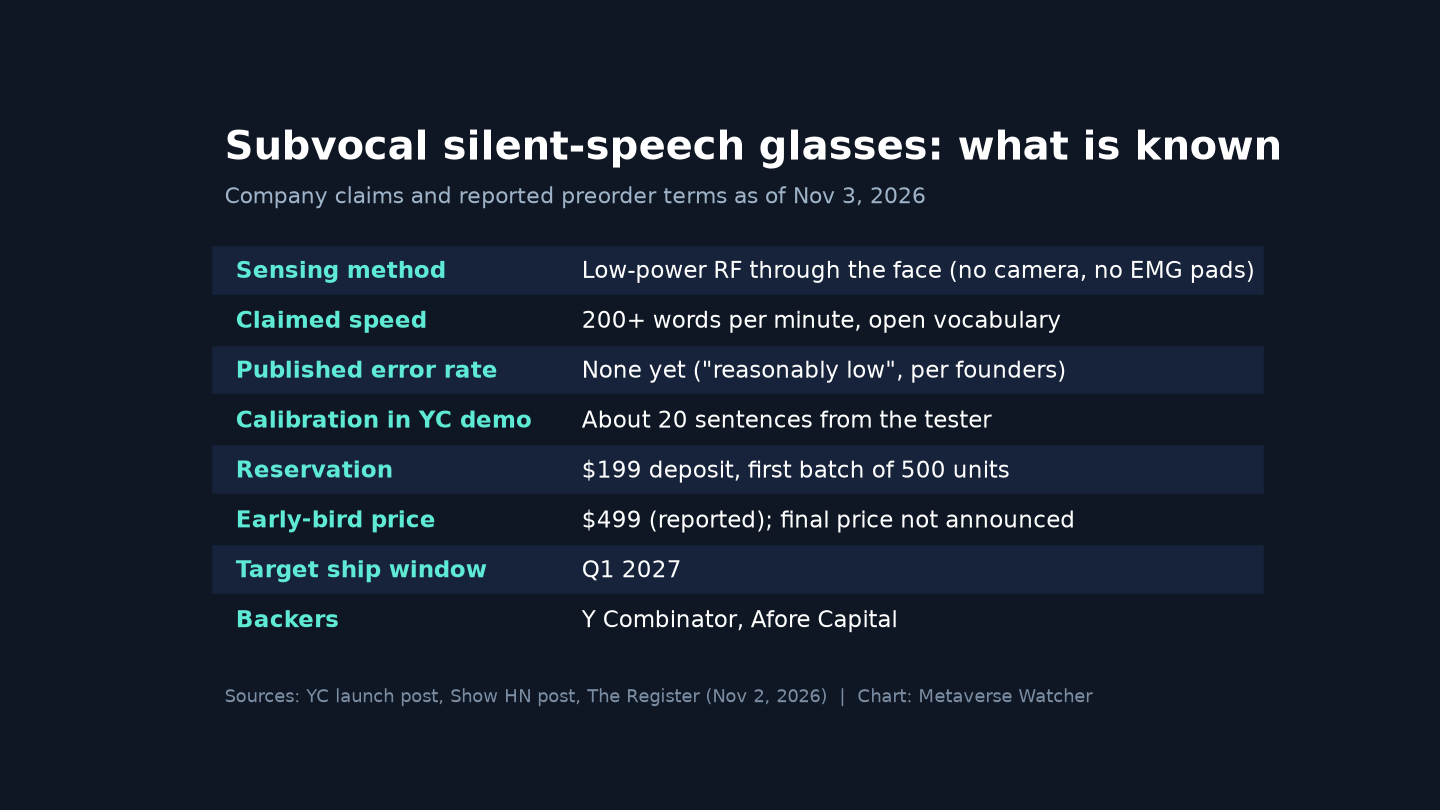
What Subvocal announced
Founders Aarush Yadav and Arnav Kumar, both Georgia Tech computer science students, introduced the product in a YC launch post and a Show HN thread posted on November 2. The Hacker News thread had about 800 points and 373 comments when we checked on November 3, which makes it one of the more widely discussed smart glasses launches of the fall outside the Meta, Google and Samsung orbit. The Register reported the early-bird price as $499, with the $199 deposit paid now and the remaining $300 due when the glasses ship. The final retail price has not been announced.
According to the founders, the project began about four months ago at a hackathon. They say the current system decodes open-ended speech at more than 200 words per minute with “a reasonably low error rate even at a small dataset scale.” A crude early version won the product showcase at YC’s G1 event. The startup has backing from Y Combinator and, per The Register, earlier funding from San Francisco firm Afore Capital.
How silent-speech glasses work
Most smart glasses that take input rely on a microphone, a touchpad on the arm, or, in the case of Meta Ray-Ban Display, an EMG wristband. Subvocal takes a different route. The glasses send low-power radio waves through the wearer’s face and measure how those signals change as the tongue, lips, jaw and soft palate move. Machine learning models then decode the changes directly into text.
The founders say they tried EMG first, the muscle-signal approach used by Meta’s Neural Band and by the Mudra Link wristband, but dropped it because of sweat, electrical interference, placement variability and the simple fact that “no one wants to stick electrodes onto their face.” RF sensing avoids skin contact. In the Show HN post they also say the system does not strictly require visible lip movement: because the radio signal reaches inside the mouth, it can be tuned to recognize words articulated with the lips closed.
In a demo video, YC partner Dave Lieb tries the prototype. The Register reports he only had to read 20 sentences to calibrate the device to his speech patterns.
Preorder terms at a glance
| Item | What has been disclosed | Source |
|---|---|---|
| Reservation | $199 deposit | YC launch post |
| Early-bird price | $499 total; $300 due at shipping | The Register |
| Discount | $200 off the final price for early reservations | YC and Show HN posts |
| First batch | 500 units | Show HN post |
| Shipping target | Q1 2027 | Preorder page, via The Register |
| Claimed speed | 200+ words per minute | YC launch post |
| Accuracy, battery life, companion app | Not disclosed | The Register |
Why it matters for smart glasses
Input is one of the hardest unsolved problems in the category. Voice assistants on today’s best smart glasses work well at home and in the car, but most people are reluctant to talk to their glasses on a train or in an open office. Meta answered that with the Neural Band for Ray-Ban Display, which reads finger gestures. Neither is built for long-form text entry. A reliable silent-speech interface would let glasses handle emails, prompts and notes in public without broadcasting them, which is why the Hacker News reaction was so strong.
Subvocal’s focus on text input is also a narrower, more realistic first target than the all-day AI glasses that Meta, Google and Samsung are chasing, and it fits the crowded 2026–2027 launch calendar without competing head-on with camera glasses.
What is still unproven
The claims are bold and the evidence so far is thin. Buyers should weigh several open questions before putting down a deposit:
- Accuracy: Subvocal has not published a word error rate or any independent test. “Reasonably low” is not a benchmark, and a demo with one calibrated user does not show how the system handles accents, fatigue or noisy RF environments.
- Generalization: The founders say they still need to collect thousands of hours of population-scale RF data to pretrain a model that works for anyone after a short calibration. That work is ahead of them, not behind them.
- Hardware: The company’s next step is miniaturizing the hardware onto glasses. Fitting RF sensing hardware and a battery into normal-looking frames by early 2027 is a significant engineering step.
- Battery and software: Battery life, pairing, operating system support and whether text goes through a cloud service have not been disclosed.
- Regulation: A device that intentionally emits radio waves needs FCC authorization before it can be sold in the U.S. No filing has been reported yet.
The privacy angle
Subvocal’s design has one clear privacy advantage over camera glasses: it has no camera and does not record bystanders. That matters at a time when U.S. senators are pressing Meta over recording by its glasses. The flip side is that the device captures something very personal about the wearer. RF data that can reconstruct words a user never said aloud is a new kind of biometric signal, and the company has not yet explained where that data is processed, how long it is kept, or whether it is used to train future models. As we noted in our analysis of eye-tracking privacy, the rules for sensor data collected from inside a wearable are still being written, and silent-speech data deserves the same scrutiny.
Our take
Subvocal is attacking a real gap. If silent speech works reliably, it could become the missing text-input layer for smart glasses, much as touchscreens did for phones. But this is a four-month-old project with a prototype, a promising demo and no published accuracy data. The $199 deposit is a bet on the team, not on a finished product. We will track whether Subvocal publishes error rates, files with the FCC and hits its Q1 2027 window. For glasses you can buy and use today, see our guide to the best smart glasses of 2026 and our Meta Ray-Ban Display vs Even G2 comparison.
Sources: Y Combinator launch post, Show HN thread, The Register, The Subvocal Company.