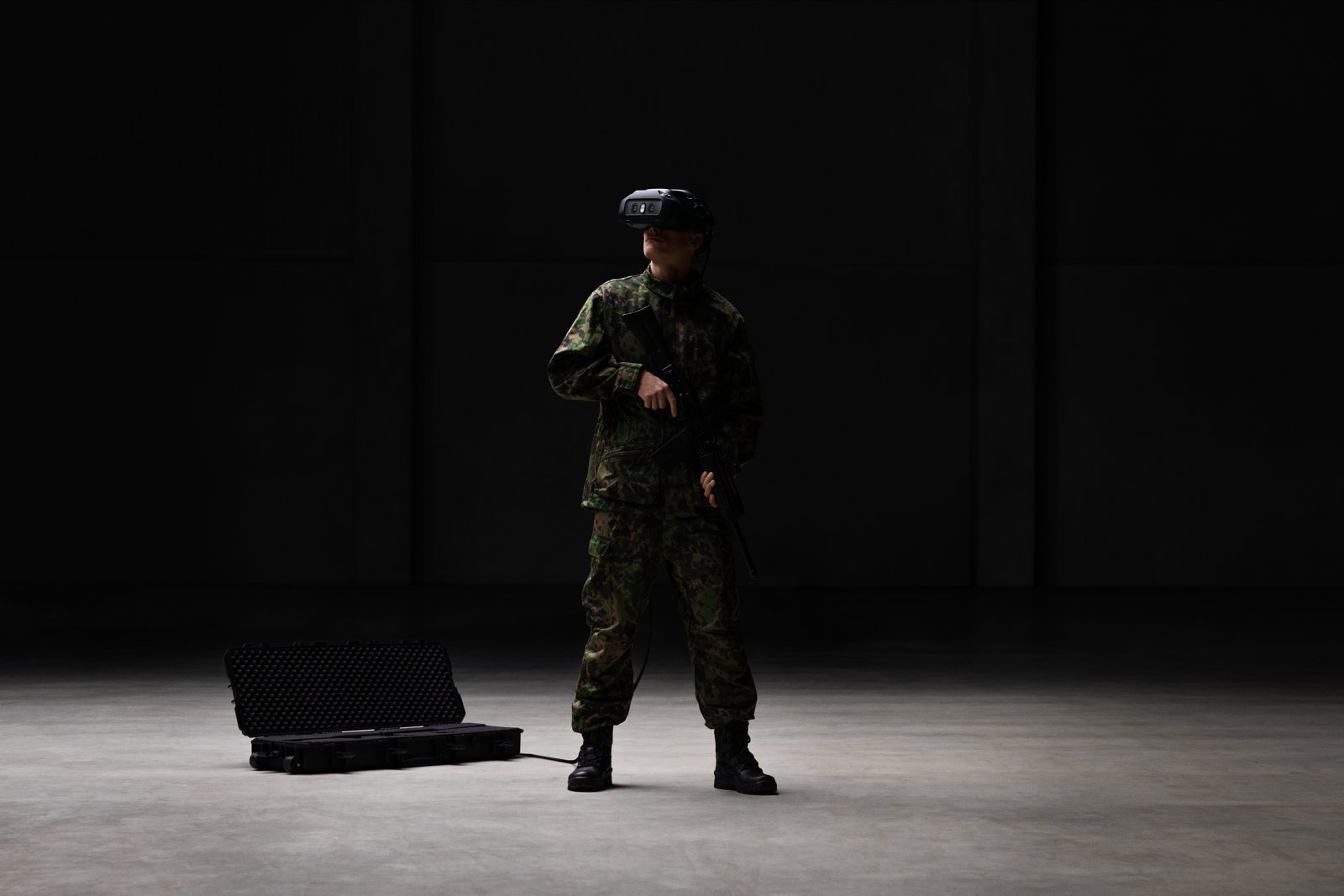
The Finnish Defence Forces are testing whether a mixed reality headset can teach soldiers to spot and counter small attack drones before they meet real ones. The Defence Forces’ Innovation Unit and Helsinki-based Varjo announced the pilot on October 29, 2026, and it runs with a brigade-level unit using the Varjo XR-4 Series headset. The target is the threat that has reshaped the war in Ukraine: first-person-view (FPV) micro-drones and loitering munitions.
What Finland and Varjo Announced
According to the joint announcement, the two partners are “piloting and developing virtual training solutions which aim at improving soldiers’ counter-UAS readiness.” Preparations started in February 2026. Varjo’s central claim is that the XR-4 “provides visual clarity sufficient for training to counter even a five-inch FPV drone from realistic distances.” Five-inch refers to the propeller size class most common in battlefield FPV drones.
Because the XR-4 is a mixed reality headset, its outward cameras show the soldier the real training ground and the software adds virtual drones into that view. Trainees can practise detecting and engaging drones repeatedly without flying physical aircraft or spending munitions. Major Ville Kuparinen, head of the FDF Innovation Unit, said virtual technology lets soldiers “train and prepare for drone threats in a realistic and repeated manner without consuming real resources.” Varjo CEO Timo Toikkanen called the drone threat “one of the critical challenges of the modern battlefield.”
What Has Not Been Disclosed
This is a pilot, not a procurement. As Defence Blog and DroneNR point out, neither side has named the brigade, the number of headsets or soldiers involved, the pilot’s duration, a contract value, or the simulation software running on the headsets. No fielding date or budget has been announced.
One plausible candidate for the software is Horizon Guardian, a counter-UAS simulator from Australia’s Applied Virtual Simulation. Varjo said in June 2026 that Horizon Guardian is integrated with the XR-4, is being used to train soldiers in Ukraine, and is in trials with the Australian Defence Force. In that system, one trainee flies an FPV drone while another tries to bring it down with a firearm. The Finnish Defence Forces have not said whether their pilot uses it, so treat that link as unconfirmed.
Why Resolution Is the Whole Story
Small drones are hard to train against in a headset because, at range, they shrink to a handful of pixels. If a virtual drone is easier or harder to see than a real one, the training teaches the wrong habit. That is why Varjo leads with clarity. On its XR-4 product page, Varjo lists 3840 x 3744 mini-LED displays per eye, a 120 x 105 degree field of view, up to 51 pixels per degree (PPD), dual 20-megapixel passthrough cameras with gaze-driven autofocus, and LiDAR depth sensing for hand occlusion.
To show what that density means, Metaverse Watcher ran a simple geometric estimate. It assumes a drone about 25 cm across, which is roughly the size of a five-inch FPV quad with propellers, and compares Varjo’s 51 PPD peak with the roughly 25 PPD Meta has quoted for the consumer Quest 3. These are approximate figures for illustration only. Real visibility also depends on passthrough quality, lens sharpness away from the center, contrast and lighting.
| Distance | Angular size of a 25 cm drone | Pixels across at 51 PPD (XR-4 peak) | Pixels across at 25 PPD (Quest 3 class) |
|---|---|---|---|
| 50 m | 0.29° | about 15 | about 7 |
| 100 m | 0.14° | about 7 | about 4 |
| 200 m | 0.07° | about 4 | about 2 |
| 300 m | 0.05° | about 2 | about 1 |
The takeaway is simple. At 100 meters, a consumer-class headset renders the drone as a smudge of three or four pixels, while the XR-4 roughly doubles that. Twice the pixel density does not double a soldier’s detection range, but it is the difference between a shape and a dot, and that is the capability Finland is paying to test.
The Bigger Picture for Varjo
The announcement landed the same day Varjo said it will move all XR-4 Series production to its own facility in Espoo, Finland, with assembly starting in January 2027. Varjo already builds the XR-4 Secure Edition there for defense customers. The company says its technology is deployed in more than 120 defense programs in NATO and allied nations, that its XR-4 processes are ISO 27001-certified, and that every Finland-built headset will be TAA-compliant. The Secure Edition is also offered as a fully offline version with no radio components for air-gapped sites.
Put together, the two announcements describe a company leaning harder into defense and “European-made” security as a selling point. We have tracked the same pattern in Varjo’s simulation work, from a B-52 air-refueling trainer that cut practice sorties to Flytpath’s FP7+ motion simulator built around the XR-4. Civil aviation is following a similar path, as seen with the Cessna Skyhawk Veris VR trainer.
What to Watch Next
- Whether the Finnish Defence Forces expand virtual counter-drone training beyond the first brigade, or move it from the Innovation Unit into formal acquisition.
- Whether the partners name the software, which would show how much of the training is Varjo’s hardware and how much is the simulator.
- Any published results on how mixed reality training affects detection or reaction times compared with live drone drills.
- Whether other NATO members announce similar pilots now that Finland, Ukraine and Australia have shown interest in headset-based counter-drone training.
For enterprise buyers, the lesson goes beyond defense. Mixed reality earns its place when the task depends on seeing something small, fast and dangerous, and simple display maths decides whether the headset can show it honestly. For more on how XR hardware is moving into regulated workplaces, see our analysis of smart glasses rules at work and our look at the XR device sales forecast to 2030.
Sources: Varjo and Finnish Defence Forces joint release (October 29, 2026); Varjo XR-4 production release (October 29, 2026); Varjo Ukraine counter-UAS release (June 2026); Varjo XR-4 product specifications; Defence Blog; DroneNR. Pixel estimates are Metaverse Watcher’s own calculation.